
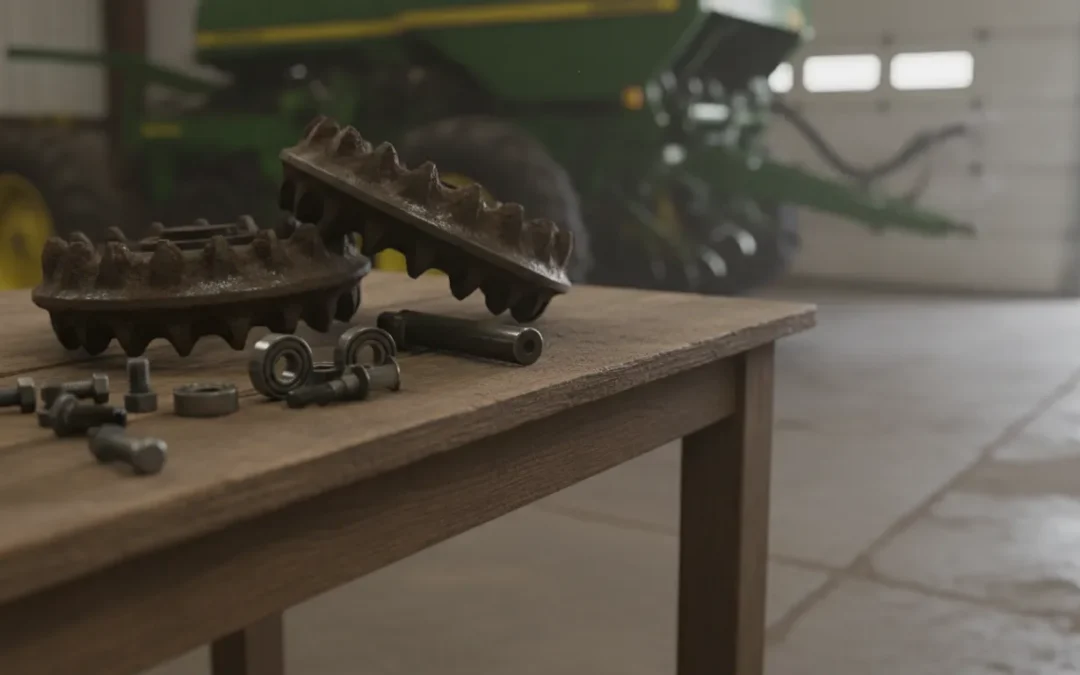
A closing wheel that looks finished is only one line on the order. The bearing inside the hub, the bolts that clamp the arm, and the tailpiece the wheel rides on can all be worn at the same time. A closing wheel replacement parts checklist keeps those pieces separate so the shop order matches the row unit, not just the wheel that came off the planter.
Review Germinator steel closing wheels
Work one row at a time and record what you find. The wheel, the bearing, the hardware, and the row-unit fit each follow a different replacement path. Ordering a new wheel while leaving a loose bearing or a bent arm in place only carries the problem into the next planting season.
What a Closing Wheel Replacement Parts Checklist Should Cover
The useful list is short, but it has to be complete. It names the parts that leave the row unit when you change closing wheels, plus the parts that stay on the planter and still decide whether the new wheels will track the furrow.
- The closing wheels themselves, counted per row and matched to the planter series.
- The bearings in each hub, including shields and any pressed-in races.
- Bolts, nuts, spacers, and the axle or hub hardware that holds the wheel on the arm.
- Row-unit fit: the closing-wheel arm, tailpiece, and any model-specific bracket or conversion kit.
- Small add-ons that only some rows need, such as a rock block where stones jam the wheels.
Iowa State University Extension says the closing wheel should firm soil around the seed and eliminate air pockets without smearing the slot shut. That job fails when any one of those parts is wrong, even when the wheel face still looks serviceable. The same extension note treats closing-wheel choice as a match to soil and planter setup, not a one-size swap.
This checklist stops at the parts. It does not replace the wear signs that tell you the wheel itself is done, and it does not walk through the full install sequence for closing wheels. Use those guides after the parts list is settled.
Treat the row as a small assembly rather than a single wear item. A wheel can still cut a clean shoulder while the bearing growls, the spacer is missing, or the arm pivot has ovaled enough to let the pair walk off the furrow center. Recording those conditions separately keeps a replacement order from repeating the same miss. During the next season, that miss shows up as an open trench on rows that received new wheels and worn hardware.
Start With the Wheels on Each Row
Count wheels before you count anything else. Most row units carry a pair. A 16-row planter means 32 wheels when every row is still a pair, and a staggered or single-wheel setup changes that count. Record the number on the work order so a per-row price is not mistaken for a per-wheel price.
Then match the wheel to the planter series, not to a photo of a similar row unit. Farm Shop MFG sells the Germinator steel closing wheel as a per-row set of two that replaces factory rubber wheels. The current steel listing names John Deere MaxEmerge, Plus, XP, and XP Pro. It also names Kinze from 1993 to current, AGCO White, Massey Ferguson, Great Plains, Monosem, Precision Planting ready row units, and Harvest International. Older John Deere planters use a separate steel wheel for older John Deere models. A shallow-furrow row is a third choice. The shallow furrow closing wheel has the teeth sawed off for shallow planting. It is not a trimmed version of the standard wheel.
Nylon is a separate part number. The Germinator N6 is the Nylon 6 wheel, sold per row as a set of two, for farms that want a lighter wheel than the steel part. The product page describes Nylon 6 as a durable plastic at a lower price point, not as the same wheel in a different color. Do not mix steel and nylon on the same row and assume the arms will carry them the same way. If only some rows are being upgraded, note which rows stay on the old wheels so the hardware list stays accurate.
Order the wheel that matches the hub you still have. Some rows only need the closing ring. Others need that ring already mounted on a hub and rim.
Wheel-only versus wheel with hub
The steel closing wheel with hub and rim is the complete wheel when the factory hub is cracked or rusted to the arm. It is also the right box when the old hub is not worth a new bearing. The listing says these ship unassembled, because assembled wheels were getting damaged in transit. Plan shop time to put the hub and ring together. If the existing hub is sound and the bearing turns clean, a wheel-only part can be the smaller order. If you have to heat the hub off or the rim is out of round, order the hub with the wheel.
Inspect Bearings Before You Reuse a Hub
Remove the hub from the planter, then spin it by hand. A sound bearing turns smoothly and stays quiet. Grit, a notch, side play, or a shield packed with dirt means the bearing belongs on the order, even when the wheel face still has tread.
Farm Shop MFG lists two bearing paths. Standard bearings cover a normal replacement on a hub that is otherwise straight. Heavy-duty bearings are the sealed option for rows that see more load and more dirt. The heavy-duty listing calls out a labyrinth double seal with a triple lip, corrosion-resistant steel, and up to an 80 percent high-quality grease fill. That is the part to choose when last year’s bearing failed from mud, not from simple mileage. Read the current listing before you treat those specs as a match for a particular hub bore.
The Germinator wheel assembly is a different line on the list. It is the plastic rim with bearings and bolts, and it does not include the Germinator closing wheel. Use it when the rim and bearing are the worn pieces and the steel or nylon wheel is still good. Do not order it as a substitute for the closing wheel itself.
Mark each row as reuse, standard bearing, heavy-duty bearing, or full wheel assembly. A planter rarely needs the same answer on every row. The outside rows, and the rows that planted through wet headlands, usually fail first.
Hardware, Axles, and Caps Are Separate Line Items
New wheels do not include their own row hardware unless the product listing says so. Check the bolts, nuts, spacers, and axle before you close the order.
On a John Deere 7000, the axle is its own part. The Germinator axle for the John Deere 7000 is sold per row and includes two bolts, two nuts, and two spacers. The listing is for the 7000 only. Do not put that axle on a later MaxEmerge row and expect the spacing to match. If the 7000 axle is bent, wallowed at the bolt holes, or missing a spacer, it belongs on the order with the wheels. The older-model John Deere wheel page is a different kit. On that listing, 7000 and 7100 rows include two complete wheels plus two axle sets. The 7200 and 7300 rows include a closing-arm bracket. Do not assume the standalone 7000 axle and the older-model kit are the same box.
Look at the bolt threads and the nut faces. A bolt that ran loose will show a polished shank and an oval hole in the arm. Replace that bolt and nut. Reusing them lets the new wheel walk even when the bearing is new. Spacers that are cupped or missing change the gap between the wheels and the furrow center.
The Germinator cap on the site is an embroidered logo cap, not a hub dust cap. Do not add it to a parts order as a closing-wheel component. Hub shields, when you need them, come with the bearing or the wheel assembly, not with that hat.
Rocks create a separate hardware problem. The rock block is an attachment that keeps large rocks from jamming the closing wheels. Add it only on planters that already pick up stone between the wheels. It is not required for an ordinary replacement.
Match the Parts to the Row Unit
Closing wheel row unit fit check: Before ordering, compare one representative row from each planter series with the product’s fit listing. Confirm (1) the planter family and model, (2) the closing-wheel arm and tailpiece sit centered on the opener, and (3) the row has the correct axle, hub/rim, or conversion kit. A John Deere 7000 may need its dedicated axle, while Case IH 1200 and 2000 series may need the Case IH conversion kit. If the arm is bent, the pivot is wallowed, or the tailpiece sits off center, repair that row-unit issue before multiplying the parts order. If the model is not listed, call Farm Shop MFG at (712) 520-6051 before ordering.
- Planter family on the current listing. The steel and N6 pages name John Deere MaxEmerge, Plus, XP, and XP Pro. They also name Kinze from 1993 to current, AGCO White, Massey Ferguson, Great Plains, Monosem, Precision Planting ready row units, and Harvest International. The hub-and-rim page names the same families except Harvest International, and it does not list the original MaxEmerge. Older John Deere planters take the older-model steel wheel. A 7000 also needs its own axle if that axle is worn.
- Case IH conversion. Case IH 1200 and 2000 series planters may need the Case IH conversion kit in addition to the wheels. The kit page says it is for those series. The wheel listing alone does not convert those row units.
- Hub condition. A sound hub can take a new bearing or a wheel-only part. A cracked hub, a rim that wobbles, or a bearing bore that is egg-shaped needs the wheel with hub and rim, or the wheel assembly if only the rim and bearing are bad.
The Case IH and Kinze compatibility guide and the John Deere aftermarket fit guide go deeper on brand fit. Use them when the shed has more than one planter series. This checklist only needs enough detail to keep the wrong part number off the order. Mixing a later MaxEmerge wheel with a 7000 axle, or skipping the Case IH kit, is a fit error rather than a wear error. Down pressure will not correct that mismatch in the field.
Also inspect the closing-wheel arm and the tailpiece while the wheel is off. A bent arm, a wallowed pivot, or a tailpiece that sits off the opener centerline will make a new wheel look like a bad part. Repair or replace that row-unit piece before you blame the wheel. If the arm is straight and the wheels still will not track the furrow, the next check is alignment, covered in the planter closing wheel alignment check, not another parts swap.
Closing Wheel Replacement Parts Checklist
Use one row as the pattern, then multiply by the rows that match it. Change the count when a row is staggered, missing a wheel, or already upgraded to a different wheel.
Checklist and order
Check for a pair per row and confirm the series named on the product page. Order the matching steel, nylon, or shallow-furrow wheel, sold per row as a set of two.
Check for cracks, wobble, or an egg-shaped bore. Order the wheel with hub and rim, or the rim assembly if the ring is still good.
Check for a notch, side play, or a shield packed with dirt. Order a standard bearing, or the heavy-duty seal where mud caused the failure.
Look for a bend, missing spacer, or oval bolt hole on a 7000. Order the 7000 axle only; it includes two bolts, two nuts, and two spacers.
Check for rounded heads or threads that will not hold. Order new hardware and do not reuse a loose bolt.
Check for a bent arm, loose pivot, or an unconverted Case IH 1200 or 2000 row. Order the arm repair, plus the Case IH kit where that series needs it.
Add it only if rocks already jam the wheels. Skip it on clean ground.
Price the list from the live product pages at order time. Published ranges move, and a per-row price already assumes the pair that product includes. On the pages checked for this guide, the standard steel wheel was listed from $180 to $212 per row. The wheel with hub and rim was listed from $250 to $274, and the N6 from $130 to $216. Those figures are the ranges on the product pages, not a quote. Bearings, the 7000 axle, and the rock block are smaller lines. Confirm each figure on the product page before you treat it as the current ticket. Accessory prices and per-row wheel prices do not move together.
How to Walk the Planter Without Doubling the Order
Park the planter on a level shop floor. A clipboard with a column for wheel, bearing, hardware, and fit is enough. A paint marker on the arm works if you would rather not carry paper under the toolbar. Do not order a hub-and-rim wheel for every row because two hubs were bad.
- Start at row 1. Pull one wheel and set it next to the arm so the pair stays together.
- Remove the hub from the planter and spin it by hand. Note a notch, side play, grit, or a dirty shield before you decide to reuse it.
- Inspect the bolt holes, spacers, and axle. Mark an oval hole or a missing spacer on that row, not on the whole planter.
- Check the arm and tailpiece against the opener centerline. A bent arm is a row-unit repair, not a reason to change the wheel part number.
- Move to row 2 only after that row is marked reuse, wheel only, bearing, hub and rim, or axle.
- Group the rows after the inspection. Most rows may need wheels only, two headland rows may need bearings, and a 7000 may need axles.
Leave the gauge wheels and openers on a separate list. Worn gauge wheels change planting depth, and a dull opener changes the trench, but neither piece belongs on a closing-wheel parts order. Folding them into this checklist hides the parts that actually have to ship with the new wheels. The closing wheel and gauge wheel setup guide is the place for that comparison once the new wheels are on.
When the list is complete, stage the parts by row before anything goes back together. A bearing in the wrong hub, or a 7000 axle on a newer row, is an easy mix-up once the boxes are open. The installation itself stays in the install guide.
What This Checklist Does Not Decide
The parts list does not set down pressure, planting speed, or which wheel wins a side-by-side trial. Those are operating questions. They matter after the row is carrying the right parts.
It also does not require every worn wheel to be replaced this week. If the furrow still closes and the bearing is quiet, the wear guide is the better test. The checklist applies once you have decided to replace wheels and need the rest of the row to come with them.
If two planters in the shed use different series, build two lists. A single mixed order is how a 7000 axle and a MaxEmerge wheel land in the same box. Brand fit stays in the compatibility guides linked above.
Questions about which closing-wheel parts fit your planter? Call Farm Shop MFG at (712) 520-6051.
Frequently Asked Questions
What parts should I inspect when replacing closing wheels?
Inspect the wheels, the bearings, the bolts and spacers, the axle or hub, and the closing-wheel arm on the row unit. Add a conversion kit only if the planter series requires one, and add a rock block only if rocks already jam the wheels.
Do new closing wheels include bearings and bolts?
Not unless that product says so. The Germinator wheel assembly includes bearings and bolts but does not include the closing wheel. The John Deere 7000 axle includes two bolts, two nuts, and two spacers, and it fits that model only.
Should I replace the bearing if the wheel is worn but the hub still spins?
Remove the hub from the planter and spin it by hand. Replace the bearing if you feel a notch, side play, or grit, or if the shield is packed with dirt. A smooth, quiet hub can stay. A hub that is cracked or egg-shaped should be replaced with the wheel.
Which closing wheel part fits an older John Deere planter?
Older John Deere planters use the steel wheel sold for those models, not the standard wheel used on later MaxEmerge rows. A John Deere 7000 with a worn axle also needs the 7000 axle, which is listed for that model only. Confirm the series on one row before you multiply the order.
Can I reuse the old bolts with new closing wheels?
Only if the threads are clean and the holes are still round. A bolt that ran loose leaves a polished shank and an oval hole. That hardware will let a new wheel move. Replace the bolt and nut with the wheel.