When you are checking whether aftermarket closing wheels fit a John Deere planter, the fit is only half the question. The wheel also needs to close the seed trench without creating more sidewall compaction, maintain seed-to-soil contact, and hold up through the acres ahead. Germinator steel closing wheels fit a range of John Deere row units, including MaxEmerge, MaxEmerge Plus, XP, XP Pro, and specific older-model configurations.
Contact Farm Shop MFG before ordering to confirm the right fit for your John Deere planter.
Quick answer: Germinator closing wheels fit John Deere MaxEmerge, MaxEmerge Plus, XP, and XP Pro planters, plus dedicated configurations for 7000/7100 and 7200/7300 series planters. The correct axle hardware, spacers, or bracket depends on the row unit, so verify your planter model before ordering.
For the bigger picture on wheel design, field conditions, and planter setup, start with Farm Shop MFG’s Germinator Closing Wheels: Ultimate Planter Guide. This article focuses on the fit and installation questions John Deere operators need answered before they upgrade.
Does the Germinator Fit John Deere Planters?
Yes. The Germinator is available for a wide range of John Deere planter rows, including MaxEmerge, MaxEmerge Plus, XP, and XP Pro systems. Farm Shop MFG also offers dedicated assemblies for John Deere 7000, 7100, 7200, and 7300 series planters. That gives operators a practical route to replace factory rubber wheels without replacing the entire row unit.
Fit matters because the closing wheel has a job to do after the seed leaves the meter. Germinator’s inner-rim shoulder-firmer design is intended to close the furrow, reduce air pockets, and improve seed-to-soil contact. Michigan State University Extension notes that sidewall compaction and soil smearing around the seed furrow can restrict root growth and reduce yield. The risk is especially high when planting is done in soil that is too wet or with too much down pressure.
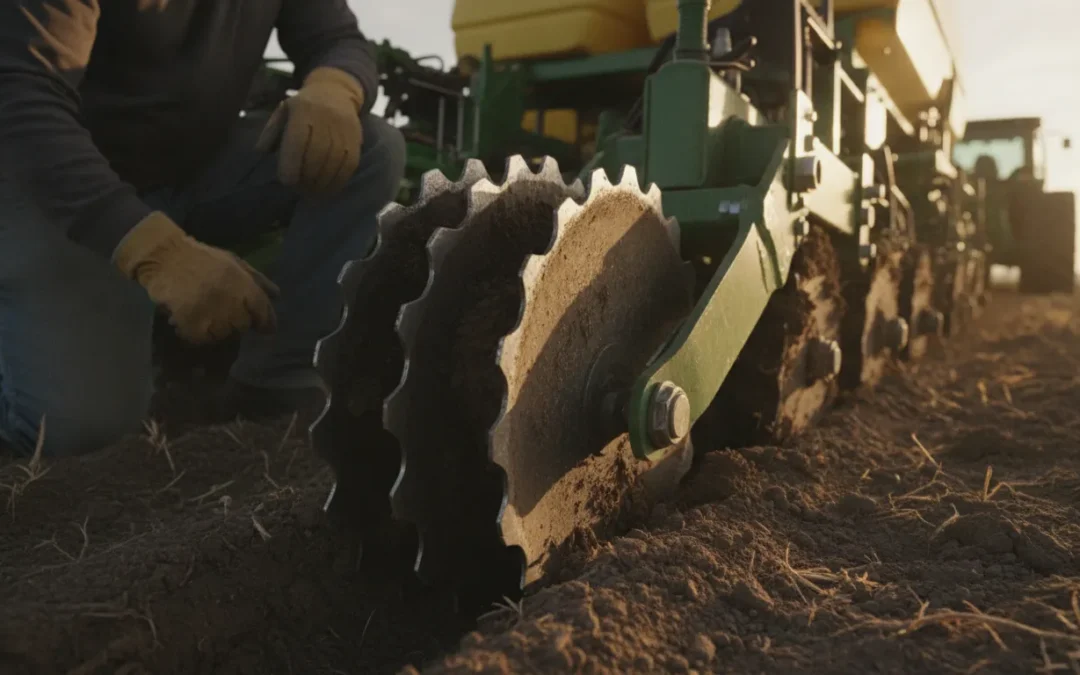
Unlike a standard rubber wheel, the Germinator is built from premium 50-grade steel. That construction is designed for durable trench closure across conventional tillage, heavy soils, and no-till conditions. For specifications and available configurations, see the Germinator steel closing wheels product page.
What changes compared with factory rubber wheels?
Factory rubber wheels are a general-purpose closing system. In tough residue, heavy soil, or a smeared furrow wall, they may not provide the soil engagement needed for consistent closure. Germinator wheels use an inner shoulder to firm soil around the seed trench while their steel profile helps address the sidewall. That does not replace sound planter setup. Soil moisture, planting depth, residue management, and down pressure still decide whether the row unit is working as it should.
Research from the University of Wisconsin found that aftermarket closing wheels increased corn emergence by 2% over standard rubber wheels in the no-till systems studied, while yield differences were not statistically significant by wheel type. Treat that as useful direction, not a yield promise. Every field, planting date, and setup is different. Read the Applied Engineering in Agriculture study for the research details.
Compatibility Guide: Germinator Closing Wheels by Planter Model
Use the planter’s row-unit design, not just the paint color on the toolbar, to choose the correct closing-wheel setup. Farm Shop MFG offers a Germinator assembly for older John Deere planters with hardware matched to the series below.
| John Deere planter family | Fitment | Included hardware | Available options |
|---|---|---|---|
| 7000 and 7100 | Dedicated older-model configuration | Two complete Germinator wheels and two axle sets. Each axle set includes one roll pin, one nut, and six spacers. | Black or Green; Standard or High-Speed bearings |
| 7200 and 7300 | Dedicated closing-arm configuration | Two complete Germinator wheels and one closing-arm bracket | Black or Green; Standard or High-Speed bearings |
| MaxEmerge, MaxEmerge Plus, XP, and XP Pro | Compatible with the applicable Germinator row-unit setup | Confirm the row-unit configuration when ordering | Wheel-only, standard-bearing, or high-speed-bearing configurations |
Germinator closing wheels are also used on several other planter brands, including Kinze, AGCO White and Massey Ferguson, Great Plains, Monosem, Precision Planting Ready Row Units, and Harvest International. If your planter has been modified, or you are unsure whether the row unit is original, take a clear photo of the closing-arm area and contact the Farm Shop before you buy.
Do not force a universal fit. The right wheel and hardware should sit squarely around the trench and turn freely. A mismatch can compromise trench closure and makes it difficult to evaluate the performance of an otherwise sound upgrade.
Installation: What Tools Do You Need?
Germinator closing wheels ship unassembled to help prevent damage in transit. The installation is farmer-friendly, and no special tools are required beyond the ordinary hand tools needed to remove and fasten closing-wheel hardware. Each planter row uses two wheels. A full wheel assembly replaces factory closing wheels directly on most compatible John Deere planters; a ring-only insert option is available for many factory wheels.
- Park safely and remove the factory wheels. Relieve row-unit pressure, remove the existing rubber wheels, and clear packed soil or residue from the closing-arm area.
- Match the hardware to your series. On a John Deere 7000 or 7100, use the supplied spacers, roll pin, and nut. On a 7200 or 7300, install the supplied closing-arm bracket. Keep the hardware with the correct row unit while assembling the planter.
- Install both Germinator wheels. Mount one wheel on each side of the row unit. Confirm that they turn freely and sit evenly around the seed trench.
- Set down pressure in the field. Start with the setting appropriate for your soil and residue, then stop and inspect trench closure. The steel design may allow lighter down pressure in heavy or no-till soil. Do not add pressure simply to make the row look aggressive, especially in wet ground.
Farm Shop MFG offers free shipping on orders of 12 or more rows with code FREESHIP. Before a full-planter conversion, many farmers choose to test a few rows first and compare emergence and trench closure in their own conditions.
What Farmers Say About Fitting Aftermarket Wheels on Their JD
Most farmers do not judge a planter upgrade by how it looks in the shop. They judge it after several seasons of changing soils, residue, rain delays, and acres. The questions stay practical: Does the wheel hold up? Does it close the trench consistently? Does it earn its place on the planter?
John M. reported little wear after covering 7,000 acres. Farm Shop MFG also has feedback from more than 20 named farmers across multiple locations, with customers reporting three to eight seasons of consistent performance. Those are customer reports, not a guarantee that every field will deliver the same result. They do show why steel construction and a properly matched fit matter to operators who want a durable replacement for factory wheels.
Long-term wear matters on a working planter
Greg H., who has farmed for 48 years, endorses Farm Shop MFG products based on practical experience. That perspective mirrors what experienced operators expect from a closing-wheel upgrade: solve a real field problem without creating another maintenance chore. Germinator closing wheels use premium 50-grade steel and an inner-rim shoulder firmer to help build consistent seed-to-soil contact.
Field results still depend on conditions
Todd Z. of Parkston, South Dakota, reported a 3.5 to 5 bushel-per-acre improvement with a 16-row planter. That is a documented customer observation, not a promised yield increase. Soil moisture, residue, planting depth, down pressure, hybrid, and in-season management all affect emergence and yield. Dan Lewis in Oregon reported his best yields over eight seasons. The useful takeaway is to inspect the row, make adjustments as conditions change, and compare results on your own acres.
For farmers dealing with sidewall compaction or inconsistent seed-to-soil contact, first-season ROI is reported when better emergence offsets the upgrade cost. If the issue you are diagnosing is trench-wall smearing, review these planter sidewall compaction causes and fixes alongside your closing-wheel options.
Frequently Asked Questions
What should I check before ordering replacement closing wheels for a John Deere planter?
Confirm the planter series and row-unit configuration, then match the wheel assembly or ring option to that setup. The correct axle, spacers, and bracket vary by model. If you are unsure, send Farm Shop MFG your planter model and a photo of the closing-arm area before ordering.
Can aftermarket closing wheels help with sidewall compaction in no-till fields?
They can support better seed-furrow closure and seed-to-soil contact, but they cannot overcome every setup problem. Sidewall compaction is associated with planting into soil that is too wet or using excessive gauge-wheel or closing-wheel down pressure. Review soil conditions and planter settings along with the wheel upgrade. Michigan State University Extension explains the causes and prevention of sidewall compaction.
Do aftermarket closing wheels improve corn emergence?
They may, especially where standard rubber wheels leave inconsistent contact or closure. A University of Wisconsin study reported 2% greater corn emergence with aftermarket closing wheels than standard rubber wheels in the no-till systems studied. The study did not find a statistically significant yield difference by wheel type, so do not treat the emergence result as a guaranteed yield outcome.
What happens if sidewall compaction is already present?
Prevention matters because sidewall compaction can restrict root growth and cannot be fully corrected after it occurs. For the next planting pass, wait for suitable soil moisture, check closing-wheel pressure, and verify that the wheels are closing the trench without excessive smearing. A steel wheel upgrade can support better closure, but sound planter setup remains essential.
Confirm Your John Deere Planter Fit
The right aftermarket closing wheels for a John Deere planter start with the correct model match, then earn their value in the field through consistent seed-to-soil contact and reliable trench closure. Contact Farm Shop MFG to talk through your planter setup and Germinator options.