
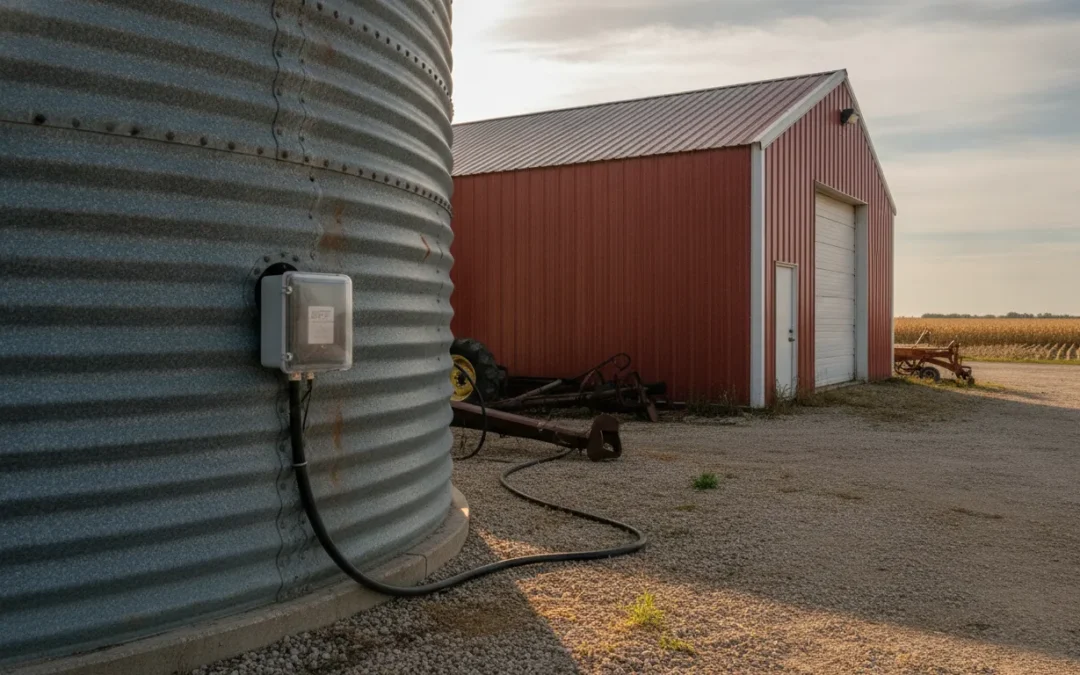
A full grain bin can look fine from the outside while temperature differences develop inside the grain. The right monitoring setup gives you earlier warning. It only helps if it matches the bin size, the locations you watch, and the decisions you make in storage.
See grain bin monitoring equipment for a two-location temperature check
When comparing grain bin sensors, start with the reading you need: temperature only, or temperature and humidity. Check probe coverage, alarm settings, installation, and ongoing costs. For a bin of 20,000 bushels or less, the first-generation Grain Temp Guard Dual-Temp closeout can fit. Use it when you want temperature readings at two locations from one unit. It does not replace aeration or safe in-person inspections.
That last point matters because aeration helps equalize temperatures and limit moisture migration, mold development, and insect activity, according to the University of Minnesota Extension. Before you compare equipment, define what you want the system to tell you and how you will respond when a reading moves outside your normal range.
What Should Grain Bin Sensors Tell You Before You Buy?
Start with the decision you need to make in the bin. Grain bin sensors are useful when a reading tells you what to do next. A temperature change may tell you to investigate a developing hot spot. A humidity reading may help when you are conditioning grain and need to know whether moisture is moving in the direction you expect. The right purchase depends on which information will change your storage decision, not on how many features appear on a product page.
Temperature is often the first question. Ask whether you need to watch grain at more than one depth or location. One reading may not represent the conditions throughout a bin. You also need a practical plan for responding to an alert. Will you inspect the bin, check the grain, start aeration, or adjust an existing storage procedure? If the answer is unclear, a sensor may give you information without giving you a useful next step.
Humidity matters when you are conditioning grain and managing moisture. It can add context to a temperature reading, but it does not remove the need to understand your grain, your bin, and your aeration plan. The University of Minnesota Extension aeration guide explains that aeration helps equalize temperatures and limit moisture migration between warmer and colder grain. A sensor can help you see a change. It does not perform the aeration.
Before you buy, decide which readings you will use, where you need them, and what threshold should prompt action. Then review how a temperature monitoring system works so you understand what the equipment can and cannot tell you.
Keep the limits clear. A sensor does not replace aeration or a safe inspection. You still need to follow safe entry practices and inspect the bin when conditions or an alert call for it. The goal is not to collect readings for their own sake. It is to receive useful information early enough to support a sound storage decision.
Which Questions Should You Answer Before You Choose Grain Bin Sensors?
Start with the job you need the system to do. A clear answer to each question will help you avoid paying for readings, alerts, or automation that do not fit your bins.
-
How large are your bins, and how many reading locations do you need? Write down the bushels in each bin, the bin depth, and the areas where a problem could develop. Then ask whether point sensors give you enough coverage or whether a cable makes more sense for the way your grain is stored. This cable-versus-point question affects probe count, installation, and the readings you can collect.
-
Are you monitoring dry stored grain, or are you managing in-bin conditioning? Dry storage may call for temperature readings and alerts that help you spot a developing hot spot. Conditioning or soybean moisture risk may make humidity or moisture-related readings more important. Do not assume a temperature-only unit covers the same job as a temperature-and-humidity unit.
-
Who will hear the alarm and respond? Decide whether the alert must reach someone in the yard, the shop, the house, or somewhere else. Check the alarm type and cord or communication range. A useful alarm is one that reaches the person who can inspect the bin while the reading still matters.
-
Do you want a subscription? Compare the full ownership model, not just the equipment. Ask whether the system requires a monthly fee, a cloud account, cellular service, or ongoing software access. If you prefer a system without a recurring subscription, make that a requirement before comparing features.
-
What will you do after an alert? Write the response down before installation. It may include checking the grain, confirming the reading, inspecting for moisture migration, or starting aeration under safe conditions. Aeration helps equalize grain temperatures and limit moisture migration, but sensors do not replace aeration or an in-person inspection. If you also need automatic fan control, treat that as a separate purchase, such as EndZone, rather than assuming the sensor controls the fan.
Match the monitoring question to the job.
Situation: Dry stored grain under 20,000 bushels
Reading you need: Temperature at useful locations
Next step: Set probe coverage and alarm limits.
Situation: Conditioning or soybean moisture risk
Reading you need: Temperature plus humidity information
Next step: Confirm the unit measures that condition.
Situation: Bins that also need fan automation
Reading you need: Monitoring plus separate fan control
Next step: Choose sensors, then compare fan control.
When Does the First-Generation Dual-Temperature Unit Fit?
The Grain Temp Guard DT 1st Generation can make sense for a straightforward temperature check at two locations. The closeout price is part of that choice. The product schema lists it at $275, and first-generation inventory is being cleared as next-generation models remain available. For a practical overview of the unit, see this grain bin monitoring equipment option.
Choose it for temperature checks in smaller bins
One DT unit monitors temperature at two locations. It is designed for bins of 20,000 bushels or less. If you are monitoring a larger bin, plan on an additional probe for every additional 10,000 bushels. Each temperature probe has its own high and low trigger point, so you can set the alert limits for each monitored location.
This is a temperature-only system. It does not measure humidity or help you manage conditioning based on moisture readings. If humidity and temperature at one location are both part of the job, the current Grain Temp Guard unit is listed at $499. Compare the temperature-and-humidity unit before choosing the closeout model.
Know the tradeoffs before ordering
The first-generation unit has a stated reading error rate of 2 percent. The next-generation models state a 1 percent error rate. That difference may matter if you need the newer accuracy specification. It is worth comparing the price savings with how closely you need to track changes in stored grain.
The hardware uses 110 V power with battery backup. A visual and audio alarm is carried on a 10 m cord. Standard probes are 15 m long, with extra lengths available in 10, 15, 25, 30, and 45 m options. Before ordering, check the distances and locations you need to monitor. Use the grain bin sensor placement guide for the planning considerations, rather than assuming the standard probe will suit every bin.
The unit also comes with a 30-day return window. The product must be returned in like-new condition with its original packing, accessories, and manuals for a complete refund. Shipping to or from Farm Shop MFG is not reimbursed. The return policy reduces purchase risk. It does not remove the need to confirm bin size, probe length, and whether you need humidity monitoring.
What Will a Grain Bin Sensor Not Do for You?
A grain bin sensor gives you information from the points where its probes are installed. It does not provide a perfect picture of every part of the bin. A single rising reading can warn you that something needs attention. But a normal reading at one location does not prove the entire grain mass is in good condition.
That is why probe coverage should be part of your buying decision. The current Grain Temp Guard page suggests two probes for the first 10,000 to 20,000 bushels, then one more probe for each additional 10,000 to 15,000 bushels. Treat that as a coverage question, not a universal placement map. Your bin size, grain depth, equipment, and monitoring goals still matter. For crop-specific considerations, see the guides for grain bin sensors for corn and grain bin sensors for soybeans.
An alarm is also not a repair. It tells you that a temperature or humidity reading has crossed a trigger point. You still need to investigate the bin and decide what action is appropriate. Aeration is necessary to equalize and maintain uniform temperatures during storage. Without it, temperature differences can move moisture from warmer grain toward colder areas. Sensors can help you notice a developing problem, but they do not replace aeration or a safe in-person inspection. Learn more about what causes hot spots in grain bins before choosing how you will respond.
Temperature is not the same as a moisture test. A temperature reading can help identify an abnormal change, while a moisture test measures a different condition. Do not assume a sensor has measured moisture unless the specific model and setup are designed to do so.
The Grain Temp Guard page illustrates why timely information can matter. It states that each 1 percent moisture loss reduces product by about 1.5 percent. For a 30,000 bushel bin, the page figures that 1 percent loss at $1,650 for corn or $3,850 for beans, based on the prices used there. Those are examples, not guaranteed savings. A sensor helps you make a better-timed decision. It cannot guarantee the outcome or manage the bin for you.
How Should You Confirm the Setup With Farm Shop MFG?
Once you know what you want to monitor, talk through the setup before you order. Farm Shop MFG sells Grain Temp Guard direct. You can ask about your bins and probe requirements instead of forcing a standard package onto every bin. The published phone number is (712) 520-6051, and you can also contact Farm Shop MFG through the website.
Have two details ready for that conversation: the bushels in each bin and whether you are storing dry grain or conditioning grain. Those details help frame the monitoring job and the number of locations you need to watch. If you are still comparing types of grain bin sensors, use the temperature-sensor buying guide first. The temperature and humidity buying guide can help when moisture conditions are part of your decision.
Confirm probe length before ordering, too. A standard probe may not reach where you need it in every bin. A probe that is too short can limit the setup even when the monitoring unit is otherwise a good fit. Farm Shop MFG lists 15-meter probes as standard for the current Grain Temp Guard, with other length options available. Ask which length suits your bin dimensions and intended placement rather than assuming the standard length will work.
It is also useful to settle cost questions during the same call. The grain bin monitoring system cost guide can help you frame that discussion without relying on a price copied from a different configuration. Farm Shop MFG also builds EndZone fan controls and Germinator closing wheels, but those are separate product lines from Grain Temp Guard. Bring your bin size, grain condition, and probe-length question to the conversation, then confirm the setup that fits your operation.
If you already know the bin size and whether you need temperature only or temperature and humidity, ask Farm Shop MFG which probe setup fits or call (712) 520-6051.
Frequently Asked Questions
What should grain bin sensors measure?
Start with grain temperature. A useful sensor should help you identify temperature changes inside stored grain so you can decide when a closer inspection or management step is needed. Before buying, confirm how many temperature points the unit covers, where those points sit, and how you will read the information from the bin.
Does the first-generation Grain Temp Guard dual-temperature unit measure humidity?
No. The first-generation dual-temperature Grain Temp Guard closeout is designed to measure temperature at two points, not humidity. If humidity readings are important to your storage plan, treat that as a separate requirement and verify that any replacement or add-on product specifically includes humidity measurement.
Can a grain temperature sensor replace aeration?
No. A sensor provides information, but it does not move air through the grain or lower its temperature. Use the readings to support decisions about inspection and aeration, then follow your normal grain-management practices and equipment guidance.
Is a first-generation dual-temperature unit a good fit for every bin?
Not necessarily. It may fit a straightforward need for basic temperature checks at two points, especially when you want a closeout option and do not need humidity data. Compare the unit’s sensing coverage with your bin size, monitoring routine, and need for additional readings before purchasing.
Ready to Choose the Right Grain Bin Sensor?
The right sensor setup depends on your bin size and whether you need temperature monitoring alone or temperature and humidity together. Call Farm Shop MFG to talk through those details and find a practical fit for your grain storage needs. Call Farm Shop MFG at (712) 520-6051 to get started.