
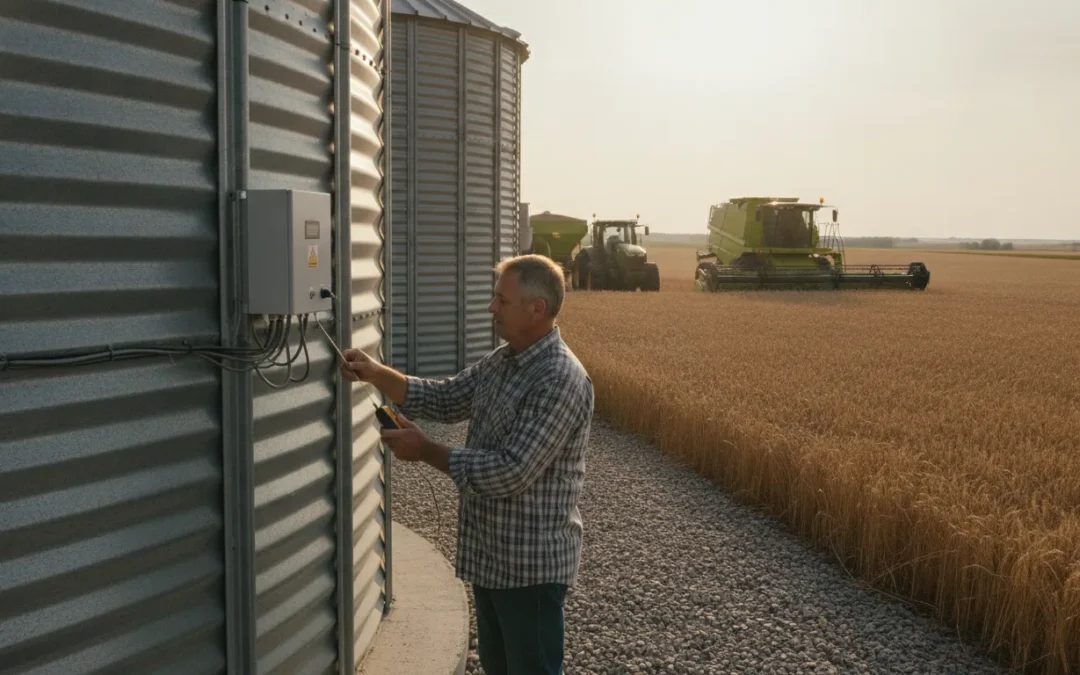
The right grain temperature setup depends less on the label on the equipment and more on how you manage the bin. A large bin where you need to follow aeration progress calls for a different view than a smaller bin where you want readings from specific locations and an alarm you can reach easily.
Contact Farm Shop MFG about your bin monitoring setup.
In the grain temperature cables vs sensors decision, cables provide readings at fixed points along an installed line. Point sensors let you target selected areas such as the grain core, upper grain, or another known risk location. Neither approach measures every kernel. Grain insulates temperature sensors, so placement, bin size, access, and your inspection routine all matter.
Start by matching the monitoring pattern to the problem you need to catch. The next step is to look closely at what each approach actually measures and where its readings can guide aeration or follow-up inspection.
How Should You Compare Grain Temperature Cables vs Sensors?
Distributed grain temperature cable systems and point sensors both measure conditions inside stored grain, but they organize that monitoring differently. A cable is installed through the grain mass with sensing points along its length. That arrangement gives the operator a set of readings along a planned path, which can be useful for following temperature changes and aeration progress in larger bins. University of Minnesota Extension identifies thermocouple cables as especially valuable in bins holding about 20,000 to 25,000 bushels and up. Read the extension guidance on stored-grain aeration.
Point sensors, often called probes, measure at selected locations rather than along a continuous cable route. In a bin without temperature cables, thermometer probes can be used at different locations to help monitor aeration progress and locate trouble spots. That makes placement the central decision. The readings are useful only in relation to where the probes sit within the bin and what part of the grain mass you are trying to watch.
Cable coverage is not the same as whole-bin coverage
A cable can improve access to readings at multiple points, but it does not measure every kernel or every area of the bin. North Dakota State University Extension notes that cable sensors measure the grain next to each sensor. Grain a few feet away may have a different temperature because grain is an effective insulator. Nebraska Extension makes the same practical point: cables detect the temperature near the cable, not the entire bin. Cable placement and sensor quantity therefore matter as much as the fact that a cable is installed.
That distinction matters when a farmer is comparing grain temperature cables vs sensors. The better question is not simply which device has more sensing points. It is whether the monitoring locations match the bin, the grain condition, and the inspection routine. A cable-based design can be a strong fit for larger storage and aeration tracking. A probe-based design can be more appropriate when the priority is monitoring specific locations, adding humidity information, or choosing a configuration that matches an existing bin layout.
How Farm Shop MFG uses probe-based configurations
Farm Shop MFG’s Grain Temp Guard monitoring system is probe-based, not a distributed temperature cable system. Its Humidity-Temperature configuration monitors temperature and humidity at one location. The Dual-Temperature configuration monitors temperature at two distinct locations. Available probe lengths are intended to help fit the installation, but they should not be described as continuous sensing along the probe length.
Before choosing either approach, map the locations you need to monitor and confirm how readings will be checked after installation. For a practical look at cable placement considerations, see this grain bin temperature cable installation guide. The right setup is the one that gives you useful information from the areas that matter without creating a false sense that one cable or probe represents the entire grain mass.
Which Gives Better Coverage: Grain Temperature Cables vs Sensors?
Coverage is not simply a matter of how many sensors appear on a product sheet. It depends on where readings are taken and whether those locations represent the grain that is most likely to warm. In the comparison of grain temperature cables vs sensors, the key question is whether you need a broad pattern across a large grain mass or targeted information from known risk areas.
Temperature cables can provide readings at multiple points along the cable, which is useful for following temperature changes through a larger bin and checking aeration progress. However, a cable sensor measures the grain immediately around that sensor. It does not measure the entire bin. North Dakota State University Extension cautions that grain is an excellent insulator, so grain a few feet away can be at a different temperature without changing the cable reading: NDSU’s stored-grain guidance explains this limitation.
Hot spots can develop outside the sensor’s immediate area
That insulation effect matters when a warming area is near, but not directly beside, a cable or probe. Nebraska Extension reports that warming often develops within a couple of feet of the bin wall and in the upper few feet of grain. Solar radiation can also make grain next to the wall warmer than the average outdoor air temperature. Those locations deserve deliberate attention, especially when deciding where to place a sensor or where to take manual readings.
The top of the bin is important for another reason. Temperature differences can move moisture from warmer grain toward colder areas, and moisture can condense near the grain surface when weather turns warmer. A single reading in the grain core may look normal while conditions near the wall or top require management. Sensor placement should therefore reflect the bin’s shape, fill level, grain condition, and aeration plan, rather than being treated as a one-size-fits-all layout.
Placement and interpretation work together
Iowa State University identifies sensor quantity, placement, and interpretation as key parts of monitoring stored grain and choosing aeration windows. In practice, that means a well-placed point sensor can answer a useful question about a specific location, while a cable can show a temperature pattern along its installed path. Neither approach eliminates the need to investigate an unusual reading or inspect the grain for crusting, insects, odors, or other warning signs.
For a practical reference on how temperature ranges relate to storage decisions, review this grain storage temperature chart and safe ranges. Use it alongside regular inspections and moisture checks. The best setup is the one that gives you meaningful readings from the locations most likely to affect grain quality, not simply the one with the greatest number of sensors.
When Do Grain Temperature Cables Make More Sense?
Grain temperature cables make the strongest case when you are managing a large volume of stored grain and need a repeatable way to watch conditions through the mass. University of Minnesota Extension identifies thermocouple cables as valuable in larger bins of roughly 20,000 to 25,000 bushels and up, particularly for tracking aeration progress. A cable-based setup can give you readings from fixed points while fans run, helping you see whether cooling is moving through the bin rather than relying on a single check at the surface.
That advantage is most useful when aeration decisions involve more than one area of the bin. Sensor number, cable placement, and interpretation all affect how well a system supports aeration management, according to Iowa State University research. In a large operation, consistent readings from installed locations can make the inspection routine more systematic, especially when several bins need attention during changing weather.
Cables fit a planned monitoring routine
A cable system can be a practical fit when the farm already has a defined schedule for checking stored grain and recording changes. North Dakota State University Extension recommends checking stored grain at least every two weeks and measuring both temperature and moisture content during those checks. A cable does not replace that work, but it can make temperature readings easier to repeat at known locations. It is also useful when you need to compare readings before, during, and after an aeration cycle.
Use the readings as management information, not as a stand-alone verdict. Temperature differences can move moisture from warmer areas toward colder areas, and condensation near the grain surface can create spoilage risk when conditions warm. Aeration helps maintain a cooler, more uniform grain temperature, but fan operation still depends on weather, grain condition, and the operator’s judgment. For fan management, measure the conditions that matter to the decision, including ambient and exhaust air temperatures.
Know what cables cannot tell you
The central limitation in the grain temperature cables vs sensors decision is coverage. A cable sensor measures the grain next to that sensor, not every bushel in the bin. Grain is an effective insulator, so a hot spot a few feet away may not change the cable reading. Nebraska Extension also notes that warming often occurs near the bin wall and at the top, where solar heating can raise grain temperature above the average outdoor air temperature.
That means cable placement matters, and physical inspection remains essential. Do not use cable readings as a substitute for checking for insects, crusting, odors, or other signs of a storage problem. If you are comparing a cable approach with targeted probes, the broader grain bin monitoring systems guide can help frame the larger decision. Keep this comparison focused on coverage and management fit, then match the setup to your bin layout, grain condition, and inspection routine.
When Are Point Sensors the Better Fit for a Farm?
Point sensors can make sense when your monitoring plan is built around a few locations that matter most, rather than a distributed reading pattern throughout the bin. That may be the grain core, the upper portion where moisture conditions deserve attention, or a lower and upper point that lets you compare conditions at different levels. The right choice depends on the bin, the grain, and how you inspect and manage it.
Farm Shop MFG’s Grain Temp Guard is a probe-based system, not a distributed temperature cable. Its Humidity-Temperature configuration monitors temperature and humidity at one location. That focused approach can suit a farm that wants a practical reading from a selected point and an alert it can act on. Review the Grain Temp Guard monitoring system to see how the probe-based setup fits your bins.
Choose locations that match your management routine
A point sensor is most useful when its location answers a specific management question. If you are watching the grain core, place the probe where that reading represents the area you want to check. If moisture near the top is a concern, a humidity-capable probe in that area may provide more useful information than a temperature-only reading somewhere else. Farm Shop MFG describes a midsize-bin setup using temperature probes in the grain core and a humidity-temperature probe near the top.
For smaller or midsize bins, the company also describes using probes in the lower and upper portions of the bin. That gives the grain manager distinct locations to compare without treating one reading as a measurement of the entire grain mass. Placement still matters. Grain temperature can vary by location, and a monitoring device should support regular inspection and sound grain-management practices rather than replace them.
Use alarms where someone can respond
Point monitoring is a strong fit when an operator needs a visible or audible signal in an accessible place. Grain Temp Guard allows the operator to set high and low trigger points for temperature and humidity. Its visual and audio alarm can be mounted in a more accessible area with a 10-meter cord. That matters on a busy farm: the alarm location can be chosen around the daily route, equipment area, or another place where a change is more likely to be noticed.
This workflow is different from trying to interpret a large volume of readings across a distributed cable network. It is a targeted alert system tied to selected probes and thresholds. The alarm tells you that a reading crossed the limit you set. You still need to investigate the bin, consider moisture and temperature conditions, and decide what action is appropriate.
When one or two locations are enough
One location may fit a focused monitoring need. Two distinct locations may be more useful when you want to watch different grain levels or combine temperature and humidity information with separate temperature readings. Farm Shop MFG lists dual-system configurations for two monitoring locations, with package choices organized by bin-capacity bands rather than a universal sensor-count rule. See the dual-location temperature monitoring options and match the configuration to your bin layout and routine.
How Should You Choose a Monitoring Setup by Bin Size?
Bin capacity is a useful starting point, but it should not be the only decision. The right setup depends on where you need readings, whether moisture is part of the monitoring plan, how often you inspect the grain, and how you intend to respond when conditions change. A larger bin may benefit from broader temperature coverage, while a smaller bin may be better served by targeted readings at locations where grain conditions are most likely to differ.
Extension guidance describes thermocouple cables as valuable for monitoring temperature and aeration progress in bins of roughly 20,000 to 25,000 bushels and up. In bins without cables, thermometer probes can be used at different locations to help find trouble spots. That is a practical distinction, not a universal dividing line. Cable systems still read the grain next to each sensor, and grain can insulate a cable from a hot spot a few feet away. Placement and interpretation matter at every capacity.
| Bin situation | What to prioritize | Cable or targeted-point strength |
|---|---|---|
| Smaller bins | Readings at meaningful locations, simple access, and a routine for checking changes over time. | Targeted point probes can help check different locations and locate trouble spots without assuming the entire grain mass has one temperature. |
| Midsize bins | Coverage of the grain core plus attention to conditions near the top, especially when moisture monitoring is important. | Farm Shop MFG describes a configuration using a DT for grain-core temperatures and an HT near the top for moisture monitoring. Treat this as a product-specific setup, not a universal rule. |
| Larger bins | Temperature visibility across the stored grain, aeration progress, inspection access, and a clear response plan. | Cables can provide useful distributed locations for temperature checks in larger bins, while targeted probes can focus on selected zones. The best choice depends on layout and management goals. |
Farm Shop MFG’s own capacity guide lists package bands such as 3,000 to 6,000, 7,000 to 15,000, and 16,000 to 23,000 bushels, followed by larger ranges. Those bands help match a product configuration to a bin, but they do not establish one sensor count that works for every operation. The dual-system guidance describes dual HT units for smaller-to-midsize bins, with probes in lower and upper portions, and a dual-alarm DT configuration for larger bins with previously dried grain. Review the dual-location temperature monitoring options alongside your bin layout and grain-management routine.
Whichever approach you choose, use readings as management information rather than a substitute for inspection. A useful setup helps you notice changes, decide when to investigate, and connect temperature information with the condition of the grain and the work happening around the bin.
What Should Farmers Check Besides Temperature Readings?
A temperature reading is a signal, not a complete grain-management decision. The useful question is what the reading means alongside moisture, weather, aeration, and what you can see or smell during a routine check. That broader view helps you respond to changing conditions instead of treating one number as a pass-or-fail answer.
Connect readings to aeration and moisture movement
Aeration is intended to maintain a cool, more uniform grain temperature. It can also reduce conditions associated with mold development, insect activity, and moisture migration. Without aeration, temperature differences in a bin can move moisture from warmer areas toward colder areas. If that moisture condenses near the grain surface, spoilage can accelerate when the weather turns warmer.
Use the reading to ask whether the fan is moving conditions in the right direction. When managing fans, compare ambient-air temperature with exhaust-air temperature rather than looking only at the grain reading. The difference can help you judge whether air is moving through the grain and whether the current aeration cycle is accomplishing its purpose. For a practical reference, review the grain storage temperature chart and safe ranges, then interpret those ranges with the grain’s moisture content and storage conditions in mind.
Check moisture, not just heat
Allowable storage time depends on both grain temperature and moisture content. A cooler reading does not erase the risk created by excess moisture, and a moisture reading should be recorded with its temperature and location. During each check, note whether the grain condition is changing, whether the measurement came from the same area as the previous check, and whether weather has created a new condensation risk.
Keep a simple record of date, grain temperature, moisture content, ambient conditions, exhaust-air temperature, fan activity, and any action taken. Maximum-minimum readings can also show how conditions changed between visits. A trend that is slowly moving in the wrong direction may deserve attention before a sharp alarm appears.
Inspect the grain and the bin safely
Monitoring does not replace physical inspection. Extension guidance recommends checking stored grain at least every two weeks and looking for insects, crusting, odors, and other signs of storage problems. Inspect the areas where warming commonly develops, including near the bin wall and toward the top. Grain insulates temperature cables and probes, so a reading may not represent a hot spot a few feet away.
Those checks must follow safe bin-entry practices. Do not treat an alarm or a normal reading as permission to enter a bin without the proper precautions. If fan management is becoming a repeated chore, EndZone automated grain-bin fan control can be evaluated as part of the aeration routine. The goal is not to collect more numbers. It is to use readings, moisture checks, observations, and records together to protect stored grain.
A Practical Buying Checklist for Grain Bin Monitoring
Buy the monitoring setup around the way you manage grain, not around a feature list. A good fit should show conditions where they matter, make abnormal readings easy to notice, and fit the inspection routine your operation can maintain. Sensor quantity and placement are central to interpreting stored-grain conditions and choosing useful aeration windows, so treat them as design decisions rather than installation details. Iowa State University emphasizes the importance of sensor number, placement, and reading interpretation when monitoring stored grain.
- Define the coverage you actually need. Decide whether you need readings at one location, two distinct locations, or distributed readings through a larger grain mass. A cable measures the grain near each sensor, not automatically the entire bin, and grain insulation can hide a hot spot a few feet away. Include areas near the wall and top where warming may occur.
- Plan probe or cable placement before you buy. Mark the grain core, upper grain, lower grain, wall-side exposure, and any location that affects fan decisions. Match probe length to the bin and installation path. Grain Temp Guard lists a standard 15-meter probe, with 10, 15, 25, 30, and 45-meter options available, so confirm the length rather than assuming a standard will reach.
- Make the readings accessible. An alarm that can be heard or seen where someone works is more useful than one hidden near the bin. Ask where the display or alarm will be mounted and how often someone will check it. Grain Temp Guard includes a visual and audio alarm on a 10-meter cord for mounting in a more accessible area.
- Set alarm thresholds you can act on. Look for independent high and low trigger points for the measurements you monitor. Then decide who responds, what inspection follows an alarm, and when fan operation or sampling is appropriate. An alarm is a prompt for management, not proof that every part of the bin is safe.
- Check power and backup. Confirm the installation has the required power at the monitoring location and understand what happens during an outage. Grain Temp Guard uses 110 V external power with an internal battery backup.
- Include moisture in the plan. Temperature alone does not tell the full storage story. Ask whether humidity or moisture conditions need monitoring near the top or another specific location, especially where moisture migration and condensation could affect grain quality.
- Keep records and plan service. Decide how readings, alarms, moisture checks, and corrective actions will be recorded. Also confirm probe replacement, troubleshooting, and support before installation. Stored grain still requires physical inspection, not just remote or mounted readings.
- Leave room for expansion. Use the product’s capacity-specific configuration guidance, not a universal sensor-count rule. Farm Shop MFG lists configurations for several bin-capacity bands, so discuss the current bin, future bins, and whether a second monitoring location may be needed. Review the Grain Temp Guard monitoring system with those details in hand.
The right checklist turns a cable-versus-sensor decision into an installation plan you can use through harvest, winter storage, and the next expansion.
Contact Farm Shop MFG before choosing a grain monitoring setup.
Frequently Asked Questions
Are grain temperature cables or point sensors better for most farm bins?
Neither is automatically better. Cables provide readings at multiple fixed points along the cable, which can help track conditions through a larger grain mass and follow aeration progress. Point sensors focus on selected locations, such as the grain core, upper grain, or an area where access is limited. The better choice depends on bin size, probe placement, how often you inspect the bin, and whether you need broad coverage or targeted alarms.
How large should a bin be before I consider temperature cables?
Thermocouple cables are especially valuable in larger bins of about 20,000 to 25,000 bushels and up, where checking several areas manually becomes more difficult. That is a guideline, not a universal cutoff. In smaller bins, point probes can still provide useful readings at selected locations, including areas near the top or bin wall where grain may warm. University of Minnesota Extension discusses cables and probes by bin-monitoring use.
Can a temperature cable detect every hot spot in a grain bin?
No. A cable measures the grain next to each sensor, and grain can insulate the cable from a hot spot a few feet away. Placement matters, especially near the bin wall and top, where warming commonly develops. Temperature readings should support, not replace, physical inspections for insects, crusting, odors, or other storage problems. NDSU Extension recommends regular inspection alongside cable monitoring.
What does Grain Temp Guard monitor?
Grain Temp Guard uses probe-based configurations to monitor temperature and, with the Humidity-Temperature setup, humidity at a selected location. Farm Shop MFG also offers dual-location configurations for monitoring distinct areas. The system can use operator-set high and low alarm points, with a visual and audio alarm, so you can focus attention when readings move outside your chosen range. Review the probe lengths and configuration options before ordering.
Choose the Monitoring Approach That Fits Your Bins
The right setup depends on your bin size, grain, access points, and how you manage readings during storage. A quick review can help you compare coverage and day-to-day practicality before you install equipment. Contact Farm Shop MFG with your bin size, grain, and monitoring goals so we can discuss the approach that fits your operation.