
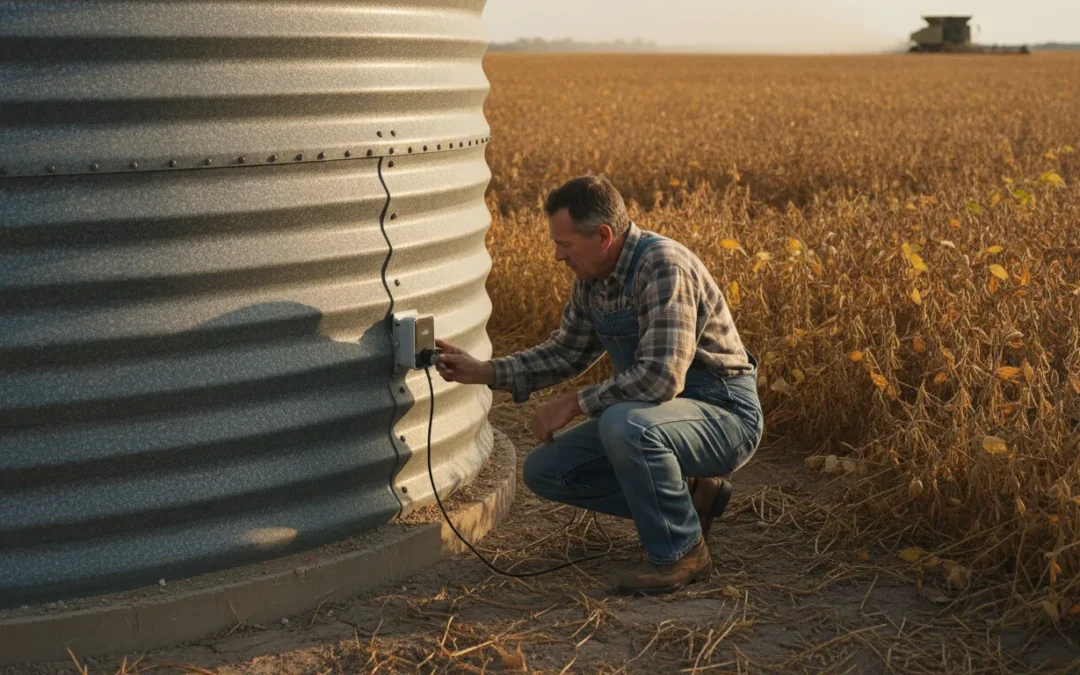
.Stored soybeans can look fine at the surface while heat, moisture migration, or spoilage develops deeper in the bin. A practical monitoring setup gives you a trend to watch before a small storage problem becomes a quality or drying decision.
Talk with Farm Shop MFG about your grain monitoring setup.
Grain bin sensors for soybeans should track changing grain conditions, especially temperature and humidity, while calibrated grain-moisture tests confirm what is happening in the sample. That distinction matters because a sensor does not directly measure kernel moisture. Iowa State notes that soybeans are more susceptible to spoilage than corn because of their higher oil content. So storage decisions should account for crop condition, storage duration, and current readings.
The right setup starts with a clear baseline, reliable sensor coverage, and a routine for confirming readings before you aerate or adjust your storage plan. Here is how to set up the equipment and use the information without treating one reading as the whole answer.
How to Set Up Grain Bin Sensors for Soybeans
A good soybean monitoring setup starts with a clear division of responsibility. Sensors help you watch changing conditions inside the bin, while a calibrated handheld tester confirms the moisture content of a physical grain sample. Those are related decisions, but they are not the same measurement. Soybeans are especially vulnerable to spoilage because of their higher oil content. So the goal is to establish a dependable baseline and catch changing conditions before a storage problem spreads.
- Define the storage objective before installing equipment. Record whether the bin holds commercial soybeans for winter storage, seed for one planting season, or carryover seed. Iowa State recommends 13% moisture or less for commercial soybeans stored through winter, 12% or less for seed stored over one planting season, and 10% or less for carryover seed. Treat those as storage guidance, not as a sensor alarm setting that applies to every bin. Review the full Iowa State soybean storage guidance alongside your handling plan.
- Choose coverage that matches the bin and the decision. Do not copy a cable count or spacing rule from another bin. Bin diameter, grain depth, access, and the equipment you are monitoring all affect the installation. The research cited for soybean monitoring used multiple chambers arranged vertically through the grain mass, with an optional headspace chamber. That is a useful way to think about coverage, not a universal farm-bin layout. Follow the equipment instructions and verify that each sensing point can be read after filling.
- Install condition monitoring and establish a baseline. A system such as Grain Temp Guard monitors bin temperature and humidity. Take initial readings after the bin is settled, and note the grain condition, fill date, recent aeration, and weather. The baseline gives you something meaningful to compare when a reading changes. Temperature and humidity trends can point to a developing condition, but they do not directly tell you the moisture percentage of every kernel.
- Confirm decisions with physical samples. Pull representative samples and use a properly calibrated grain-moisture tester. Grain temperature can significantly affect portable moisture readings, and cold grain can read low unless moisture has condensed on the surface. Test each sample at least three times and average the results. If the sensor trend and handheld result disagree, investigate the sampling method, grain temperature, and tester compensation before changing the storage plan.
- Document the first response. Keep the installation notes, baseline readings, sample results, and aeration actions together. When a condition changes, you can compare the new reading with both the sensor history and a confirmed sample instead of reacting to one number in isolation.
Which Conditions Should Soybean Bin Sensors Monitor?
A practical soybean monitoring setup should follow more than one signal. Start with grain temperature, add relative humidity when the system supports it, and use periodic moisture samples to confirm what the sensors are indicating. Carbon dioxide can add another layer of information, but it is an advanced signal rather than a requirement for every on-farm bin.
Temperature shows where conditions are changing
Temperature is the most useful first signal because a developing hot spot can indicate changing conditions inside the grain mass. A single reading matters less than the trend at the same sensor location. Compare readings with the bin’s earlier baseline and pay attention to a localized rise rather than relying only on an average bin temperature. A temperature monitoring system can help identify where to inspect or consider aeration before a small problem spreads.
Temperature also matters when you check moisture with a portable tester. Iowa State Extension cautions that grain temperature can have a large effect on moisture readings. And cold grain generally produces low readings unless moisture has condensed on the surface. Test each sample at least three times and average the results. This is why Grain Temp Guard should be used as a condition-monitoring tool, not treated as a replacement for a properly handled, calibrated grain-moisture test.
Relative humidity helps add context
Relative humidity can help explain whether the surrounding environment is becoming more favorable to spoilage. It is especially useful alongside temperature because the two readings provide context that one number alone cannot. Use the data to spot changes and decide when to inspect, sample, or evaluate aeration. Do not treat a humidity reading as a direct measurement of kernel moisture. And do not apply one universal alarm threshold to every soybean bin, crop condition, or storage season.
CO2 is an optional advanced signal
Research has evaluated probes that measure temperature, relative humidity, and CO2 in soybean transport environments. The ScienceDirect study is useful research context for understanding why these signals may help monitor grain conditions. It was conducted with soybean trailers during transport, however, so it should not be presented as a universal bin-monitoring standard. For most farms, reliable temperature trends, useful humidity context, and confirmation through representative moisture samples are the practical foundation.
Where Should Sensors Go in a Soybean Grain Bin?
Sensor placement is a coverage decision, not a matter of putting one probe wherever it is easiest to reach. The goal is to observe conditions across the grain mass and understand how readings relate to the bin’s geometry, fill pattern, airflow, and headspace. A sensor near one access point may show a useful local trend while missing a developing hot spot elsewhere.
Vertical coverage is one practical way to think about the layout. A soybean-monitoring study used a probe with four sensor chambers spaced vertically through the grain mass, plus an optional chamber in the headspace above the grain. That research was conducted in soybean transport trailers, not farm grain bins. So it should be treated as a monitoring concept rather than a universal rule for the number, height, or spacing of sensors in your bin. The study measured temperature and relative humidity, along with carbon dioxide, at multiple locations. Read the study details.
Match coverage to the bin and grain condition
Before installing anything, consider the bin diameter, the depth and shape of the grain mass, the normal fill pattern, and where air enters and exits during aeration. The most useful layout is the one that gives you meaningful coverage of the areas where conditions can differ. A sensor cable or point sensor should be installed and supported according to its equipment instructions. Avoid treating a published research layout as a substitute for the manufacturer’s installation guidance.
Headspace information can add context, but it does not replace readings within the grain. Likewise, temperature or humidity monitoring does not directly measure soybean kernel moisture. Use monitored trends to identify a reason to inspect, sample, or aerate, then confirm with an appropriate grain-moisture test and visual check.
For the practical details on cable positioning, connections, and testing, review Farm Shop MFG’s grain bin temperature cable setup guide. A sound installation gives you better information over time, which is more valuable than a single reading from an easy-to-reach location.
What Moisture Readings Mean for Stored Soybeans
A moisture reading is useful only when you match it to the crop, the storage period, and the drying plan. Iowa State recommends storing commercial soybeans at 13% moisture or less for winter storage. That is a storage guideline for commercial beans, not a universal number for every soybean situation. Soybean seed kept for one planting season should be at 12% moisture or less, while carryover seed should be stored at 10% moisture or less. Review the full Iowa State soybean storage guidance before setting a target for a specific lot.
Those thresholds also help frame the next decision. Iowa State says soybeans with less than 15% moisture can be dried with bin fans. In a normal year, natural unheated air can dry soybeans to 13%, but cool, wet fall conditions may require supplemental heat. Soybeans are fragile, so drying decisions should avoid excessive heat and overly dry air. A temperature trend from grain bin sensors for soybeans can show where conditions are changing, but it does not replace a properly collected and calibrated moisture sample.
Read the number in context
Do not treat a single handheld reading as the final answer. Moisture testers vary, and grain temperature can have a large effect on the result. Iowa State recommends testing each sample at least three times and averaging the readings. This gives you a more dependable number for comparing a load with the storage target.
Cold grain deserves extra caution. Cold soybeans generally produce low moisture readings unless moisture has condensed on the surface. Use a tester’s temperature-compensation method consistently, and note the grain temperature when you sample. If a result does not fit the grain condition, repeat the test rather than making a drying decision from one questionable number.
Use moisture and temperature together
Moisture tells you how much water is present in the sample. Temperature monitoring helps reveal whether conditions are stable or changing inside the bin. Keep both records with the date, sample location, and storage purpose. For a quick reference while evaluating a trend, use this guide to soybean grain storage temperatures. The goal is not to chase a perfect reading from one device. It is to combine repeated moisture tests with temperature observations so you can decide whether to hold, dry, inspect, or aerate the grain.
How to Use Temperature Changes to Decide When to Aerate
A temperature reading is most useful when you compare it with your bin’s earlier readings, the crop condition, and what you see during inspection. Establish a baseline after filling, then watch for changes rather than treating one number as a complete diagnosis. A rising or uneven temperature pattern can point to developing storage trouble, while a stable pattern supports continued monitoring. Sensors help you see those trends, but they do not replace a physical inspection or a properly handled grain sample.
For soybeans, the first aeration decision comes soon after the bin is filled. Iowa State recommends aerating soon after filling to remove heat, regardless of moisture. That guidance addresses the heat brought into storage with the crop. It is a practical first step, not a signal to run fans continuously or to ignore drying conditions. Soybeans are fragile and can be damaged by air that is too hot or too dry. So match the operating decision to the crop condition and the current weather.
Use trend changes with regular inspections
Continue checking the bin every couple of weeks throughout the season. Look for crusting, unusual odors, changes at the surface, or other signs that the grain mass is not staying in condition. If inspection findings or sensor trends point to a developing problem, aerate as needed and continue watching the readings afterward. Record what changed, when the fan ran, and what the next inspection showed. That record makes it easier to distinguish a short weather-related fluctuation from a persistent hot spot or moisture-migration issue.
Airflow also matters when you interpret fan performance. Soybeans have about 25% less airflow resistance than shelled corn, according to Iowa State, so a fan sized for corn may move more air through soybeans. That is useful context, not a universal fan-sizing prescription. Bin depth, crop condition, fan equipment, and the goal of the run still matter. For operators who want aeration decisions to follow changing conditions, automated bin fan control can help manage the fan response. Keep the focus on the crop: use temperature trends to decide when to investigate, inspect to confirm what is happening, and aerate deliberately rather than by guesswork.
Sensor Cables, Point Sensors, and Remote Monitoring Compared
Choosing a soybean monitoring setup comes down to how much of the grain mass you need to see, how often you can visit the bin, and how quickly you need to respond when conditions change. These approaches are not interchangeable. A cable can show conditions at several points through the grain. A point sensor gives a focused reading at one location. Remote monitoring adds access to readings without requiring a trip to the bin site.
| Approach | Signal coverage | Reading access | Setup complexity | Best fit for a soybean operation |
|---|---|---|---|---|
| Temperature cable | Multiple fixed points along the cable, giving a view through more than one level of the grain mass. | Read at the bin or through an attached monitoring system, depending on the installation. | Requires planning around bin geometry, cable placement, and safe installation. | Operations that want to track temperature changes across the stored crop and investigate potential hot spots. |
| Point sensor | A focused reading at one selected location, with less coverage than a distributed cable arrangement. | Usually checked at the sensor location or through whatever connected reader the system supports. | Generally simpler at one point, but the location must represent the condition you are trying to watch. | A smaller bin or a targeted monitoring need where a single location provides useful information. |
| Remote or app-connected monitoring | Coverage depends on the underlying cables or sensors. Remote access does not increase the number of sensing points. | View readings away from the bin, making trend checks more practical during busy periods or changing weather. | Includes the sensor installation plus connectivity, account setup, and a dependable way to receive readings. | Operators managing several bins or wanting earlier notice of a changing temperature or humidity pattern. |
For soybeans, prioritize useful coverage over a dashboard that simply produces more data. A point reading can miss a developing condition elsewhere in the bin, while a cable arrangement can help you compare readings at different levels. Research on soybean monitoring has examined temperature and relative humidity at multiple vertical positions, but that work should guide questions rather than dictate one layout for every bin. Bin size, fill depth, roof design, and access all matter.
Remote access is most useful when it supports a consistent routine. Establish a baseline after filling, watch for changes, and confirm concerning readings with an inspection or properly handled grain sample. Temperature and humidity sensors monitor conditions; they do not replace a calibrated moisture test. For a practical temperature and humidity monitoring option, review Grain Temp Guard and match the equipment to your bin layout and management habits.
A Practical Monitoring Routine After Installation
Good monitoring is not a single reading taken when the bin is filled. It is a repeatable check that helps you spot a change early, confirm whether it matters, and act before stored soybeans lose quality.
1. Establish a baseline
After the system is installed and the bin is settled, record the date, crop, approximate fill condition, recent weather, and each sensor reading. This first record gives you something useful to compare against. A reading that is normal for one bin, fill level, or season may not be normal for another, so your own history matters more than a generic number.
Record readings from Grain Temp Guard along with any observations from your inspection. Its temperature and humidity data can help show how conditions are changing, but it is not a replacement for a properly calibrated handheld grain-moisture test.
2. Watch the trend, not only the absolute reading
Check the same locations on a consistent schedule and look for movement. A steady reading is different from one sensor that keeps rising, a new difference between locations, or a change that appears after a weather shift. Use remote grain temperature monitoring when available to review conditions between physical bin visits, but treat the data as a reason to investigate, not as a substitute for inspecting the grain.
3. Confirm unusual readings
If one reading changes unexpectedly, take a representative grain sample and test it carefully. Temperature can affect portable moisture readings, and Iowa State recommends testing each sample at least three times and averaging the results. Review the guidance on soybean grain storage temperatures alongside the sample results, season, and intended storage duration. Do not assume a sensor directly measured kernel moisture.
4. Inspect, decide, and record
Look for crusting, odor, condensation, insects, or other visible changes when conditions warrant. If the evidence points to a temperature or moisture problem, decide whether aeration is appropriate for the current conditions and equipment. Soybeans should be aerated soon after filling to remove heat, and Iowa State advises checking stored soybeans every couple of weeks for crusting and aerating if needed. An automated option such as automated bin fan control can support that decision process, but it does not eliminate the need for judgment.
After each action, write down what changed, when the fan ran, and what the next reading showed. That record turns scattered sensor data into a working storage history and makes the next decision faster.
Contact Farm Shop MFG about your grain monitoring setup.
Frequently Asked Questions
What should grain bin sensors for soybeans monitor?
Start with grain temperature and relative humidity, because changes in those conditions can help reveal a developing spoilage problem. Carbon dioxide can be an optional research-informed signal, but it is not required for every farm setup. Use sensor trends as an early warning system, then confirm concerns with a representative grain sample and visual inspection. A sensor reading should support a management decision, not replace it.
Do sensors replace a handheld soybean moisture test?
No. Temperature and humidity sensors do not replace a properly calibrated grain-moisture test. Iowa State notes that grain temperature can significantly affect portable moisture readings. So use the tester’s temperature-compensation method and test each sample at least three times, then average the results. For winter storage, Iowa State recommends commercial soybeans at 13% moisture or less. But the right target also depends on whether the grain is commercial or seed and how long it will be stored. Iowa State’s soybean storage guidance provides the relevant context.
How should sensors be placed in a soybean bin?
Plan coverage around the bin’s geometry, grain depth, and likely risk areas rather than copying a universal spacing rule. Vertical readings through the grain mass can help identify temperature differences, while a headspace reading can add context above the grain. One soybean-monitoring research design used four vertically arranged chambers in the grain mass and an optional chamber in the headspace. But that transport study is not a prescriptive bin-installation standard. Follow the equipment manufacturer’s installation instructions and verify each reading after setup.
When should I aerate stored soybeans?
Establish a baseline after filling and watch for meaningful temperature changes or localized hot spots. Iowa State advises aerating soon after the bin is filled to remove heat, regardless of moisture, and checking the bin every couple of weeks for crusting and aerating if needed. Use sensor trends alongside grain samples, weather conditions, and a visual inspection. Do not treat one unexplained reading as a complete diagnosis, especially when the grain temperature or sampling conditions have changed.
Ready to Set Up Soybean Grain Monitoring?
A practical monitoring setup can make it easier to track changing grain conditions and decide when to take a closer look. If you are planning soybean storage or want to improve an existing setup, Farm Shop MFG can help you think through the next step.