
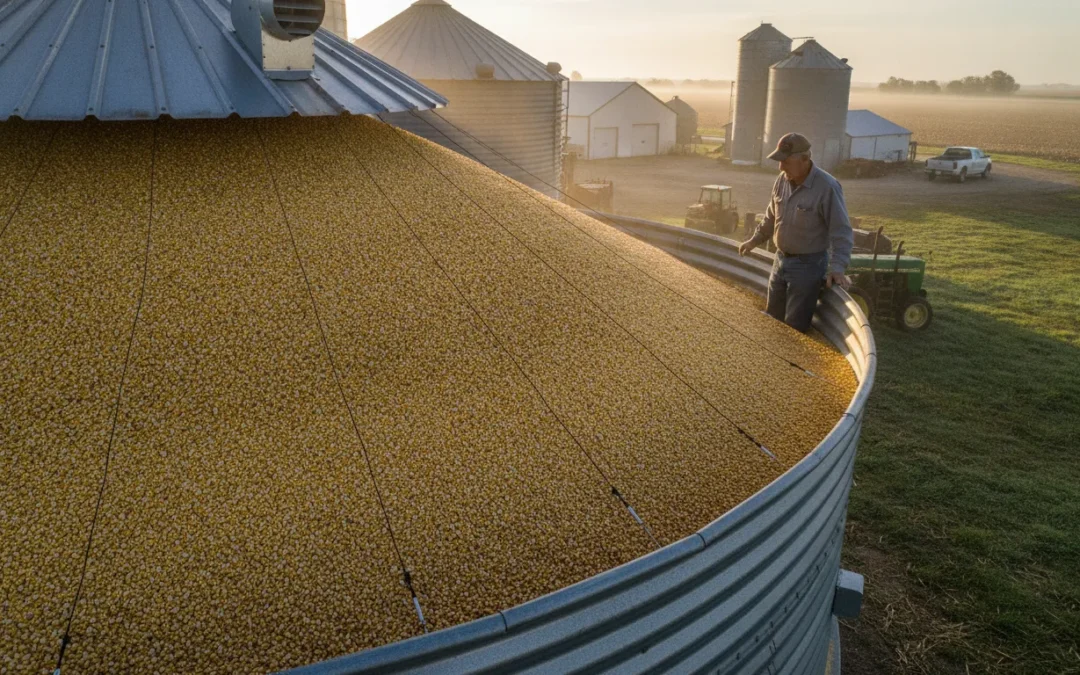
Stored corn does not fail all at once. A small temperature change, a developing hot spot, or a missed moisture problem can turn into quality loss before the grain looks different from the outside. The right monitoring setup gives you earlier information and a clearer response plan, without treating sensors as a substitute for inspections or sound aeration decisions.
Talk with Farm Shop MFG about grain monitoring.
The best grain bin sensors for corn monitor grain temperature across meaningful locations, help you track changes over time, and give you information to guide inspections and aeration. They should fit your bin, your monitoring routine, and the level of response you can manage.
Start by deciding what readings matter most, how much coverage your bin actually needs, and who will act when a reading changes. Temperature is the practical starting point because it supports quality control and helps determine aeration needs, but placement and blind spots matter just as much.
What Should Grain Bin Sensors for Corn Monitor?
Short answer: Grain bin sensors for corn should track grain temperature at each probe. They should show changes over time and give you useful context for deciding when to inspect or consider aeration. Moisture readings can add context, but no sensor replaces representative moisture checks, surface inspections, or crop-specific storage guidance.
Temperature comes first
Temperature is the clearest early warning signal most on-farm monitoring systems can provide. USDA-ARS describes grain-temperature monitoring as a management tool for quality control and says temperature helps determine aeration needs. NDSU Extension also advises keeping stored grain as cool as possible during summer to extend storage life and limit insect activity. Summer warming can contribute to insect infestations and mold growth.
That does not mean one reading proves the entire bin is safe. A sensor reports the grain around its location. Readings should be interpreted alongside probe placement, recent weather, grain condition, and your inspection routine.
Moisture context matters
Temperature changes are easier to act on when you understand the moisture situation. Moisture can affect whether aeration is conditioning grain or causing unwanted moisture movement and reconditioning work. Use current readings, crop-specific references, and local extension recommendations rather than applying one universal temperature or moisture threshold to every bin. A monitoring system should help you ask better questions: Is this change isolated? Is the grain warming after a weather shift? Does the surface or headspace show a matching problem?
For a practical checklist covering moisture checks, aeration timing, and inspections, see how to prevent spoilage in on-farm storage.
Trends and response signals
A single number is less useful than a trend. Look for a probe that rises relative to its earlier readings, a difference between nearby locations, or a pattern that persists after conditions change. Those signals tell you where to investigate before a small problem spreads. Temperature monitoring informs the decision, while fan operation remains a separate control step. The goal is not to automate every judgment. It is to give the person responsible for the bin timely information and a clear reason to inspect, verify, and respond.
NDSU notes that insect reproduction is reduced below about 60 F, but that figure is a qualified reference point, not a universal safe-storage rule for every corn bin. Storage history, moisture, crop condition, and local conditions still matter.
How to Choose Grain Bin Sensors for Corn Storage
The best sensor setup starts with the decision you need to make. If your priority is finding temperature changes inside stored corn early enough to inspect the bin or evaluate aeration, temperature monitoring should be the foundation. USDA-ARS describes grain-temperature monitoring as a management tool for quality control and says temperature helps determine aeration needs.
Match the sensor design to the bin
Traditional systems commonly use thermocouples integrated into supporting cables suspended through the bin. This approach gives you measurement points at established locations and can fit well when the bin already has cable infrastructure. Before choosing a replacement or new system, review cable condition, sensor spacing, reading access, and whether the layout gives useful coverage for the grain volume you actually store.
Probe-based systems take a more modular approach. Probes can be placed at selected locations and read as individual points, which can make it easier to follow a change at one part of the grain mass. Farm Shop MFG describes Grain Temp Guard as a grain-bin temperature monitoring system that uses probes. For a practical overview of grain bin temperature cable placement, look at the physical layout before comparing features.
| Sensor approach | What it measures | Best selection question |
|---|---|---|
| Cable thermocouples | Temperature at fixed points along suspended cables | Does the existing cable layout cover the stored grain well? |
| Probe-based monitoring | Temperature at selected probe locations | Can you place and review probes where decisions depend on change? |
| CO2 or humidity concepts | Additional indicators of storage conditions | Will the extra signal support a defined inspection or response plan? |
| Combined setup | Temperature plus other condition signals | Can the operator interpret the readings without confusing signals? |
Use extra signals carefully
CO2 or humidity monitoring may add context when the operation has a clear reason to track those conditions. They should supplement, not replace, temperature readings and physical inspection. A new signal is only useful if someone knows what change matters, how to verify it, and what action follows. Avoid buying a sensor because it produces more data than the farm can use.
Coverage matters as much as sensor type. NDSU notes that cable sensors measure the grain next to each sensor, while grain’s insulating properties can allow temperatures to differ only a few feet away. Choose a system that supports the bin’s layout, your inspection routine, and your ability to act on trends. Monitoring informs the decision; it does not operate the fan or guarantee uniform grain conditions.
Where Sensor Coverage Falls Short in a Corn Bin
Grain bin sensors for corn are useful because they give you a view into a stored grain mass you cannot inspect from the outside. They are not a complete map of every bushel. A reading is a signal to interpret alongside probe location, recent weather, grain condition, and what you observe at the bin surface.
A cable measures a point, not the whole grain mass
NDSU Extension makes the limitation clear: cable sensors measure the temperature of the grain next to each sensor. Corn also acts as an insulator, so the temperature may be different only a few feet away. That creates a blind spot when a developing hot spot sits between sensor locations or outside the monitored area.
This is why placement deserves more attention than simply counting probes. Consider where grain is likely to vary, including the center, outer edges, and areas affected by fines, uneven filling, or airflow. The goal is not to pretend that a sensor sees everything. The goal is to place useful checkpoints and recognize what remains outside them. For more planning detail, see this guide to grain bin temperature cable placement.
Insulation can hide a developing problem
A stable reading at one sensor does not prove that every nearby section is stable. Grain insulation can slow the movement of temperature changes, and a localized condition may develop before it appears at another probe. Watch for changes over time instead of treating one number as a pass-or-fail verdict.
Surface and headspace checks add another layer of awareness. Look for condensation, crusting, unusual odors, bridging, or other visible changes when conditions and safety procedures allow. These observations can point to a problem that the current sensor layout does not capture directly. Do not enter a bin to inspect it without following proper grain-bin safety procedures.
Use readings to support a decision
Temperature monitoring is a management tool for quality control and can help determine aeration needs, according to USDA Agricultural Research Service guidance. It is decision support, not a guarantee that corn is safe or that aeration will produce the same result in every bin. Use current readings with crop-specific information and local extension recommendations when reviewing safe corn storage temperature ranges. That approach keeps the sensor useful without turning a limited measurement into a universal storage claim.
How Often Should You Check Corn in Storage?
There is no single inspection schedule that fits every corn bin. The right rhythm depends on the condition of the grain, the bin, the season, recent weather, and what your readings are doing over time. A sensor check is most useful when it becomes part of a repeatable management process, not a one-time glance at a number.
Build a trend, not just a reading
Review temperature readings consistently enough to recognize a change from the previous record. A steady trend across several readings can tell you more than an isolated value. Note which probe or location changed, how quickly it changed, and whether nearby readings show the same pattern. The USDA Agricultural Research Service describes grain-temperature monitoring as a management tool for quality control and identifies temperature as useful when determining aeration needs: USDA-ARS grain monitoring guidance.
Keep a simple record of readings, inspections, weather changes, aeration activity, and any corrective action. Records help separate a normal seasonal shift from a developing problem. They also give the next person checking the bin enough context to make a sound decision.
Use a routine that changes with conditions
Rather than putting every operation on the same calendar, use a baseline check routine and increase attention when conditions change. Pay particular attention after unusual weather, during seasonal warming or cooling, after filling, and when a reading moves differently from the rest of the bin. Include the grain surface and headspace in the inspection. Temperature monitoring is decision support, not a substitute for looking at the bin and considering the crop condition.
- Review the latest readings. Compare current temperatures with prior records and look for a rising trend, an unexpected difference between locations, or a reading that does not fit the surrounding pattern.
- Check the bin and its surroundings. Inspect the roof, vents, surface, odor, and visible grain condition when it is safe to do so. Look for signs that call for closer evaluation rather than assuming the sensor sees every part of the grain mass.
- Account for weather and season. Consider recent temperature swings, humidity, and changing outdoor conditions. Use crop-specific information and local extension recommendations when deciding whether aeration will condition or recondition the grain. See the guide to safe corn storage temperature ranges.
- Assign the response. Name the person responsible for reviewing the trend, inspecting the bin, documenting the decision, and escalating a concern. A reading is only useful if someone has clear ownership of the next step.
Keep monitoring separate from fan control. The data can inform an aeration decision, but the equipment and operating conditions still require their own review. This approach gives your team a practical way to protect grain quality without pretending that one universal schedule or threshold applies to every bin.
What Should You Do When a Sensor Shows a Problem?
A sensor reading is a signal to investigate, not a reason to make a rushed adjustment. Treat an unusual temperature as the start of a short response process: verify the reading, inspect the surrounding grain, check current crop-specific guidance, and then decide whether aeration or outside help is appropriate.
Verify the reading and inspect the area
First, compare the reading with nearby probes and with the recent trend. A single change may deserve attention, but a pattern across readings gives you more useful context. Check the probe location, confirm the equipment is communicating correctly, and record the time and conditions.
Then inspect the bin and the grain you can safely evaluate. Look at the roof and headspace for condensation, check for unusual odors, and examine the surface for crusting, caking, insects, or visible moisture. Because grain can insulate one area from another, a temperature change near one sensor does not describe every part of the bin. Use the reading to guide a closer inspection and identify hot spots in grain bins before deciding how broadly the problem extends.
Use guidance before choosing aeration
Do not apply one universal temperature rule to every corn bin. Use current readings, crop-specific references, and local extension recommendations to determine whether aeration is likely to condition the grain or create moisture reconditioning concerns. NDSU notes that insect reproduction is reduced below about 60 F. But that figure is a qualified example, not a guarantee that all grain is safe at one temperature. Grain condition, moisture, weather, and airflow still matter.
USDA-ARS describes temperature monitoring as a management tool for quality control and says temperature can help determine aeration needs. That does not mean the sensor should start the fan by itself. Monitoring supplies information for the operator’s decision. If the trend continues upward, the inspection finds spoilage indicators, or the situation is outside your experience, contact a grain-storage specialist or local extension expert before the problem spreads.
Keep monitoring separate from fan control
A monitoring system reports conditions inside the bin. Fan control is a separate function that determines when equipment operates. Keeping those roles distinct helps prevent an alert from being mistaken for an automatic correction. Review the evidence, choose the response that fits the crop and conditions, and document what happened so the next reading has useful context.
Is Grain Temp Guard a Fit for Corn Storage?
For a farmer storing corn on the farm, the right monitoring system should make bin conditions easier to see and decisions easier to explain. Grain Temp Guard fits that job when your priority is tracking grain temperature with probes. It helps you watch for changes and act before a developing problem turns into overdrying, moisture reconditioning, or avoidable quality loss. It is a monitoring tool, not a promise that every part of the grain mass is represented by one reading.
What Grain Temp Guard monitors
Grain Temp Guard is a grain-bin temperature monitoring system that uses probes to monitor bin temperature. That gives you a practical way to review conditions at the probe locations and follow changes over time. Temperature monitoring is useful for grain-quality management and for determining when aeration may need closer attention. But the reading still needs to be interpreted alongside the crop, current conditions, and what you see during bin inspections.
That matters with corn because a sensor is decision support, not a substitute for management. Use crop-specific guidance and current readings when deciding whether aeration will condition or recondition the grain. Farm Shop MFG’s guide to safe corn storage temperature ranges can provide additional context without reducing every storage decision to one universal number.
Battery life and ownership fit
Grain Temp Guard is listed with an 18-month battery life and no subscription. Those details may fit an operation that wants ongoing temperature visibility without adding a recurring service requirement. They also make ownership planning more straightforward: include battery replacement in the equipment calendar, assign someone to review readings, and establish what action follows a meaningful change.
The system is a good fit when you want temperature monitoring to be a defined part of your corn-storage routine. It may need to be paired with other inspection and aeration practices when your bins, crop conditions, or operating plan require more than temperature data alone.
Monitoring is not fan control
Keep the roles separate when planning the system. Grain Temp Guard measures and reports temperature through its probes. EndZone is the automated fan control option. It automates fan operation based on ambient conditions and works with Grain Temp Guard. But it is not the same product and Grain Temp Guard does not become a fan controller simply because the two can work together.
That distinction helps you build the right setup. Choose Grain Temp Guard when you need visibility into grain temperature. Consider EndZone when you also want automated fan operation. Together, they can support a more organized approach to monitoring and conditioning, while the final response should still reflect crop-specific guidance and the conditions in your bins.
Contact Farm Shop MFG to discuss your grain monitoring setup.
Frequently Asked Questions
What should grain bin sensors for corn monitor during storage?
Start with grain temperature, then watch how readings change by probe location and over time. Temperature monitoring supports grain quality control and helps inform aeration decisions, but a sensor is not a substitute for inspecting the bin surface, headspace, and trouble spots. NDSU advises keeping stored grain as cool as possible in summer to extend storage life and limit insect activity: NDSU Extension guidance.
How do you choose the right sensor system for a corn bin?
Choose based on bin size, probe coverage, how often you can check readings, and what action follows an alert. Traditional systems commonly use thermocouples integrated into suspended cables, while probe-based systems offer another way to monitor bin temperature. Ask where readings are taken and how easily you can compare trends across the bin before you buy.
Can grain bin sensors detect every problem in stored corn?
No. Cable sensors measure the grain temperature next to each sensor, and grain can insulate nearby areas enough for temperatures to differ only a few feet away. Use sensor readings alongside surface and headspace inspections, and follow crop-specific guidance from local extension resources. Treat the system as decision support, not a guarantee that every hot spot has been found.
How long will corn keep in a grain bin?
There is no single storage duration that applies to every bin. Corn condition at harvest, moisture, temperature, cooling, bin management, and changes during storage all affect how long it can remain in good condition. Use current readings and crop-specific extension recommendations rather than relying on a calendar promise.
Does Grain Temp Guard control the bin fan?
No. Grain Temp Guard monitors bin temperature with probes. EndZone is the separate Farm Shop MFG product that automates fan operation based on ambient conditions, and the two systems can work together. Grain Temp Guard is listed with an 18-month battery life and no subscription: see the product details.
Contact us About Your Grain Monitoring Setup
The right monitoring approach depends on your bins, stored crop, and the readings you need to track. Farm Shop MFG can help you discuss your grain monitoring setup and identify a practical next step for your farm.
Contact Farm Shop MFG to talk through your setup.