
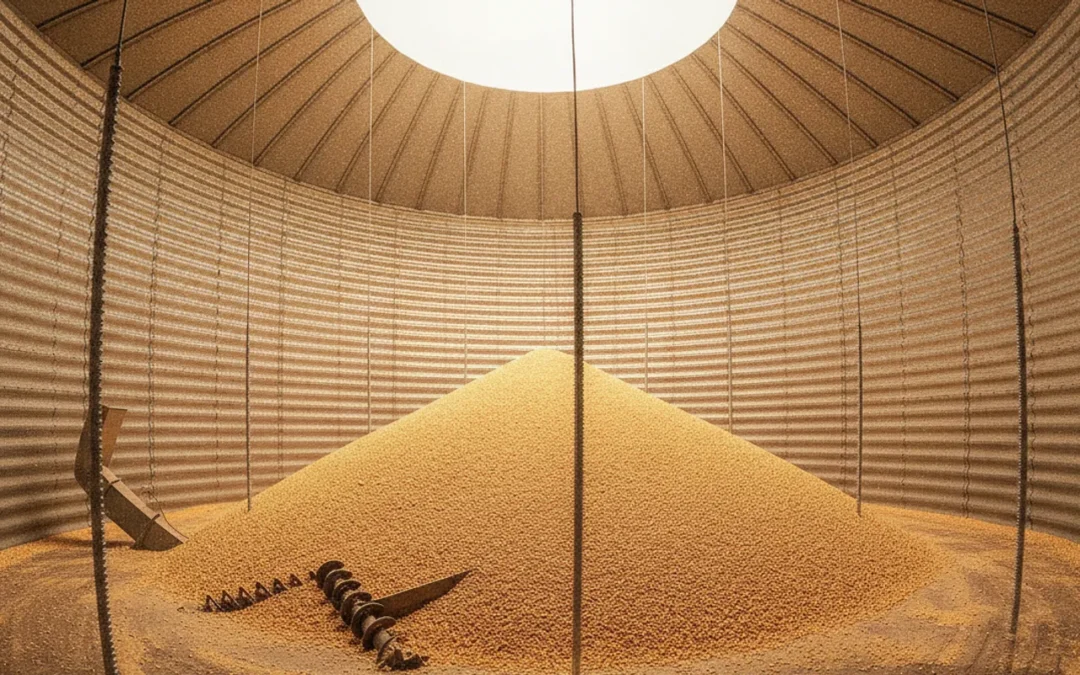
Knowing where to place grain bin temperature sensors matters because a reading from one spot cannot describe every part of a bin. Position sensors to sample different areas of the grain mass, including its center and outer zones, then use consistent readings over time to spot changes. The right layout depends on bin size, fill depth, airflow, and the monitoring system you choose.
See Grain Temp Guard monitoring options
Where to place grain bin temperature sensors for full-bin coverage
For a useful picture of conditions, spread sensing points across the bin instead of clustering them in one convenient spot. A common design uses vertical sensor cables or probe assemblies at separated positions, with sensing points at more than one level. That lets you compare conditions at different depths and across different parts of the grain mass.
Start with the areas your monitoring system can actually measure. A cable with multiple sensing points samples a vertical line through the grain. A point sensor samples the grain around its own location. Neither arrangement automatically covers the whole bin; placement and spacing determine how representative the readings are.
- Near the center: Include a vertical sensing line or point in the central grain mass where practical. It gives you a useful reference for comparison with outer locations.
- Between center and wall: Add coverage in the outer portion of the grain mass rather than relying on a single center reading. Changing conditions may not appear uniformly across the bin.
- At multiple depths: Use vertically distributed sensing points when the system supports them. Temperature can differ between the upper, middle, and lower grain layers.
- Across the bin: Separate cables or probes so that readings represent distinct zones. The number and layout should reflect the bin dimensions and the equipment maker’s installation guidance.
A published study describes point temperature and humidity sensors arranged vertically along cables, typically spaced 1.2 meters apart. That is an example of one research setup, not a universal spacing rule for every bin or product. Follow the sensor manufacturer’s specifications and account for your bin’s geometry and intended coverage. Read the study on three-dimensional grain-bin sensing.
Think of the layout as a sampling plan, not simply a hardware count. Imagine drawing a top-down view of the bin, then marking each sensor line. If all the marks fall near the center, the plan leaves the outer grain poorly represented. If the marks are spread out but all readings come from one height, the plan may miss vertical differences. A useful arrangement addresses both dimensions: where a sensor is across the bin and where its sensing points sit vertically.
How do bin size and shape affect sensor placement?
A larger bin holds a wider and deeper grain mass, so one sensing line is less likely to reflect conditions everywhere. As bin diameter and capacity increase, think in terms of coverage zones: center, mid-radius, and outer areas, with readings at different elevations where the equipment supports them. Use the manufacturer’s layout guidance to decide how many cables or point sensors are appropriate.
In a smaller bin, a compact layout may provide useful coverage, but do not assume that a single probe captures every relevant change. Consider whether the grain is stored at a consistent depth, whether filling or unloading patterns leave different zones, and whether the monitoring equipment can be safely installed in the locations you want.
Roof shape, access points, aeration equipment, and internal obstructions can affect where you can install hardware. Map the bin before installation. Mark the center, wall clearance, fill and unload paths, aeration components, and any structural members. Then compare that map with the sensor maker’s cable lengths, mounting instructions, and service requirements.
Bin geometry also affects how you interpret a sensor’s location. A probe positioned a set distance from the center is not the same as one placed near the wall, and neither represents every point in the zone between them. Avoid describing a sensor as monitoring an entire quadrant or ring unless the system’s design supports that claim. Record actual positions and use those labels when reviewing the readings.
If you are comparing approaches, our guide to grain temperature cables versus sensors explains the basic coverage tradeoffs. For a broader overview of choosing equipment, see what to compare in a grain bin monitoring system.
How many sensors or cables does a bin need?
There is no single count that fits every bin. Capacity alone does not determine the right number. The useful question is whether the installed sensing points sample enough distinct parts of the grain mass for the decisions you need to make.
Before selecting a count, write down the bin dimensions and how you use it. Note whether you need to monitor one crop or several, how full the bin usually is, how often you can check readings, and whether you need to compare temperature at different depths. Then ask the equipment provider how its system’s probes, cables, or sensors cover those conditions.
| Placement approach | What it samples | When it may fit | Key limitation to check |
|---|---|---|---|
| One central vertical cable | Multiple heights along one vertical line | A basic reference profile in a smaller or simpler setup | Does not directly sample separate zones toward the bin wall |
| Multiple spaced vertical cables | Different areas of the bin at several heights | Broader coverage across a larger or more variable grain mass | Confirm cable locations, sensing intervals, and installation requirements |
| Individual point sensors | Conditions around each installed point | A system designed for selected locations or retrofit constraints | Coverage depends on point count, spacing, and sensor depth |
| Temperature plus humidity sensing | Temperature and humidity at instrumented locations | When the equipment and monitoring plan use both measurements | Verify which measurements the particular system actually reports |
This comparison is about layout, not a guarantee that any configuration will detect every problem. Ask how many sensing points are included, where each reading comes from, what happens when a point is unavailable, and how the system displays readings by location and depth. A paper bin diagram labeled with probe positions can prevent confusion once the bin is full.
For example, a farmer considering two cables should not stop at asking whether two is enough. Ask whether the cables will sample separate parts of the grain mass, whether their sensing points cover useful heights at the usual fill depth, and how they will be identified in the display. Then compare that map with the actual bin dimensions. This turns a vague sensor-count question into a concrete coverage discussion.
Also check whether the sensing locations remain useful at partial fill. A point that is in grain when the bin is full may be exposed when the grain level falls. Find out whether that point continues to report a meaningful reading under those conditions and how the system indicates it. If you store different crops or change the usual fill level, include those operating conditions in the question you put to the equipment maker.
Where to place grain bin temperature sensors: near the wall, center, or roof?
Use different positions for different purposes. The center provides a reference through the grain mass, while spaced outer locations help you see whether a condition is localized or differs from the center. Avoid treating the roof or an empty headspace reading as a substitute for grain-temperature measurements: place sensing elements at the intended depths in the grain, according to the equipment’s instructions.
Keep probes and cables clear of equipment and structures that could damage them or interfere with safe operation. Do not improvise attachments or put a sensor where it can obstruct unloading or aeration. Check mounting, clearances, and any limits on contact with grain or bin components in the product manual.
A sensor close to one wall may represent only that area, not the entire outer ring. If you use multiple cables, spread them according to the intended layout instead of placing them side by side. In a bin with uneven fill or known operating differences, ask the equipment maker whether the standard arrangement should be adjusted.
There is a practical distinction between a sensor being physically near the roof and its sensing element measuring grain at a useful depth. Cable mounting may begin at the roof, but the points along it must be positioned as specified to measure the intended layers. Do not choose a location based only on what is easiest to reach from the roof opening. Confirm the complete installed position, cable length, and sensing-point locations before the bin is filled.
Air movement and grain movement are also part of the layout conversation. Aeration equipment may create operating zones that differ, and filling or unloading can change the grain profile. Sensors do not correct for those differences; they provide readings at their installed points. Keep notes about fan use, fill events, and grain removal so that later comparisons are made with the operating context in view.
How can you place sensors to find changing conditions?
Temperature monitoring is most useful when you have a baseline and can compare readings consistently. Record the location and depth of every sensing point during installation. When checking the system, compare like with like: the same zone and depth over time, as well as different zones at the same time.
- Draw the layout. Mark the center, wall, cables or points, and approximate sensing depths. Keep a copy with your bin records.
- Check initial readings. After the system is installed and operating, note the starting values and confirm each sensor is reporting from the expected position.
- Look for patterns. Compare neighboring points and changes over time. A difference between locations is a reason to investigate, not by itself a diagnosis.
- Connect readings to your routine. Keep records of grain condition, fill or removal activity, and aeration operation so you can interpret changing measurements in context.
- Act on the full picture. Follow your grain-management procedures and the monitoring system’s guidance. Do not rely on one reading alone to make a high-consequence decision.
A simple record makes this routine easier. For each bin, note the bin identifier, crop, approximate fill level, sensor labels, locations, depths, and date installed. In your readings log, keep the same sensor names used on the diagram. If the system calls a cable “B,” use “B” in your notes instead of switching between labels such as “north cable” and “second probe.” Consistent naming reduces the chance of comparing readings from different places by mistake.
When a reading changes, compare it first with that same point’s earlier readings, then with nearby points and corresponding depths elsewhere. Check whether the change lines up with a known event, such as filling, grain removal, or fan operation. If one value looks different, confirm the system is reporting and the sensor is functioning as intended before assuming the grain itself has changed. Take the difference seriously enough to investigate, but do not treat a single number as a complete diagnosis.
Sensor data can support timely checks, but it is not a substitute for safe inspection and sound storage practices. For a broader prevention plan, see how to keep grain from spoiling and our guide to grain-bin aeration and temperature management.
What placement mistakes make readings less useful?
- Relying on one point: A single reading says little about conditions in other areas. Add coverage appropriate to bin size and monitoring goals.
- Clustering sensors: Several sensors in nearly the same location may leave other zones unmeasured. Spread them to represent distinct areas.
- Ignoring vertical position: A reading at one level does not show how temperature changes higher or lower in the grain. Use multiple depths when supported by the system.
- Assuming a study layout is a product specification: Research spacing describes that study’s equipment and setup. It should not override a manufacturer’s instructions.
- Failing to label locations: Unlabeled readings are difficult to compare over time. Document cable names, sensor positions, and depths.
- Installing without planning for service: Consider safe access and maintenance before the bin is filled, and follow the manufacturer’s installation and safety guidance.
Another mistake is expecting readings to explain why a condition changed. A temperature sensor reports a measurement at its location; it does not tell you by itself whether a difference relates to grain condition, airflow, a recent operation, or a sensor issue. The next step is to check the reading against the rest of the system, your records, and the manufacturer’s guidance. A broader view helps prevent overreacting to one data point or overlooking a trend.
It is also easy to forget that sensors need to remain part of the maintenance plan. Before installation, ask how to confirm operation, what the system does if a point stops reporting, and what inspections or maintenance the manufacturer recommends. Keep product instructions with the bin records. If a cable or sensor is damaged or a reading seems implausible, use the manufacturer’s troubleshooting process rather than assuming a nearby point can replace it.
Grain bins are confined spaces and can present serious hazards, including engulfment and dangerous atmospheres. Never enter a bin to install, adjust, or inspect a sensor while grain is moving, and follow applicable safety procedures and qualified guidance. Plan installation from outside the bin wherever the system allows.
What should you check before choosing a layout?
Before buying or installing equipment, use a short checklist. It will help you compare systems based on useful coverage rather than sensor count alone.
- What bin capacity, diameter, and typical grain depth will the sensors cover?
- Does the system use point sensors, a cable with multiple sensing locations, or another arrangement?
- How many distinct areas and elevations can it measure in your bin?
- Can you identify each reading by its actual position in the bin?
- What are the mounting, power, communications, and maintenance requirements?
- How can readings be reviewed when you are away from the bin, and what alerts are available?
- Does the layout remain useful at the fill levels and crop types you actually store?
Make the checklist specific to the bin. For instance, take a photo or draw a plan that shows roof access, fill opening, aeration equipment, obstructions, and the path grain takes during loading and unloading. Add approximate dimensions and typical grain depth. This gives the equipment provider enough context to discuss a practical arrangement rather than answering with a generic sensor count.
Before installation, verify the proposed mounting point and cable route against the manual. Check where the cable will hang, how it will be secured, whether it remains clear of moving equipment, and how it can be serviced. Confirm that the sensing points will sit at useful levels for the grain depths you expect. If two bins differ in size or equipment, do not assume that the first bin’s layout can be copied without checking the second one.
Some systems transmit readings from sensors embedded in the grain to a base station outside the storage structure. That arrangement is one example of how readings may be collected; confirm the communication method and coverage of the specific equipment you are considering. See research on in-bin sensor data and a base station.
For product-specific questions, review how a grain bin temperature monitoring system works and remote temperature monitoring options. You can also compare costs in this grain bin monitoring system cost guide.
Contact us about your grain bin monitoring setup
Frequently asked questions
Can I use one temperature sensor for an entire grain bin?
One sensor measures conditions at its own location, not every area of the bin. A single sensor may offer a reference point, but broader coverage requires sensing locations that represent more of the grain mass. Ask the equipment maker what a given configuration can and cannot monitor.
Should grain bin temperature sensors be installed before filling?
Plan installation before filling when possible, because access and safe mounting can be simpler. Follow the system’s installation instructions and do not enter a bin with moving grain or take unsafe shortcuts. If the bin is already full, get qualified, product-specific guidance rather than improvising an installation.
How far apart should grain bin temperature sensors be?
Spacing depends on the system, bin geometry, and intended coverage. A research paper may describe one sensor interval, but that does not establish a universal spacing requirement. Use the manufacturer’s layout specifications for the equipment you install.
Are temperature sensors enough to manage stored grain?
Temperature readings are useful information, but they are only one part of grain management. Use them alongside your storage practices, grain condition records, and the monitoring system’s instructions. If readings change unexpectedly, investigate the cause and follow an appropriate management plan.
Choose sensor locations that match your bin
The best sensor layout is the one that gives you meaningful readings from the parts of the grain mass you need to monitor, with every location clearly identified. Map the bin, compare coverage at multiple positions and depths, and confirm the installation plan with the equipment maker before the season. A thoughtful layout makes readings easier to interpret and gives you a clearer basis for protecting stored grain.