
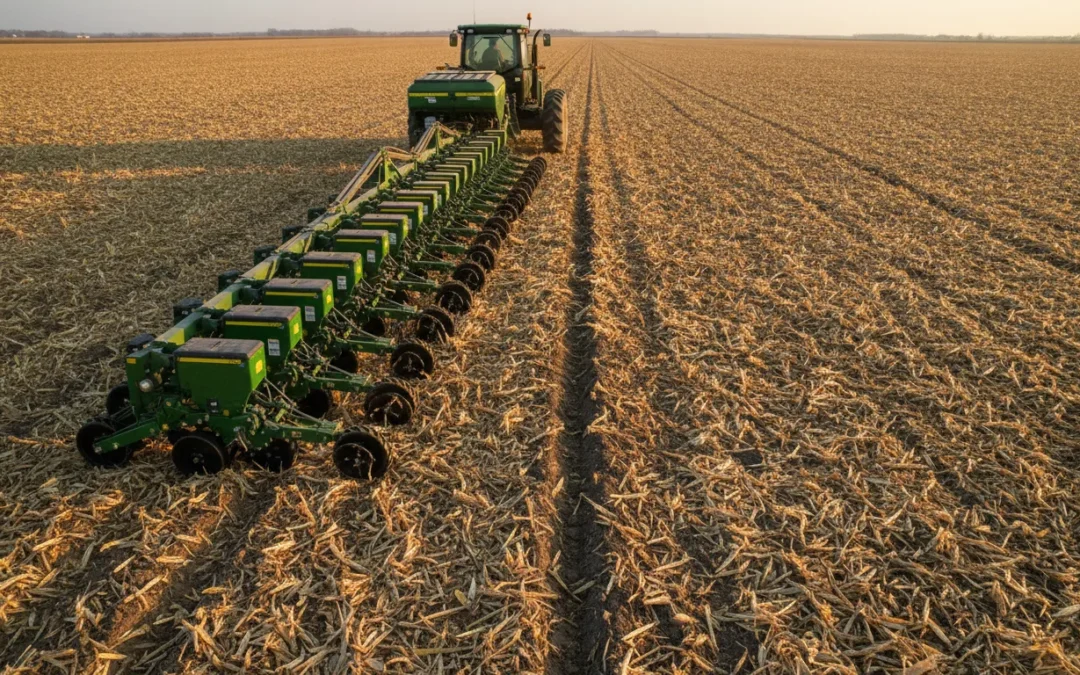
How to plant sorghum starts with a warm seedbed and a shallow, moist seed slot. The closing system should firm soil around a small seed without packing the trench shut. Grain sorghum can go in once soil at seeding depth is above 60 degrees F. An ideal depth is near 1.5 inches, with moist soil above the seed so the slot does not dry out. Kansas State University puts the practical depth window at 1 to 2 inches. Plant shallower than that and the seed can sit in dry, uneven soil. Plant deeper and emergence slows and stands thin out.
See how Germinator closing wheels firm the seed slot
The rest of the job is local. Population follows rainfall, row spacing follows the planter and header you already own, and the calendar follows the last freeze and the hybrid’s maturity. University of Georgia Extension and the United Sorghum Checkoff Program both treat seed-to-soil contact as the difference between a uniform stand and a field of skips. This guide stays on those planting decisions. It does not cover bin monitoring, winter storage checks, or fan control after harvest.
How to plant sorghum once the soil is warm enough
Soil temperature is the first gate. University of Georgia Extension says sorghum can be planted once soil temperature is greater than 60 degrees F. Kansas State agronomy guidance is a little tighter for reliable emergence. Plant when the soil at seeding depth is at least 60 degrees F, and preferably 65 degrees F or higher. A cold snap after a calendar date that “looks right” will still stall a small seed.
Check the temperature at seeding depth in the morning for several days. One noon reading on the warmest ridge is not enough. The Kansas Crop Planting Guide shows why a single statewide date fails. Suggested sorghum windows run about May 15 to June 10 in the northwest and May 15 to June 20 through the central zones. Southeast Kansas uses a split early-May or early-June window. The earlier end of a spring range fits southern and eastern ground. Northern and western fields wait.
Oklahoma State’s grain sorghum production calendar is built for May and June planting on irrigated or dryland fields. Double-crop or late sorghum starts in July so pollination falls after the hottest part of August. That calendar is a planning tool, not a planting prescription. Match the hybrid maturity to the frost-free days you actually have, then move the rate, not the depth, if you are late.
Kansas State recommends raising the seeding rate 15 to 20 percent when planting after the local optimum window. Late plants tiller less, and the tillers they do make are less likely to finish a productive head. Do not “fix” a late start by burying seed deeper to chase moisture that is not there. Wait for a warm, moist slot or switch hybrids.
Set depth and seed-to-soil contact before you set the rate
Sorghum seed is small. University of Georgia Extension calls 1.5 inches the ideal depth, and says to place seed so about 0.25 inches of moist soil sits above it when you can. The same guide says the last tillage pass should leave the surface level and firm so seed lands at one depth with soil packed around it. In reduced tillage or no-till, the same rule holds: even spacing and real seed-to-soil contact, with weeds dead before the planter rolls.
Kansas State puts the working depth at 1 to 2 inches. The seed needs uniform moisture and temperature, and it still has to emerge. A slot that is packed shiny on the sidewalls, or left open to the air, wastes that placement. Farmers who want the mechanics of that contact, separate from this crop, can read how closing wheels affect seed-to-soil contact and how closing-wheel pressure changes furrow closure in wet soils.
Farm Shop MFG builds the Germinator closing wheel for that slot. The wheel uses an inner-rim shoulder firmer to pull soil around the seed. The company designs it to work in conventional till and no-till.
On the Germinator product page, Farm Shop cites corn yield gains of up to 5.1 bushels per acre versus older rubber wheels. Soybean gains on that page are up to 2.5 bushels per acre. The same page cites a Precision Planting 2023 comparison: 13 bushels in no-till and 7 bushels in conventional till. Those figures are corn and soybean results, not sorghum trials. The planting lesson that transfers is the slot. Sorghum fails the same way when air pockets or smeared sidewalls keep a small seed from taking up water evenly.
Use the right seed disk or plate. University of Georgia Extension warns that the wrong plate creates skips and doubles, which no population chart can repair after the seed is in the ground. If the meter is right and the stand is still uneven, look at depth, residue hairpinning, and closing pressure before you add seed.
Choose a population from rainfall, not from the neighbor’s corn chart
Sorghum compensates. It can add tillers, change seeds per head, and change seed weight. Kansas State notes that seeds per head is the yield component that moves the most. A stand can miss the target by about 25 percent and still yield well. That forgiveness has a limit. Too many plants in a dry year make fewer fertile tillers and thinner stalks. Too few plants in a wet, high-yield year cap the crop because the heads cannot make up the missing stand.
Kansas State published a 2026 seeding-rate table that assumes about 70 percent field emergence. It is the cleanest public range to start from. The original table is in Kansas State’s sorghum seeding-rate eUpdate.
| Average annual rainfall. | Seeding rate, seeds per acre. | Target stand, plants per acre. |
|---|---|---|
| Under 20 inches. | 30,000 to 35,000. | 23,000 to 27,000. |
| 20 to 26 inches. | 35,000 to 64,000. | 25,000 to 45,000. |
| 26 to 32 inches. | 50,000 to 80,000. | 35,000 to 55,000. |
| Over 32 inches. | 70,000 to 125,000. | 50,000 to 90,000. |
| Irrigated. | 110,000 to 150,000. | 80,000 to 110,000. |
University of Georgia Extension uses a tighter irrigated and high-yield band: 50,000 to 60,000 seed per acre for a goal of about 85 to 145 bushels. Treat that as a humid-South starting point, not a High Plains rate. If your field sits on the dry side of a rainfall band, use the low end. If you are planting after the optimum window, add the 15 to 20 percent Kansas State suggests. Then confirm the meter drop on a measured length of row before you fill the boxes.
Count emerged plants, not just the monitor population. A 70 percent emergence assumption means a 50,000-seed drop is planned as roughly 35,000 plants. If you are well under that and the seed is still sitting in an open or smeared slot, the fix is the planter, not another bag of seed. Signs that closing wheels are not keeping soil contact walk through the field symptoms.
Match row spacing to the planter you will actually run
Row width is an equipment decision as much as an agronomy decision. University of Georgia Extension says spacing can vary with tillage and with the planter and header on the farm. Kansas State favors narrower rows when the goal is faster canopy, less early evaporation, and better light capture, as long as the seed is still placed evenly.
The same Kansas State table turns a target stand into within-row spacing. You can check the meter without a calculator in the cab. At 70 percent emergence, a dryland drop of 30,000 to 35,000 seed sits about 7 to 6 inches apart on 30-inch rows. An irrigated drop of 110,000 to 150,000 seed tightens that to about 2 to 1 inch. Those are spacing checks, not a reason to change row width the week of planting.
If you already run 30-inch rows for corn, sorghum can follow that planter. Do not invent a narrow-row setup you cannot harvest. Do confirm that each row unit holds depth in residue. A unit that rides up on clumps changes depth by half an inch, which on a 1.5-inch target is the difference between moist soil and a dry cap.
Speed belongs in the same pass. Planting speed and closing-wheel adjustment covers how a faster pass changes the slot. Sorghum has less seed reserve than corn, so a bounce that doubles or skips is expensive even when the acre average looks right on the monitor.
Use the field and the fertilizer placement that the seed can tolerate
University of Georgia Extension wants well-drained ground with a pH from 6.0 to 7.8. The field should be clear of live weeds and of herbicide carryover. The Georgia grain sorghum quick guide says not to plant where Reflex, Envoke, Brake FX, Staple LX, or similar products were used. Read the label for the product you actually applied. A planting guide cannot clear a carryover restriction.
Nitrogen planning in that Georgia guide is about 1.2 pounds of N per bushel of yield goal, minus residual soil nitrogen. A 120-bushel goal is 144 pounds of N per acre before the credit. Phosphorus maintenance is listed at 60 to 80 pounds of P2O5, and potassium need is described as similar to nitrogen. On sandy ground, split N and K so a heavy rain does not move them past the roots.
Placement matters more than the rate at planting. Georgia’s guide says no more than 8 pounds of N plus K should go in the seed furrow. Fertilizer is better placed at least 2 inches away from the seed. Kansas State’s sorghum management handbook makes the same point for starters. Place them beside and below the seed. Never use a heavy band in contact with the seed, and keep thiosulfate out of direct seed contact. A small sorghum seed in a salty furrow is a stand loss you will not see until the row is missing.
Water demand is moderate, not optional. The Georgia quick guide estimates 18 to 28 inches total to reach yield potential, and about 70 percent of the water corn would use in the same environment. One timely irrigation can still move yield. That is a reason to keep population inside the rainfall band, not a reason to plant into a dry, loose slot and hope for rain to close it.
Run a short planter checklist on the first pass
Set the planter in the field you are planting, not on the shop floor. Confirm soil at depth is at least 60 degrees F and preferably 65. Set depth near 1.5 inches, inside the 1 to 2 inch window, and dig behind the row unit every time conditions change. You want moist soil over the seed and no open trench.
Then check four things before you plant the rest of the field:
- Meter and plate. Seed spacing matches the rainfall band, with no systematic skips or doubles.
- Gauge wheels and row-unit downforce. Depth stays even through residue and wheel tracks.
- Closing wheels. Soil is firmed around the seed without a smeared sidewall or a trench that reopens as it dries. The Germinator closing wheel guide and the Germinator product page show the shoulder-firmer design Farm Shop uses for that job.
- Alignment and wear. A unit that toes out or a worn bushing will vary depth down the row. A closing-wheel alignment check is the fast version of that inspection, and planter maintenance before the season covers the parts that drift out of spec between years.
Stop after a few hundred feet and dig. If seed depth varies by more than about a quarter inch, or the slot is open, fix that row before you chase the population chart. Sorghum will tiller its way through a modest stand miss. It will not forgive a dry pocket around the seed.
Farm Shop MFG builds the Germinator in Iowa for row-crop planters and sells it direct. If you want help matching a wheel to the planter you run, call (712) 520-6051 or start from the product page above. Keep hybrid choice, herbicide carryover, and local population with your extension agronomist and the seed label. Those change by county and by the chemical program already on the field.
Frequently asked questions
How warm should the soil be before planting sorghum?
Plant when soil at seeding depth is above 60 degrees F. Kansas State prefers 65 degrees F or warmer for more reliable emergence. Check in the morning at planting depth, not at the surface on a sunny afternoon.
How deep do you plant sorghum seed?
Aim for about 1.5 inches, inside a 1 to 2 inch range. Place seed into moist soil, with roughly a quarter inch of moist soil above it when that is possible. Deeper planting slows emergence. Shallower planting leaves seed in dry, uneven soil.
How many sorghum seeds per acre should you drop?
Match the drop to rainfall and assume about 70 percent emergence. Kansas State ranges from 30,000 to 35,000 seeds per acre where annual rainfall is under 20 inches, up to 110,000 to 150,000 under irrigation. Raise the rate 15 to 20 percent if you are planting after the local optimum date.
Does row spacing change how you plant sorghum?
Yes, but only within the planter and header you can run well. Narrower rows can close the canopy sooner. A 30-inch planter is still a valid sorghum planter if each row holds depth and the closing wheels firm the slot. Check within-row spacing against your target population before you change the rate.
Why does seed-to-soil contact matter more for sorghum?
The seed is small and has little reserve. An open trench, a smeared sidewall, or an air pocket lets moisture reach some seeds and miss others, so the stand emerges unevenly. Firm soil around the seed at a uniform depth matters as much as the population on the monitor.
Questions about closing wheels for your planter? Call Farm Shop MFG at (712) 520-6051 or review the Germinator closing wheels before you set the planter.