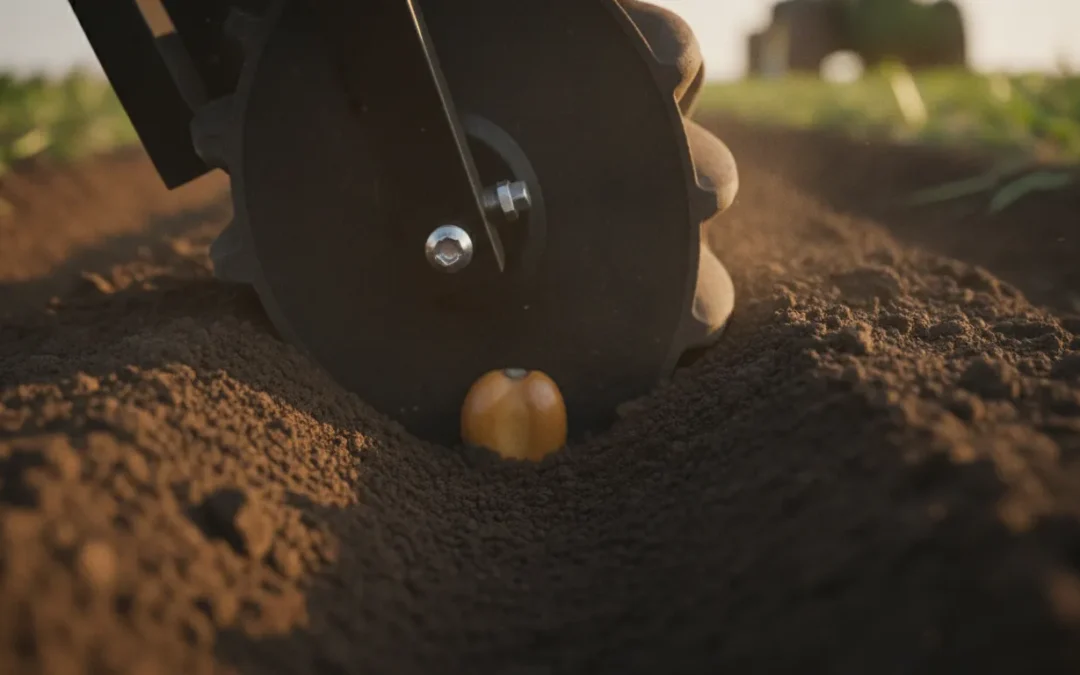
A planter can place every seed at the right depth and still deliver an uneven stand if the furrow is not closed consistently. Air pockets, exposed seed, and compacted sidewalls interrupt the moisture bridge a seed needs to start germinating. The result is not just a messy emergence pattern. It can mean plants developing at different rates and less ability to reach your yield potential.
Closing wheels seed to soil contact matters because firm, uniform contact helps transfer moisture from the surrounding soil to the seed. The right wheel design closes the trench without creating excessive pressure, reduces air gaps, and supports more even stand establishment across changing field conditions.
The goal is not simply to cover the trench. It is to create a consistent seed environment row after row, while managing the sidewall compaction left by the opener. This guide explains the mechanics behind that process, then connects them to field-tested closing wheel design. For a broader equipment overview, see our Germinator Closing Wheels: Ultimate Planter Guide.
What Is Seed-to-Soil Contact and Why Does It Matter?
Seed-to-soil contact is the physical connection between the surface of a planted seed and the soil particles surrounding it after the seed trench is closed. A well-closed trench leaves the seed pressed into a consistent soil environment, without large air gaps or loose pockets around the seed. That connection is one of the basic requirements for a uniform stand.
The mechanism is straightforward. Soil pores hold water, and when the seed coat touches moist soil particles, water can move across that contact area and begin imbibition, the first stage of germination. The USDA Agricultural Research Service describes seed-soil contact as the long-standing practical standard for rapid water transfer from soil to seed. While also noting that water vapor in the soil atmosphere can contribute to the process. In the field, reliable physical contact remains a critical target, especially when the seed zone is drying.
That is where what closing wheels do matters. Their job is not simply to make the trench look closed from above. They should bring soil back around the seed, eliminate open voids, and leave the seed at a consistent depth. If the trench closes unevenly, one seed may be surrounded by moist soil while another sits beside an air pocket or in a different moisture zone.
Why moisture uniformity drives emergence
Purdue identifies uneven soil moisture at seed depth as the most frequent cause of uneven emergence, with the potential to reduce yield. Iowa State Extension likewise explains that uniform corn germination and emergence depend on managing soil moisture and seed depth. Closing wheels cannot correct every planting condition, but consistent furrow closure helps preserve the environment the planter created.
Good contact also gives the seed a better buffer against normal fluctuations in soil moisture and temperature during early germination, according to Purdue. That does not mean planting into soil that is too wet. Purdue warns that soil at field capacity can be too wet for planting because openers and closing wheels may create furrow compaction. The goal is a closed, firm seed zone at the right moisture, not maximum pressure in every condition.
For a deeper look at the equipment and setup decisions behind this process, see the Germinator Closing Wheels: Ultimate Planter Guide.
USDA-ARS source | Purdue source | Iowa State source
How Closing Wheel Design Affects Seed-to-Soil Contact
Closing wheels have one job after the seed drops: create consistent contact without sealing the furrow so aggressively that roots face another barrier. That requires the right spacing, material, shoulder shape, and down pressure. Proper pressure closes the seed trench, keeps the seed from drying out, and maintains the moisture needed for germination. Farm Shop MFG explains the Germinator design and how it addresses sidewall compaction.
| Design factor | What it changes in the furrow | What to look for |
|---|---|---|
| Wheel spacing | A 2 to 2.5 inch gap between wheel centers concentrates force down the sidewalls instead of leaving the trench open. | Closure that firms the seed zone while avoiding a hard, continuous sidewall. |
| Wheel material | Premium 50-grade steel maintains a more consistent working edge and pressure than plastic over repeated acres. | Durability and uniform closure across the full planting season. |
| Inner-rim shoulder | The shoulder engages the furrow near the seed and helps break down the sidewall rather than simply pressing soil inward. | Mechanical action that works across silty clay loams, loams, and sandy soils. |
| Down pressure | Too little pressure leaves air around the seed. Too much pressure can create compaction, especially when soil is too wet. | Adjustable pressure matched to soil moisture and field conditions. |
Spacing and shoulder geometry work together
Spacing determines where force is applied, but the inner-rim shoulder determines how that force moves soil. A properly designed wheel can shatter sidewalls across diverse soil types, improving closure without creating a new root-penetration problem. Check the furrow behind the planter. You want a closed trench and firm seed-zone contact, not a polished, compressed slot.
Material determines consistency over acres
Yetter Twisters use plastic UHMW, which can wear as acres accumulate. Farm Shop MFG specifies premium 50-grade steel for the Germinator, with stated durability of three to five times that of plastic alternatives. That consistency matters because a wheel that changes shape or working edge during planting can change contact pressure row by row.
Price is also part of the equipment decision. Precision Planting FurrowForce is listed at $1,208 per row, compared with $212 per row for Germinator. The right comparison is not just purchase price. It is whether the wheel maintains the pressure and furrow closure your soil requires, season after season.
What Happens to Germination When Seed-to-Soil Contact Is Poor?
Poor contact creates several problems in the same seed trench, and each one can widen the gap between your best plants and your weakest plants. The result is not simply a slower start. It is an uneven stand that is harder to manage through the rest of the season.
Air pockets interrupt moisture uptake
When the furrow does not close firmly around the seed, air pockets can remain between the seed and surrounding soil. Those pockets reduce the seed’s access to moisture, which can delay germination or prevent it from starting uniformly. Farm Shop MFG identifies air pockets as a direct cause of uneven and delayed emergence. Proper closure keeps the seed in contact with soil that can supply the moisture needed during the first stages of germination.
A loose furrow can also allow moisture to escape more quickly. Seeds near the surface may dry out before they absorb enough water to germinate, especially when conditions turn warm or windy after planting. Closing wheel pressure has to match the soil condition. Purdue notes that soil at field capacity is too wet to plant without creating furrow compaction problems from disk openers or closing wheels. So forcing a wet seed trench closed is not the answer either: timing and adjustment matter.
Sidewall compaction restricts early roots
Disk openers can compress the soil along the sides of the furrow. If that sidewall remains smooth and hard. Emerging roots may struggle to penetrate it and can be forced to grow along the trench instead of moving into the surrounding soil. That restricts access to water and nutrients just as the plant is establishing its root system. Addressing sidewall compaction requires a closing wheel that breaks the compressed layer while closing the furrow.
Uneven closure creates tiered emergence
Inconsistent furrow closure can leave seeds at different effective depths, with different amounts of soil contact and moisture around them. Some plants emerge on schedule while others germinate days later. This tiered emergence creates uneven plant size and competition within the row. Purdue describes uniform stand establishment as a prerequisite for reaching the yield potential of modern corn hybrids. In other words, closing wheels seed to soil contact is an early-season management detail with consequences that can carry into harvest.
When emergence is already uneven, correcting the stand after planting is difficult. The better opportunity is to create consistent contact and closure as the planter passes through changing field conditions.
How the Germinator Closing Wheel Maximizes Seed-to-Soil Contact
The Germinator closing wheel is built around a simple planting objective: close the seed trench while pressing soil into the seed zone, not just rolling the furrow shut. Its inner-rim shoulder-firmer design works from inside the trench, pushing soil around the seed and creating a more complete soil envelope. That helps limit air pockets and supports the consistent moisture environment needed for emergence.
Inner-rim engineering that closes around the seed
Many closing wheels focus primarily on bringing the trench walls together. Germinator’s inner shoulder adds a firmer point of contact where it matters most. As the wheel passes over the row, that shoulder helps fracture compacted sidewalls and encase the seed with soil. The result is a better-formed seed zone across changing field conditions, from silty clay loams to sandy soils.
That mechanical action matters because inconsistent closure can leave seeds at different effective depths or surrounded by air. The Germinator Closing Wheels: Ultimate Planter Guide explains how this design fits into the broader planter setup. Correct down pressure and field adjustment still matter, but the wheel must first be engineered to place soil where the seed needs it.
Field results and a faster payback
Third-party results support the design. Beck’s Practical Farm Research reported a 5.1 bushel-per-acre corn advantage and a 2.5 bushel-per-acre soybean advantage with Germinator closing wheels. A 2023 Precision Planting study also reported a 13 bushel-per-acre advantage in no-till and 7 bushels per acre in conventional till compared with rubber closing wheels. These figures are study results, not guarantees for every field, but they show why contact quality deserves attention.
Farmer experience points in the same direction. Todd Z. reported a 3.5 bushel-per-acre advantage in his first field and 5 bushels per acre in his second field compared with Yetter Twisters.
Germinator wheels cost $212 per row, compared with $1,208 per row for Precision Planting, making the upfront price about 6.7 times lower. Built from 50-grade steel, they are designed to outlast plastic wheels by 3 to 5 times. That combination of documented field performance, lower entry cost, and durability can create a faster first-season ROI for commercial farmers. Review the differences in closing wheel materials and see how the design supports Germinator closing wheel efficiency. For the full product line, visit the Germinator closing wheels page.
Field Data from Growers Who Upgraded Their Closing Wheels
Field results matter more than a parts catalog claim. Growers who upgraded to Germinator closing wheels report more consistent stands, stronger emergence across changing soils, and measurable yield differences. That consistency is the practical value of better closing wheels seed to soil contact: uniform depth and contact reduce emergence variance. Which is a key driver of bushels per acre.
Todd Z. saw the difference in two fields
Todd Z. of Parkston, South Dakota, compared Germinator wheels with Yetter Twisters on a 16-row planter. The first field showed a 3.5-bushel-per-acre advantage. In a second field, the advantage reached 5 bushels per acre. The value of the comparison is not that every farm will repeat the same number. It is that the improvement held across more than one field, giving a grower a practical before-and-after reference instead of a lab-only claim.
Emergence has to hold across soil changes
Dan Lewis reported improved emergence across variable conditions, from silt-loam ground to heavy clay. That matters because a closing wheel setup that performs in one soil can struggle when moisture and texture change. A more consistent furrow close helps maintain the seed environment as the planter moves through those transitions. Purdue identifies uniform stand establishment as a prerequisite for reaching a crop’s yield potential (Purdue Extension).
Durability protects the return
John M. reported that his Germinator wheels still looked new after 7,000 acres. That service life matters alongside stand counts. At $212 per row, a 16-row planter represents a $3,392 upgrade. A documented 3- to 5-bushel-per-acre advantage can make that investment a first-season ROI decision, depending on crop value and acres planted. Beck’s PFR has reported advantages of 5.1 bushels per acre in corn and 2.5 in soybeans, while a 2023 Precision Planting study reported a 13-bushel advantage in no-till. Use those figures as benchmarks, not guarantees, and judge the upgrade against your own fields, soil conditions, and stand counts.
Frequently Asked Questions
How can I improve seed-to-soil contact in my field?
Start with consistent planting depth, suitable soil moisture, and a closing wheel setup that seals the trench without over-compressing it. Inspect the furrow behind the planter for open slots, air pockets, and sidewall smearing. Soils at field capacity are often too wet for planting because openers and closing wheels can create furrow compaction problems, according to Purdue Extension.
Why is seed-to-soil contact important for stand establishment?
Good contact gives the seed a continuous path to moisture and helps create a more uniform germination environment. Air pockets can restrict moisture uptake, while inconsistent furrow closure can leave seeds at different depths and produce tiered emergence. Uniform emergence matters because optimal stand establishment is a prerequisite for reaching a crop’s yield potential, as Purdue research explains.
How do different closing wheel systems affect contact?
Wheel shape, spacing, material, and down pressure determine whether the system closes the trench, breaks up sidewall compaction, or simply presses the furrow shut. A properly matched system should create firm seed-to-soil contact while leaving enough loose soil for roots to expand. Check the result in your own fields across soil types rather than relying on the wheel label alone.
Are spiked closing wheels better than rubber wheels?
Not in every field or setting. Spiked designs can help fracture compacted sidewalls and improve closure, while rubber wheels may suit conditions where gentler pressure is preferred. The better choice is the system that produces a closed trench, consistent depth, and healthy root path at your operating speed and soil moisture. Evaluate emergence and stand uniformity after adjusting pressure.
Ready to improve seed-to-soil contact?
Closing wheel setup can influence furrow closure, moisture retention, and the consistency of your stand. If you are evaluating an upgrade for your planter, talk through your field conditions and equipment with the Farm Shop MFG team. Call Farm Shop MFG at (712) 520-6051 to discuss upgrading your closing wheels before next planting season.