
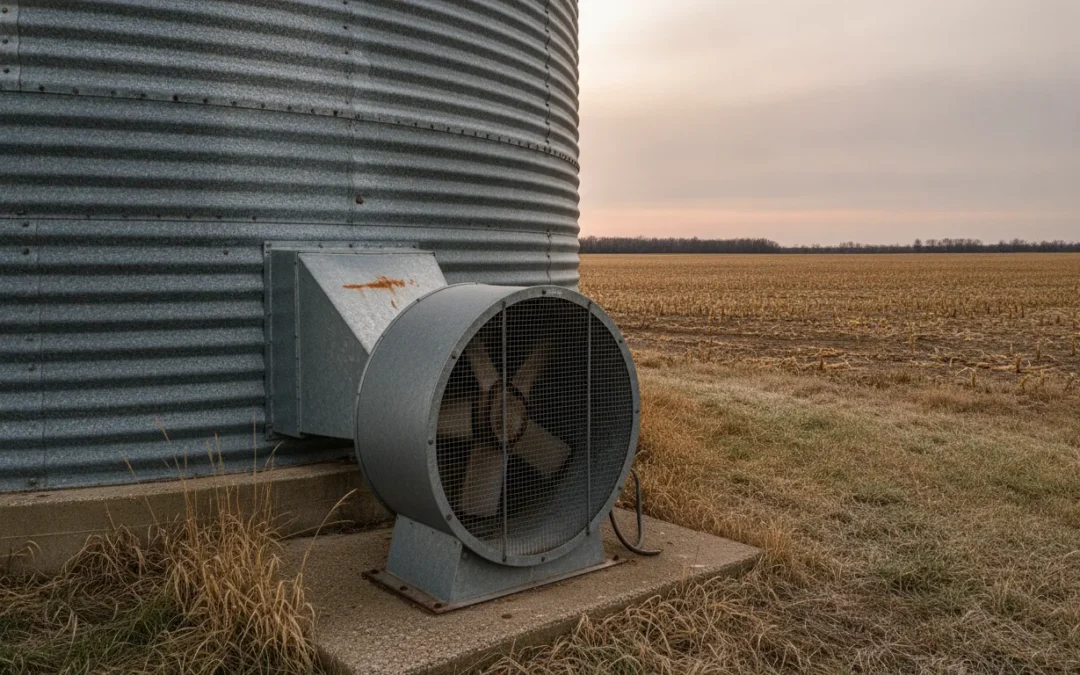
Automated bin fan control is a simple idea with a sharp edge. The controller runs the fan only when outside air is inside the temperature and humidity limits you set. That can protect moisture. It can also move the wrong air for days if the limits, the fan, or the bin do not match the job. Before you leave a fan on automatic, ask three things. What job is the fan doing? Which limits will you trust? What will you still check by hand?
Call (712) 520-6051 to talk through automatic bin fan controls
Farm Shop MFG builds EndZone for that job. The automatic bin fan controls use three modes: automatic, manual ON, and manual OFF. The box also keeps an hour count of fan run time. The questions below are the ones we walk through with farmers who already have a bin fan and want the fan to stop guessing.
What Job Should Automated Bin Fan Control Do?
Start with the job, not the gadget. A grain bin fan can dry, cool, hold moisture, or push air at a hot spot. Automated bin fan control does not pick that job for you. It only starts and stops the fan when outdoor air sits inside limits you choose. If two jobs need opposite air, one set of limits will serve one of them and fight the other.
Natural-air drying wants air that can pull moisture out of wet grain. Moisture reconditioning wants the opposite. You run the fan when the air can add a little moisture back. That is a common soybean problem after a dry harvest. Cooling stored grain wants air cooler than the grain, even when that air is not ideal for drying. Hotspot response is a fourth job. You move air because grain temperature climbed, not because the afternoon forecast looked perfect.
Name the main job for this bin before you set a single limit. Wet corn in fall is not the same call as dry soybeans you hope to bring toward 13 percent. Our grain drying versus aeration guide separates those two fan jobs if you are still deciding which one this bin needs.
Can one controller serve two jobs?
Yes, but not with one frozen set of limits. EndZone lets you change the high and low temperature limits and the high and low humidity limits. Farmers who dry in October and then hold grain through winter usually change those limits when the job changes. Leaving harvest drying limits in place through a cold snap is how a fan keeps running after the drying job is done.
Which Limits Should Automated Bin Fan Control Use?
The useful version of automated bin fan control is a fence around outdoor air, not a promise about final grain moisture. EndZone uses farmer-set high and low limits for outside temperature and relative humidity. In automatic mode it runs the connected fan only when conditions fall inside those limits. You still decide where that fence sits, and you should expect to move it when the job changes.
Ask four limit questions before you walk away:
- What is the hottest outdoor air you still want moving through this grain?
- What is the coldest air you will accept, knowing very cold air carries little moisture?
- What is the highest humidity you want during a drying pass?
- What is the lowest humidity you will allow if you are trying not to over-dry the bottom of the bin?
Those four numbers are the whole automatic decision. If you cannot say them out loud for this crop and this week, the controller has nothing honest to enforce. Copying a neighbor’s numbers is a weak start, because their fan size, grain depth, and harvest moisture are not yours.
Soybean reconditioning is the clearest published example of why the humidity limit matters. North Dakota State University Extension agricultural engineer Ken Hellevang says conditioning soybeans to 13 percent takes a narrow kind of air. During normal fall temperatures of 30 to 60 degrees Fahrenheit, he looks for an average relative humidity of about 70 to 75 percent. He also notes that air heats about 3 to 5 degrees as it goes through the fan, which drops relative humidity a little. Read the NDSU note on conditioning too-dry soybeans before you treat a humidity setpoint as a moisture guarantee.
How tight should the band be?
Tighter limits mean fewer run hours and slower progress. Wider limits mean more hours and more risk of moving air you did not want. A first season is a good time to write the limits down, then compare them with the hour counter after a week. If the fan barely ran, the band was tighter than the weather. If it ran through a wet night you meant to skip, the humidity ceiling was too high.
When Should You Override Automated Bin Fan Control?
Automatic is a mode, not a lock. EndZone also gives you manual ON and manual OFF. Ask when you will use each one before you need them at 10 p.m.
Manual ON is for a reason you can see and the limits do not know. You may want a short run after you move grain. You may also want to push air at a pocket you just found with a probe. Manual OFF is the stop button when the automatic band is wrong for today. A fast weather change belongs there. So does a fan that is icing, or a bin you decided not to dry this week. Automatic is the everyday mode once the limits match the job.
The override question is also a safety question. Do not use automatic mode to avoid walking the bin site. A controller cannot see a slipping belt, a blocked intake, or a roof vent packed with frost. If the fan sounds wrong, switch to manual OFF and look. Our grain bin fan ambient conditions guide covers how outdoor air changes the run-or-wait call when you are making that call yourself.
Does Automated Bin Fan Control Need a Grain Sensor?
Outdoor limits tell the controller about the air. They do not tell it that a pocket inside the bin is heating up. Ask whether this bin needs a grain alarm tied to the fan, or whether you will keep checking grain yourself.
EndZone can connect a Grain Temp Guard alarm so a connected fan responds when that alarm trips. The fan still waits until outdoor conditions are inside the limits you set. That pairing matters on bins where you cannot walk a probe through the grain every day. It does not replace the limits. If the outdoor air is outside your band, the fan stays off even if an alarm has sounded. That is intentional. Blowing wet or hot air at a hot spot can spread the problem.
Grain Temp Guard is Farm Shop MFG’s temperature and humidity monitoring system, with audible and visual alarms when grain leaves the target zone. Farmers who only want the fan to follow outdoor air can run EndZone alone. Farmers who want the fan to answer a hotspot need the alarm in the loop. See how the pieces fit on the Grain Temp Guard page.
What if you already check grain by hand?
Hand checks still count. A sensor pair is for the hours you are not at the bin. If you are at the site every day and the bin is small, manual checks plus automatic air limits may be enough. Settle the alarm question before harvest if the bin is large or you leave the farm for days.
Will Your Fan and Bin Let Automated Bin Fan Control Work?
A controller cannot invent airflow. Ask whether this fan, at this grain depth, can move enough air for the job you named. EndZone can help with natural-air drying and moisture reconditioning in corn and soybeans when the bin has adequate airflow. Grain depth, fan capacity, temperature, humidity, and airflow all change the result.
Hellevang’s soybean guidance is a useful yardstick, not a Farm Shop promise. He says conditioning works best in a drying bin with a fully perforated floor. The fan should deliver at least 0.75 cubic feet of air per minute per bushel. At that rate, moving a conditioning front through the bin can still take a month or more of fan operation. A smaller aeration fan, closer to 0.25 cfm per bushel, can take around 90 days. A cooling-sized fan will not recondition a deep bin just because a controller is now in the circuit.
Ask the fit questions in plain language:
- Is the floor fully perforated, or is air sneaking up one side?
- How deep is the grain compared with the seasons when this fan worked?
- Are you drying, cooling, or trying to add moisture?
- Can you leave the fan available for weeks, not one weekend?
If the honest answer is that the fan is too small, fix airflow before you automate. The grain aeration fan sizing guide is the place to check cfm per bushel. Automation will faithfully run a weak fan inside your limits and still miss the moisture target.
What Will Automated Bin Fan Control Not Do?
This is the question that saves a season. Automated bin fan control will not measure grain moisture or set your contracts. It also will not stop a fan that is moving unwanted air if the limits are stale. It will not turn a cooling fan into a dryer. It will not know that you filled half the bin with wetter grain this morning.
EndZone tracks fan run time with a built-in hour counter, and that number is part of the review. A fan that ran 4 hours in a week you expected 40 did not fail quietly. The weather never entered your band, or the band itself was wrong. A fan that ran every night through a humid stretch may have followed the limits perfectly while adding water you did not want. The counter is how you notice either case without living beside the bin.
On the EndZone product page, one soybean example shows why the stakes are large enough to ask these questions. Reconditioning 20,000 bushels from 10 percent toward 13 percent moisture could add about 54,000 pounds of water, roughly a semi load. The dollar result depends on price and on whether your fan and weather can actually finish that front. Treat that as a scale example, not a quote for your bin.
| Question to ask | What a good answer sounds like | What should make you pause |
|---|---|---|
| What job is this fan doing? | One job for this week: dry, cool, recondition, or answer a hotspot | Two opposite jobs sharing one set of limits |
| Which air limits will you set? | High and low temperature and humidity you can explain | Numbers copied from another farm or last year |
| When will you override? | Clear cases for manual ON and manual OFF | Automatic mode used to avoid looking at the fan |
| Do you need a grain alarm? | EndZone alone for air limits, or Grain Temp Guard if hotspots matter | Expecting outdoor limits to see a hot pocket |
| Can this fan move the air? | Airflow and a perforated floor match the job | A cooling fan asked to recondition a deep bin |
| What will you review? | Hour counter, limits, and grain checks on a set day | No plan to read run time after the first week |
How Should You Compare Crops Without Mixing the Jobs?
Corn and soybeans can both sit on EndZone, and they do not ask the same moisture question. Corn fans are often fighting over-drying in the grain the air hits first. Soybean fans are often trying to put moisture back after a dry harvest, or at least to stop giving it away. Automated bin fan control can serve either crop, but the limits should not be shared just because the controller is the same box.
Ask which crop is in the bin this week and which guide you will follow for the timing. The grain bin fan control notes for corn and the soybean fan control notes go deeper on those crops. Use them for timing. Use this page for the questions that apply before you trust automatic mode on either one.
A second comparison is bin size. Farm Shop MFG scales Grain Temp Guard alarms as bins get larger. A few thousand bushels may use one alarm. The largest bins use several. One EndZone still sits on the fan circuit. You do not need that whole table to make a control decision. You do need to ask whether one fan circuit is really what you have. A site with three bins and one controller on one fan is not automated bin fan control for the other two.
What Should You Review After the First Week?
The first week is a test of your limits, not a verdict on automation. Pick a day and read three things. Read the hour counter, recall the weather you had, and check grain low and higher in the bin.
- Write down the temperature and humidity limits that were set.
- Read the fan hour counter and note how many hours it ran.
- Compare those hours with the outdoor air you remember. Did the fan stay off through air you wanted?
- Check grain at the air inlet side. That is where over-drying or rewetting shows up first.
- Change one limit or leave them. Do not change all four at once or you will not know what helped.
If the bottom layer is dropping moisture faster than the rest of the bin, your humidity floor may be too low for a drying pass. If nothing moved, the fan may be short on air, or the band was so narrow that the weather never qualified. Both answers are useful, and neither one requires a new controller on day eight.
Keep the notes. Next fall you will not remember whether 55 degrees was your high limit or your wish. A short record beats a new argument in the yard.
When Should You Call Before You Automate?
Call before you buy time you do not have. Call if you cannot name the fan’s job or you do not know its airflow. Call too if you want a hotspot alarm and Grain Temp Guard is not in the plan yet. A short talk is cheaper than a season of the wrong limits.
Farm Shop MFG is in Armstrong, Iowa. The shop phone is (712) 520-6051, and the sales desk is sales@farmshopmfg.com. EndZone includes automatic, manual ON, and manual OFF modes, an hour counter, and the option to pair a Grain Temp Guard alarm. The product page lists the current price and a 30-day return if you send it back in like-new condition with the original packing. You pay shipping both ways. EndZone for Corn is a separate product aimed at corn moisture and over-drying. Ask which one matches the crop you store, and confirm the current price on the product page before you order.
Talk with Farm Shop MFG about your bin fan
Frequently Asked Questions
Does automated bin fan control dry grain by itself?
No. It starts and stops the fan when outdoor temperature and humidity are inside limits you set. Drying still depends on fan airflow, grain depth, and how many hours the right air is available. A controller will not make a small aeration fan finish a deep bin of wet grain.
Can I still turn the fan on when I want to?
Yes. EndZone includes manual ON and manual OFF as well as automatic mode. Use manual ON for a reason you can see. Use manual OFF when today’s air should not move, even if yesterday’s limits would have allowed it.
Do I need Grain Temp Guard for automated bin fan control?
Not if you only want the fan to follow outdoor limits. Add Grain Temp Guard if you want a grain alarm to call the fan when a hotspot trips. The fan should still run only while outdoor air is inside your limits. Outdoor limits alone cannot see a hot pocket in the bin.
How do I know the limits are working?
Read the hour counter after the first week and check grain where the air enters. The limits need a second look if the hours do not match the weather you expected. The same is true if the bottom layer is drying or rewetting faster than the rest.
Where do I see the EndZone controls?
The product details, modes, and current price are on the EndZone page linked above. If you want help matching limits to your bin, call Farm Shop MFG at (712) 520-6051.