
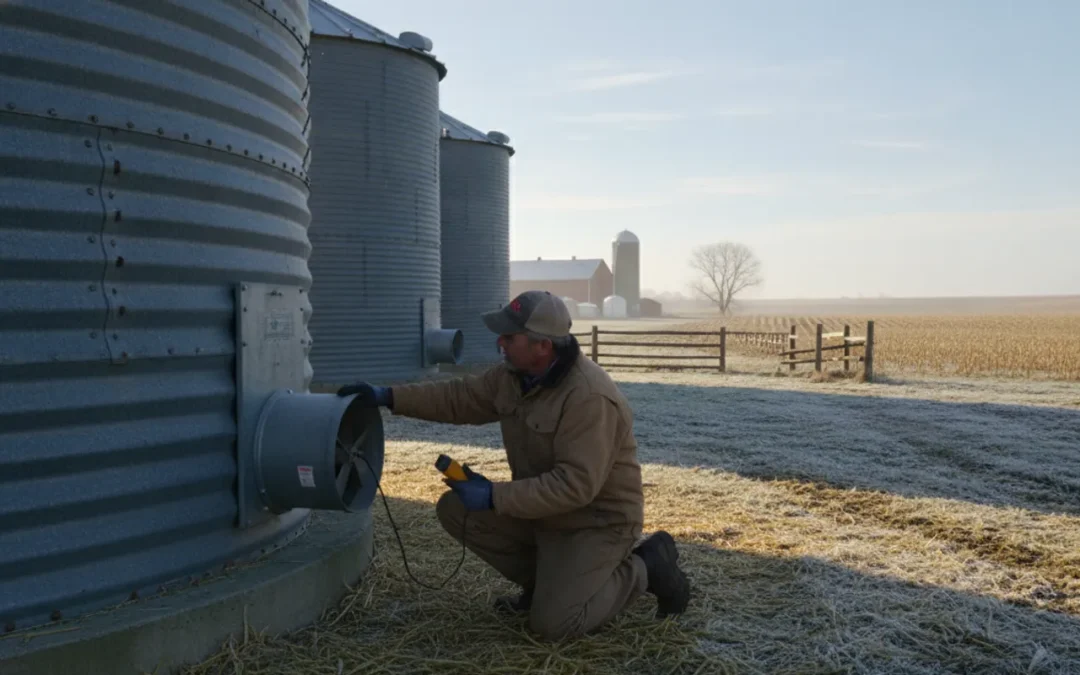
Grain bin fan ambient conditions affect whether aeration cools grain, moves a temperature front, or adds moisture instead of helping. The right decision depends on more than the outdoor temperature. Compare the air with the grain, consider the grain’s moisture and target, and use the fan for a defined purpose. A repeatable check is more reliable than running a fan simply because the weather feels cool or dry.
Contact us about your grain bin fan setup
What do ambient conditions tell you about a grain bin fan?
Ambient conditions are the temperature and moisture characteristics of the air outside the bin. They matter because a fan pushes that air through the grain mass. The air exchanges heat and moisture with the grain as it moves, and the result depends on the difference between the incoming air and the grain, the air’s relative humidity, the grain’s starting condition, and how long the fan runs.
That is why “run the fan when it is cool” is an incomplete rule. Cool air may help bring down grain temperature, but temperature alone does not tell you whether the grain will dry, stay near its current moisture, or gain moisture. Relative humidity is part of the picture. So are crop type, grain moisture, airflow, bin depth, and the goal for that fan run.
Start by separating two jobs:
- Aeration for temperature management: move a cooling front through the grain and reduce temperature differences that can contribute to storage trouble.
- Drying: use airflow to remove moisture from grain. This is a more demanding process and depends on fan capacity, grain depth, weather, and the drying plan.
A fan used for aeration is not automatically a grain dryer. For background on keeping stored grain in good condition, see this guide to how to keep grain from spoiling. For equipment that can make fan operation responsive to conditions, review EndZone fan control.
Which outdoor conditions matter most?
Air temperature compared with grain temperature
Temperature difference gives you a practical first signal. If incoming air is cooler than the grain, a fan may move a cooling front through the bin. The front does not change the entire grain mass at once. It travels through the grain in the direction of airflow, so the grain’s temperature can vary by location while the fan is running.
Do not judge success by the temperature at one point alone. The top, center, lower layers, and areas near the wall can behave differently. Check the grain at multiple points where your monitoring setup allows, and allow time for the front to move. An ambient aeration study describes using a temperature difference as a decision signal; its findings are specific to the studied strategy and should not be treated as a universal operating threshold for every bin, crop, or fan.
Relative humidity and moisture potential
Relative humidity describes how much water vapor the air holds relative to the amount it could hold at that temperature. It changes as temperature changes. As a result, a low temperature reading does not by itself mean the air is suitable for drying grain. Warm air can have a different moisture-carrying capacity from cool air, and the same relative humidity at two temperatures does not describe identical drying conditions.
For a simple aeration decision, use temperature and humidity together rather than treating either as a standalone green light. Grain and air exchange moisture as well as heat. Depending on conditions, an aeration pass can redistribute moisture within the grain mass, and the air’s effect changes as it moves through the bin. If the goal is to reach a specified moisture content, follow a crop-specific drying plan and the fan and bin manufacturers’ operating guidance.
A University of Missouri weather-system report notes that dry grain at the bottom of a bin can act as a desiccant when a fan continues to run during high-humidity nighttime conditions. That is a useful reminder that the grain mass itself affects the air moving through it. It is not a blanket recommendation to run through humid periods: monitor the grain and consider the full drying or aeration strategy.
Wind, precipitation, and changing weather
Wind and rain are not substitutes for measuring the air conditions that reach the fan intake. Weather can shift during a long run. A period that begins with favorable air may become less favorable, or the reverse. Check local forecasts and on-site readings, especially when operating unattended or when the fan will run for an extended period.
Keep the fan intake area clear and avoid drawing in rain or debris. Follow equipment instructions for weather protection and electrical safety. If ambient conditions are changing quickly, automation that monitors both grain and outside conditions can help apply a defined control strategy. Oklahoma State University’s guide to grain handling automation and controls discusses controllers that monitor grain and ambient conditions; the operating logic still needs to match the specific bin and drying objective.
How does the goal change the fan decision?
Before switching a fan on, answer one question: what do you want this run to accomplish? A clear objective makes it easier to choose the conditions to watch and decide when to stop.
| Fan objective | Conditions to compare | What to monitor | Decision caution |
|---|---|---|---|
| Cool grain | Incoming air temperature and grain temperature across the bin | Progress of the cooling front and temperature differences | A cool intake reading does not prove that the whole bin has cooled. |
| Dry grain | Air temperature and humidity, grain moisture, airflow and grain depth | Moisture movement and progress toward the drying target | Aeration fans may not have the capacity or setup for a drying job. |
| Hold grain near a storage condition | Grain temperature and moisture trends, plus changing outside air | Unexpected changes by location and fan operation history | Do not rely on one sensor or one weather reading as a full-bin assessment. |
| Automate fan operation | Sensor readings and the control rules configured for the bin | Whether the controller’s readings and settings fit the intended job | Automation follows its settings; it does not replace a sound storage plan. |
Cooling grain
For cooling, compare the air entering the fan with grain temperatures at several points. The useful window depends on the target temperature, the crop and its current condition, and the bin’s airflow. A cooling front takes time to move through the grain. Running too briefly may cool only part of the mass; running without tracking progress can leave you unsure how much of the bin was affected.
Watch for temperature changes as the front advances, and use your bin’s operating guidance to determine run duration. Temperature cables or sensors can provide trend information, but placement and coverage matter. This guide to what corn bin sensors should monitor explains why readings across the bin are more useful than assuming a single point represents all grain.
Drying grain
Drying requires a plan that accounts for the crop, starting moisture, desired endpoint, fan capacity, grain depth, and expected weather. Ambient air conditions help determine how air interacts with grain, but you should not infer a final moisture result from an outdoor humidity reading alone. Follow equipment instructions and applicable crop-specific recommendations.
Check moisture with a meter appropriate for the grain and use consistent sampling practices. A meter reading is only as representative as the sample. Learn what to consider in this overview of moisture meters for farm decisions. If temperature and moisture are not monitored together, you may miss a change that affects the next operating decision.
Using automated fan control
Automated control can reduce the need to make every fan decision by guesswork, but it should be set up around an intentional goal. Grain Temp Guard monitors bin temperature using probes; EndZone is an automated fan control system that manages aeration based on ambient conditions and works with Grain Temp Guard. Compare the systems and their roles on the Grain Temp Guard monitoring page and the EndZone product page.
Ask what conditions the controller measures, what thresholds or rules it applies, and whether those rules are appropriate for your crop, bin, and objective. Confirm that sensors are installed as directed and reporting believable values. Oklahoma State’s grain automation fact sheet describes systems that monitor both grain and ambient conditions to guide drying. The important practical point is to check that an automated system is configured for the job you actually need it to do.
How can you make a practical run-or-wait decision?
Use a consistent routine instead of relying on a single rule of thumb. The following steps are a starting framework, not a substitute for the bin and fan manufacturers’ instructions or crop-specific drying guidance.
- Define the objective. Write down whether you are cooling, drying, or responding to a monitored change. If you cannot name the goal, pause before choosing a run time.
- Record grain conditions. Check grain temperature at available sensor locations and note grain moisture or the most recent reliable measurement. Consider whether readings differ by depth or location.
- Check outside conditions. Record temperature and relative humidity near the fan intake, and check the forecast for meaningful changes during the expected run. Do not assume an app reading far from the bin exactly matches local conditions.
- Compare the readings with your plan. For cooling, consider the grain-to-air temperature difference and whether the fan can move the front through the grain. For drying, use the full drying plan, not temperature alone.
- Inspect the equipment. Check that the intake is clear, the fan and ducting are in operating condition, and the system is being used within its instructions. Address unusual noise, vibration, or electrical concerns before continuing.
- Set a check-in point. Decide when you will review conditions again. Longer runs and changing weather call for a plan to check progress rather than leaving the decision unattended indefinitely.
- Record the outcome. Note start and stop times, ambient readings, sensor temperatures, and any moisture checks. This history helps you compare what happened with the intended result on the next run.
Keep the routine simple enough to use during a busy harvest, but detailed enough to show why the fan was run. For soybeans, sensor placement and interpretation may differ from corn storage decisions; see the separate guide to grain bin sensors for soybeans.
What mistakes make ambient readings misleading?
- Using temperature alone. Temperature indicates heat, not the full moisture behavior of the air. Check humidity and grain condition as well.
- Assuming outdoor conditions are constant. Weather shifts. A reading at startup may not describe conditions several hours later.
- Expecting one sensor to represent the whole bin. Grain conditions vary by location. Think about coverage, installation, and trends, not just one number.
- Confusing aeration with drying. The equipment and operating plan needed to cool grain may not be sufficient to dry it to a target.
- Ignoring the target and starting point. A fan decision that makes sense for one crop or moisture level may not suit another.
- Running without a stopping or review plan. Define what progress you expect and when you will check it.
For a broader look at temperature monitoring, sensor placement, and bin conditions, see the corn sensor guide and the overview of Grain Temp Guard. A monitoring system is most useful when its readings lead to a clear check or action.
How do you choose between manual checks and automation?
Manual operation can make sense when someone can regularly check local weather, fan status, and grain readings, and when the control plan is straightforward. Automation can help when a farm wants fan decisions to respond to monitored ambient and grain conditions. Neither approach removes the need to understand the objective, verify sensor coverage, or follow equipment guidance.
Consider the following when assessing your current setup:
- How often can someone check the bin during the expected operating window?
- Do you have reliable readings for the grain and the air conditions used in the decision?
- Can you tell which parts of the bin a sensor reading represents?
- Is the control strategy intended for cooling, drying, or another defined task?
- Will you review fan operation and grain trends after the run?
Farm Shop MFG’s EndZone system is designed for automated grain-bin fan control based on ambient conditions and works with Grain Temp Guard. Product fit depends on the operation and the intended use. The details on the Farm Shop MFG product overview can help you compare equipment paths; contact the company with questions about your bin and setup.
Contact us to discuss your bin monitoring and fan control needs
Frequently asked questions
Should I run a grain bin fan when it is cool outside?
Cool air may be useful for cooling warmer grain, but temperature alone is not enough to decide. Compare outside temperature with grain temperatures, consider humidity and the goal, and follow your fan and bin guidance.
Does high relative humidity always mean the fan should be off?
Not as a universal rule. The result depends on temperature, grain condition, airflow, and whether the goal is cooling or drying. A Missouri weather-system report describes a specific situation where dry grain at the bottom can act as a desiccant during high-humidity nighttime operation. Use a complete operating plan and monitor results rather than applying that example to every bin.
Can an aeration fan dry grain?
Airflow can move moisture, but an aeration fan is not automatically sized or operated as a grain-drying system. Drying depends on the fan, grain depth, crop, starting moisture, weather, and desired endpoint. Follow the equipment’s instructions and crop-specific drying recommendations.
What should I monitor while a fan is running?
Track ambient temperature and humidity, grain temperature at available locations, fan operation, and moisture where relevant to the goal. Check whether the cooling or drying progress matches expectations and whether weather is changing.
Can automated controls make the decision for me?
Controls can apply rules using sensor data, but you still need suitable sensors, correct settings, and a clear purpose for operation. Confirm how the system measures conditions and what it does when readings or weather change.
Make each fan run answer a question
Good fan decisions start by identifying the job, comparing ambient conditions with grain conditions, and checking whether the fan is making the expected progress. Temperature and humidity provide useful signals, but neither replaces a crop- and bin-specific plan. Record what you observe so the next run is based on your grain and equipment, not guesswork.