
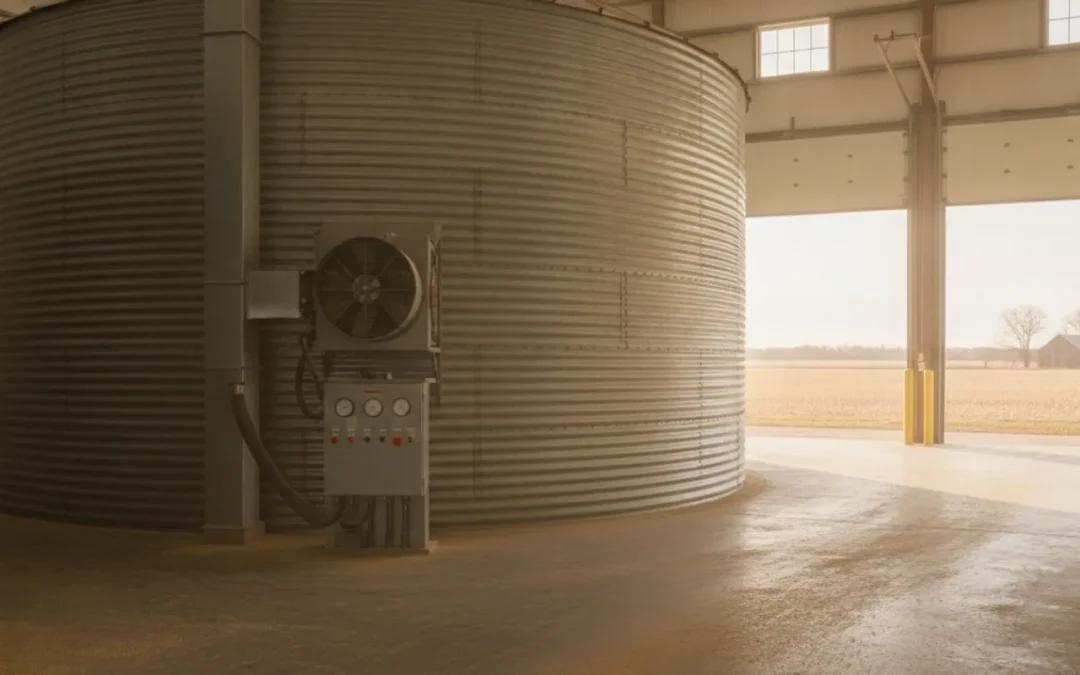
Grain bin fan control for soybeans is a timing decision, not simply a matter of switching the fan on when the air feels cool. The right choice depends on grain condition, the temperature and moisture of outside air, the goal for the storage period, and what you can monitor once the fan starts. A steady routine helps you avoid running fans without a clear purpose and catch changes before they become a storage problem.
Contact us to discuss your grain bin fan setup
What should soybean bin fan control accomplish?
Before choosing a schedule or controller, decide what the fan needs to do. In a typical aeration plan, fans move air through stored grain to manage grain temperature and help maintain storage conditions. That is different from assuming every fan run will dry grain evenly or correct a moisture problem. Air movement, airflow rate, the condition of the grain, and how air travels through the bin all matter.
For soybeans, the practical objective is to manage the grain you actually have, not follow a calendar rule detached from conditions. You may be cooling warm grain after harvest, reducing temperature differences within the grain mass, or maintaining conditions during storage. If you are trying to reduce moisture, first confirm the moisture reading and understand whether the fan and bin setup are suited to that goal. Aeration can move a drying front through the grain; it is not an instant or uniform moisture adjustment.
That distinction matters because fan operation has costs and consequences. Running when outside air is unsuitable can add unwanted moisture or make conditions less consistent. Running without knowing whether air is moving as intended can leave parts of a bin under-managed. The USDA Agricultural Research Service describes controlled aeration as a way to make fan operation easier for grain storage managers and to manage the aeration process; its overview is a useful starting point for the control question, not a substitute for matching a system to your bin and crop (USDA Agricultural Research Service guidance on controlled aeration).
Think of a controller as a tool for making a sound operating plan more consistent. It cannot replace accurate readings, a working fan, suitable airflow, or regular checks. Farm Shop MFG describes EndZone automated fan control as a system that controls grain-bin fans based on ambient conditions and works with Grain Temp Guard. Whether automated control fits your operation depends on your bins, your existing equipment, and how you want to supervise aeration.
When should you run soybean bin fans?
There is no single date or outdoor temperature that answers every soybean fan-control question. Start by checking the grain temperature and moisture, then compare those readings with current and forecast outdoor conditions. Consider what you want this run to accomplish. If the goal is cooling, look for an appropriate window to move air through the grain and bring stored grain toward the temperature you are targeting. If the goal is drying or moisture management, be more deliberate: confirm that the air conditions, fan capacity, and bin configuration support that goal.
Use a repeatable decision sequence before starting a fan:
- Take a baseline. Record grain temperature and moisture readings from the locations and instruments available to you. Note the date, bin, and any recent changes.
- Check the air. Review outside temperature and relative humidity, and look at the forecast for the length of time you expect to operate. A short favorable period followed by a major weather change may affect the result.
- Set the purpose. Write down whether the run is intended to cool grain, move a temperature front, or support a drying plan. Avoid treating these goals as interchangeable.
- Confirm the equipment. Make sure the fan, vents, controls, and any sensors are functioning. Follow the fan and bin manufacturer’s operating instructions.
- Recheck after operation. Measure again and compare the result with the baseline. Do not assume a running fan means the whole bin has reached the desired condition.
Fan schedules and targets should be adapted to the crop, harvest condition, bin design, fan capacity, and intended storage period. The Purdue Extension grain-quality publication discusses why matching fan airflow and operating decisions to the grain condition is important in storage. Its numerical recommendations are context-specific and should not be copied as universal soybean targets; use guidance intended for your crop and setup (Purdue Extension grain quality and aeration publication).
For a broader checklist on sensor placement and routine observation, see Farm Shop MFG’s guide to setting up grain bin sensors for soybeans. Sensors help you see trends, but readings still need to be interpreted alongside the fan’s purpose and the outside conditions.
How do moisture and weather affect the decision?
Moisture readings are essential, but a single number does not tell the whole story. Grain can vary by location, and a sensor or handheld meter samples only the area it measures. A reading taken near a wall, at the surface, or at one point in a bin may not represent the entire grain mass. When a reading looks unusual, compare it with other available measurements and check the instrument and sampling method before changing your plan.
Outside air conditions also change what aeration can accomplish. Temperature affects how quickly grain cools. Relative humidity influences the moisture relationship between air and grain. The direction and pace of change can vary across the bin as air moves through the grain. This is why a useful plan considers both the current condition and the expected operating window, rather than using temperature alone as an on/off trigger.
Keep separate records for moisture and temperature. Temperature trends can help show whether a cooling front is moving or whether a warm area is developing. Moisture readings help you assess the condition of the grain and whether your management objective is being met. A rising temperature in one area deserves investigation even if other readings look normal. Likewise, a moisture change should be checked against location, sampling method, and recent fan use before you conclude the entire bin has changed.
A moisture meter can support harvest and storage decisions, but it does not replace bin monitoring. If you need a refresher on what meters measure, read what a moisture meter is and how it is used. For help comparing measurement approaches, Farm Shop MFG also covers the best grain moisture meter for harvest decisions. Choose a method you can use consistently, and keep the instrument’s instructions and calibration guidance in mind.
What should you monitor while fans are running?
Operating the fan is only one part of the job. Confirm that it starts and runs as expected, and pay attention to unusual noise, vibration, airflow restriction, or electrical issues. Check the bin and surrounding area for conditions that could affect safe operation. Follow the manufacturer’s safety requirements, and do not enter a bin or approach moving equipment in an unsafe way.
Then track the grain response. Note when the fan started, the outside conditions, and the reason for running it. Check available temperature points as operation continues and after the run. A temperature change at one sensor can indicate movement in that part of the bin, but does not prove that all grain has been treated. Use multiple readings and observations where your system allows.
- Log date, start and stop time, and the purpose of each run.
- Record outdoor conditions and grain readings before and after operation.
- Watch for changes that differ from the rest of the bin or from the expected trend.
- Investigate unexpected readings instead of repeatedly running the fan without a diagnosis.
- Revisit the plan when weather, grain condition, or storage duration changes.
For a wider storage-protection checklist, see how to keep grain from spoiling. The point is not to add complexity. A short, consistent record makes it easier to tell whether a control decision helped and to spot a condition that needs attention.
What if the grain does not respond as expected?
A fan run that does not produce the change you expected is a reason to pause and diagnose, not simply extend the run by habit. First compare the new readings with the baseline and check whether you are measuring the same locations in a consistent way. Then review the conditions during operation and whether the fan ran for the intended period. If only one point changed, that may show a localized response rather than a bin-wide result.
Next, look for practical causes that can be checked safely: a sensor that is not reporting reliably, a blocked or restricted air path, an operating fan that sounds or behaves differently, or a change in the grain or weather conditions. Confirm that vents and controls are set as directed by the equipment manufacturer. Keep notes on what you observe so that a technician or equipment supplier can understand the sequence rather than guess from one reading.
For example, if one probe stays warm while others show a change, document its location and compare nearby observations before treating the whole bin as uniformly warm. If the fan runs but grain readings remain unchanged, check that the system is actually moving air as expected and that the measurement interval is appropriate. If you cannot identify the cause, seek qualified technical guidance before changing settings or continuing operation. The right response depends on the bin and equipment, so avoid treating one troubleshooting sequence as a universal repair instruction.
Manual or automated fan control: which fits your farm?
Manual control can work well when someone can check conditions, make the decision, and verify the result reliably. It gives the operator direct control, but it depends on availability and a consistent routine. Automated control can help apply operating rules more consistently when suitable conditions occur, but the rules and equipment still need to fit the bin and be reviewed by the operator.
| Consideration | Manual control | Automated control |
|---|---|---|
| Starting a run | An operator checks conditions and switches the fan on. | A controller can operate the fan according to its configured conditions and system design. |
| Best fit | Operations with a reliable person available to check and act. | Operations seeking more consistent control without relying on every decision being made by hand. |
| What still needs attention | Readings, weather, fan condition, and follow-up checks. | Sensor function, control settings, fan condition, and confirmation that grain responds as expected. |
| Common limitation | Busy periods or missed checks can delay a decision. | Automation does not correct poor airflow, a faulty sensor, or an unsuitable plan. |
| Decision before buying | Assess whether the manual routine is practical across every bin. | Confirm compatibility, control approach, monitoring needs, and installation details. |
Automated control is not automatically better for every bin. It is most useful when it solves a clear operational problem, such as applying a repeatable plan when the operator is occupied elsewhere. If you are considering it, identify which fans you want controlled, which conditions should govern operation, how readings are monitored, and what you will do if a sensor or fan stops working.
Farm Shop MFG’s EndZone fan control product information describes the controller, while the Grain Temp Guard monitoring system provides another part of a monitoring setup. Product fit depends on your equipment and application; check the product details and ask questions before selecting a configuration. You can also browse Farm Shop MFG products to compare the available grain-management equipment.
How can you build a practical soybean aeration routine?
A good routine should be simple enough to follow during harvest and detailed enough to guide a decision. Assign responsibility for checking each bin. Keep the readings and fan history in one place, whether that is a logbook or a digital record. Record the target for each run in plain terms, such as cooling or monitoring a specific temperature trend, rather than only noting that a fan was switched on.
- At filling: Note harvest moisture information, grain temperature if available, and any conditions that could affect storage. Identify the fan and sensor locations for that bin.
- Before each run: Check grain readings, outside conditions, equipment status, and the intended result. Decide whether conditions support that action.
- During and after the run: Confirm operation and check the relevant readings. Allow time for the change to be observed through the grain; do not assume one measurement represents the whole bin.
- Between checks: Continue looking for unusual temperature or moisture patterns, equipment problems, and changes in the storage plan.
- When results do not match expectations: Stop and investigate airflow, sensor placement, measurement reliability, and the fan settings. Seek qualified technical guidance when needed.
Keep a written distinction between your desired grain condition and the controller’s operating trigger. A trigger is an input to the equipment; it does not guarantee the desired outcome. Review settings when you change crops, bins, fans, sensors, or the intended storage period. If multiple bins differ in capacity or configuration, do not assume one setting is appropriate for all of them.
Farmers comparing equipment can review the company’s Grain Temp Guard product page for its stated monitoring features. Match any monitoring option to the way you plan to check the grain; an added data point is useful only if it is reliable and informs an action.
It also helps to write down a simple record for each bin rather than keeping one general note for the entire farm. A useful entry can include the bin identifier, crop, date, readings and measurement locations, the forecast considered, the purpose of the run, and the result of the follow-up check. If two bins have different fan capacities or sensor coverage, these details keep their operating histories distinct. At the end of a storage period, the record can help you see which decisions were repeatable and where results were uncertain.
Before the busy season, walk through the routine with whoever may operate the fans. Agree on where readings are recorded, who is responsible for checking them, and how an unexpected change will be escalated. If a controller is installed, review its settings and confirm that the operator knows how to verify its operation. That short preparation can prevent missed handoffs when harvest and other work compete for attention.
Contact us about your soybean fan control questions
Frequently asked questions
Can I use a fixed calendar schedule for soybean fans?
A calendar can remind you to check a bin, but it cannot account for changing grain condition and weather by itself. Use readings and the purpose of the run to decide whether to operate the fan.
Does a fan always dry soybeans?
No. Aeration moves air through grain, but the result depends on grain condition, outside air, airflow, and bin setup. Do not assume a fan run will dry the entire bin uniformly; verify readings and consult crop- and equipment-specific guidance for a drying plan.
Is cooler outside air enough reason to start a fan?
Not on its own. Consider humidity, the grain temperature and moisture, the goal of the run, and whether conditions are expected to remain suitable. Temperature is one part of the decision.
Can an automatic controller replace bin checks?
No. Automation can apply configured control logic, but it cannot confirm every part of the grain mass is in the desired condition. Continue inspecting the equipment and checking grain readings.
What should I compare before choosing a fan controller?
Check compatibility with your fan and bin, what conditions the controller uses, sensor and monitoring requirements, installation needs, and what happens if a component fails. Make sure the system supports your operating plan rather than expecting the controller to create that plan for you.
Soybean fan control works best when every run has a purpose and every decision is checked against grain readings, outside conditions, and the way air moves through your bin. A practical monitoring routine—manual or automated—helps you protect stored grain while making fan operation more deliberate.