
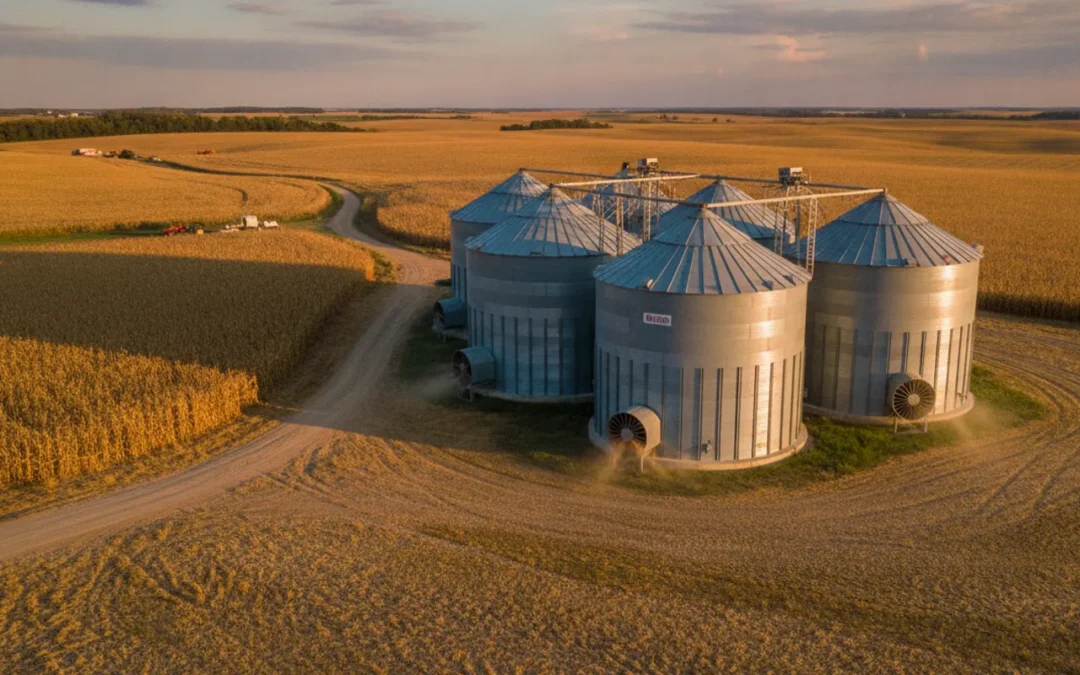
Grain drying vs aeration is not a choice between two names for the same fan job. Drying removes moisture so grain can reach a storage-appropriate level; aeration moves air through grain mainly to manage temperature and help maintain stored quality. A fan may contribute to both, depending on the air, grain, and system, but knowing the main goal helps you decide what to run and what to watch.
Contact us to discuss your grain-bin fan setup
What is the difference between drying and aeration?
Drying and aeration both move air through grain, but the intended result is different. Grain drying aims to lower moisture content. Aeration aims to change or even out grain temperature and manage conditions in storage. The distinction matters because air that cools grain may not dry it enough for the storage plan, and air that is drying grain still needs to be managed so the crop is not taken past its intended condition.
Think of drying as a moisture-removal job and aeration as a grain-condition management job. In practice, the processes can overlap. Ambient air that is cooler or drier than the grain can change both temperature and moisture as it passes through the grain mass. That does not mean every fan run should be treated as a drying cycle. Start with a clear objective and check whether the equipment and conditions can accomplish it.
| Question | Drying | Aeration |
|---|---|---|
| Main objective | Reduce grain moisture toward the level needed for the storage plan. | Manage grain temperature and help maintain storage conditions. |
| What determines the result? | Starting moisture, crop, airflow, air conditions, grain depth, and the drying system. | Grain temperature, ambient conditions, airflow, bin layout, and when the fan is operated. |
| What should you monitor? | Moisture change as well as temperature and fan operation. | Temperature changes through the grain mass and any signs conditions are not responding as expected. |
| Common planning question | Will this system and operating plan reduce moisture enough? | Will this fan run move the desired temperature condition through the grain? |
When does grain need drying rather than aeration?
Drying is the priority when the harvested crop is wetter than the level required by your storage and marketing plan. The job is to remove moisture in a controlled way. Aeration alone should not be assumed to be a substitute for a drying system when a meaningful moisture reduction is required.
Before choosing a drying approach, establish what you are starting with and what the crop needs to reach. Use a suitable moisture measurement method, note the crop and bin or dryer, and confirm the target with your storage plan, grain buyer, or local extension guidance. Avoid basing the decision on one reading if measurements vary across loads or locations. A useful record includes the date, crop, measured moisture, temperature, bin or batch, and the equipment settings used.
Then consider how the crop will be dried. Some systems use heated air and are designed to remove moisture more quickly; other bin-based approaches rely on airflow and prevailing air conditions and can take longer. The right method depends on the crop, harvested moisture, available capacity, weather, and how quickly grain must be moved or stored. Follow the equipment manufacturer’s operating instructions rather than applying settings from a different system.
Drying is not finished simply because a fan has run for a certain number of hours. Verify the grain condition with measurements and observations appropriate to the system. Grain may not be uniform throughout a bin or batch, so sample locations and timing matter. If readings do not move as expected, check airflow, equipment operation, and whether the current air conditions suit the task before extending the run.
For example, suppose a harvest load tests wetter than your planned storage condition. First confirm the reading with a representative sample and record where it came from. Next, check which equipment is intended to lower moisture and the operating directions for that system. Set a follow-up measurement rather than assuming that a fan schedule used for another crop or bin will work here. The decision is about the moisture result, not whether the fan has been running for a familiar number of hours.
When is aeration the main job?
Aeration is the main job when the goal is to manage the grain’s temperature or maintain more consistent conditions in storage, rather than to deliver a planned reduction in moisture. A fan pushes air through the grain mass. The effect reaches grain progressively, so a single temperature reading or a short run may not tell the whole story.
Plan aeration around the condition you want to manage and the air available. Ambient temperature and moisture conditions influence what air moving through the bin can do. The fan, ducting, grain depth, and bin design influence how effectively air moves. Review the fan’s intended use and your bin setup; a fan sized or installed for one situation may not perform the same way in another.
Use readings from more than one point when your monitoring setup allows it. Compare changes over time, not just a single snapshot. A temperature trend can help show whether the change is moving through the grain or whether one area is behaving differently. For practical sensor considerations, see this guide to grain-bin sensors for corn and the overview of grain-bin sensors for soybeans.
A useful aeration check has three parts. Before operating, note the grain temperatures you can access and the current conditions outside the bin. During the run, confirm the fan is operating as expected and record the time. Afterward, compare readings at the same locations and allow for the fact that the temperature change moves through the grain rather than appearing everywhere at once. If one point changes while others do not, treat that difference as information to investigate, not a reason to assume the entire bin has reached the same condition.
For a soybean-specific routine, crop and weather considerations deserve attention. This soybean bin sensor guide offers crop-specific context for temperature monitoring. The useful takeaway is not to copy a schedule blindly, but to match the fan run to the crop condition and the result you need.
Can one fan do both jobs?
Sometimes a fan run affects both moisture and temperature. The outcome depends on the air entering the bin, the grain condition, and the equipment. A fan on an aeration system may move some moisture under suitable conditions, but that does not automatically make it a complete or predictable drying solution. Likewise, using a drying system changes grain temperature as well as moisture.
Separate the objective from the hardware. Ask: “Am I trying to remove moisture, manage temperature, or do both in sequence?” If moisture reduction is essential, check whether the system is designed and operated for drying. If the priority is storage temperature management, make sure the run is appropriate for the bin and ambient conditions. When both outcomes matter, define which one takes priority and verify each result separately.
This distinction helps avoid two common planning errors. First, a farmer may run an aeration fan expecting a rapid moisture reduction it was not intended to deliver. Second, a farmer may treat a drying cycle as complete without checking the crop condition after the run. A written plan that states the goal, measurement method, and stopping point is more useful than a fan schedule detached from current conditions.
When the plan includes both jobs, treat them as distinct stages even if the same equipment is involved. Write down what result ends the drying stage, then state what the aeration stage is intended to manage. At the transition, take fresh readings rather than carrying forward assumptions from the earlier phase. This makes it easier to see whether moisture is still the limiting concern, whether temperature management is now the priority, or whether the results call for a change in equipment use.
How should you choose a fan approach?
Use this sequence to make the decision practical:
- Define the problem. Is the grain too wet for the storage plan, too warm for the condition you want, or both? State the immediate priority.
- Measure the starting condition. Record crop, moisture, temperature, bin or batch, and the date. If readings differ, note where each sample or sensor is located.
- Identify the system’s purpose. Check whether the fan and associated equipment are intended for drying, aeration, or both. Confirm capacity and operating instructions for your setup.
- Check the air and operating conditions. Consider the ambient conditions and whether they suit the goal. Do not assume that any available air will produce the same result.
- Set a check-in plan. Decide when and how you will recheck the grain. Track a trend rather than relying only on hours of operation.
- Respond to the result. If the grain is not changing as expected, inspect the equipment and airflow and reassess whether the chosen process matches the job.
Make the sequence specific to the bin rather than treating all bins on a farm as interchangeable. For each one, record its crop, approximate fill condition, fan or system being used, accessible temperature points, and where moisture samples can be taken. If the operator changes, those notes make the next decision easier to follow. They also help separate a process problem from a measurement problem: a reading from a different location may not be comparable to the previous one.
This is also where a simple monitoring routine earns its place. The Grain Temp Guard grain-bin monitoring system monitors bin temperature using probes. It can provide readings to support a temperature-management routine, but a temperature reading is not a moisture measurement. Keep using the right method to verify moisture when drying is the objective.
What does a grain drying and aeration plan need to include?
A useful plan should be specific enough that someone checking the bin can tell why a fan is running and what result is expected. It does not need to be complicated. Write down:
- Crop and location: Identify the bin or batch and crop stored.
- Starting readings: Record moisture and temperature using suitable measurement methods.
- Purpose: Mark the run as drying, aeration, or a defined sequence of both.
- Equipment details: Note which fan or system is operating and follow its instructions.
- Conditions and timing: Record when the fan runs and relevant ambient conditions.
- Follow-up: Set a time to check readings and record what changed.
Use the same measurement locations where practical so comparisons are meaningful. Keep notes when the result differs from expectations. If the top, center, or edge of the grain mass shows a different trend, record that distinction instead of reducing the bin to one number. For more on the possible consequences of poor storage management, see how to keep grain from spoiling.
One simple record can make those details actionable. For instance, a log entry might state the bin identifier, crop, date and time, starting readings, stated goal, fan used, and the conditions observed. A later entry should use the same sensor points or sampling approach where practical and state what changed. If you cannot compare like with like, note that limitation. A brief explanation such as “temperature at the center probe changed; moisture sample came from the south side” is more useful than a single unexplained number.
Set a point at which you will reassess instead of leaving the fan to run without review. That does not require a universal timer; the right interval depends on the system, conditions, and objective. The important part is knowing when someone will check the grain and what evidence will guide the next decision. If readings are inconsistent or the equipment behaves unexpectedly, consult the equipment instructions and appropriate local expertise rather than guessing at settings.
What can go wrong when the two jobs are confused?
The first risk is choosing the wrong process for the problem. If grain needs moisture removed, relying only on aeration may leave the farmer short of the needed result. If the goal is temperature management, treating a fan run as a drying cycle can lead to checks that focus on the wrong measurement.
The second risk is running equipment without a clear response plan. A fan can be operating while conditions in the bin still need attention. Monitoring only whether the motor is on does not establish that air is moving as expected or that the desired grain condition has been reached. Match the observation to the goal: measure moisture for drying and follow temperature patterns for aeration management.
The third risk is assuming every bin responds alike. Bin size, grain depth, airflow, crop, starting condition, and ambient conditions all affect the result. A routine that worked in one bin or season may not transfer exactly to another. Use equipment documentation and relevant local guidance to make a farm-specific plan. The Farm Shop MFG resources are a starting point for reviewing related grain-management information; check your own fan and bin specifications before making operating decisions.
A fourth mistake is using a measurement as a stand-in for something it does not measure. A temperature probe can show temperature at its location, but it cannot confirm the moisture of the entire grain mass. A moisture sample can inform drying progress, but it does not by itself show how temperature is changing at other points. Use each tool for its intended question and note where the result represents only part of a bin.
What does Purdue Extension say about stopping a drying fan?
Purdue Extension’s grain-quality guidance gives a specific example of the need to watch both moisture and temperature: it says that after the top layer has dropped below 18% moisture and grain temperature is below 30–35°F, the drying fan can be turned off. Those thresholds belong to that guidance and should not be treated as universal settings for every crop, system, or storage plan. Review the source and follow current advice appropriate to your situation: Purdue Extension, Grain Quality.
The broader lesson is to use the appropriate measurements and a defined stopping decision. Do not infer moisture from temperature, or assume the top layer alone describes the whole bin. If the plan depends on a specific moisture or temperature target, verify it with suitable measurements and relevant extension or equipment guidance.
Before applying a published threshold, check the surrounding context in the source and confirm that it addresses the crop, process, and equipment you are using. A number taken out of context can sound like a universal rule when it is actually guidance for a particular situation. If the conditions or equipment differ, use current recommendations that fit your operation.
How does automated fan control fit in?
Automated control can help manage when a fan operates, but it does not erase the difference between drying and aeration. Before selecting a controller, decide what job the system will manage, what conditions it uses to make operating decisions, and how you will check the grain itself. Automation should support a clear bin-management plan, not replace measurement or equipment instructions.
Farm Shop MFG’s EndZone fan control system is an automated fan-control option for grain bins. Review its operation and compatibility with your setup, then consider how it fits the goal for each bin. The site also provides information about EndZone fan controls and grain-bin temperature monitoring. For broader equipment choices, browse Farm Shop MFG products.
Automation is most useful when the operating rule is well understood. A farmer should be able to explain what condition turns the fan on, what condition turns it off, and what readings will be checked afterward. If those answers are unclear, start by writing the manual decision process down. Then compare that process with what the controller is designed to do.
When evaluating a control approach, list the decisions you currently make by hand. Which conditions do you check? What makes you start or stop a run? How do you confirm the grain responded as intended? Then check the controller’s documented inputs and operating logic against that list. This comparison keeps the purchase question tied to the farm’s actual workflow, rather than assuming that automation solves every drying or storage concern.
For a farm-specific conversation about fan control, contact Farm Shop MFG. You can also review the broader grain-bin monitoring information when deciding how temperature readings fit into your routine.
Explore EndZone fan control for grain bins
Frequently Asked Questions
Is aeration the same as drying grain?
No. Drying is intended to reduce grain moisture. Aeration is primarily used to manage grain temperature and storage conditions. A fan run can affect both, but the amount and result depend on the air, grain, and system.
Can an aeration fan lower grain moisture?
Air moving through grain can influence moisture under suitable conditions, but an aeration fan should not automatically be treated as a dedicated drying system. Check whether your equipment and operating plan are designed to achieve the moisture reduction you need, then verify the result with moisture measurements.
Which measurement should I check during drying?
Moisture is central when drying is the objective. Temperature also matters for managing the grain and interpreting the process. Use suitable measurement methods and locations for your system, and follow equipment and extension guidance for your crop.
Does a temperature monitor tell me whether grain is dry?
No. Temperature readings help you track temperature conditions; they do not replace a moisture measurement. Use each measurement for the question it can answer.
When should I use automated fan control?
Consider automated control when you have a clear operating objective and understand the controller’s conditions and limits. Confirm compatibility with the bin and fan, and continue checking grain conditions rather than assuming automation alone confirms the result.
Choose the fan job before you switch it on
For grain drying vs aeration, begin by naming the result you need: moisture reduction, temperature management, or a planned combination. Measure the grain, match the equipment to the job, and check the result with the right readings. A straightforward plan makes every fan run easier to evaluate and helps you decide when conditions call for a different approach.