
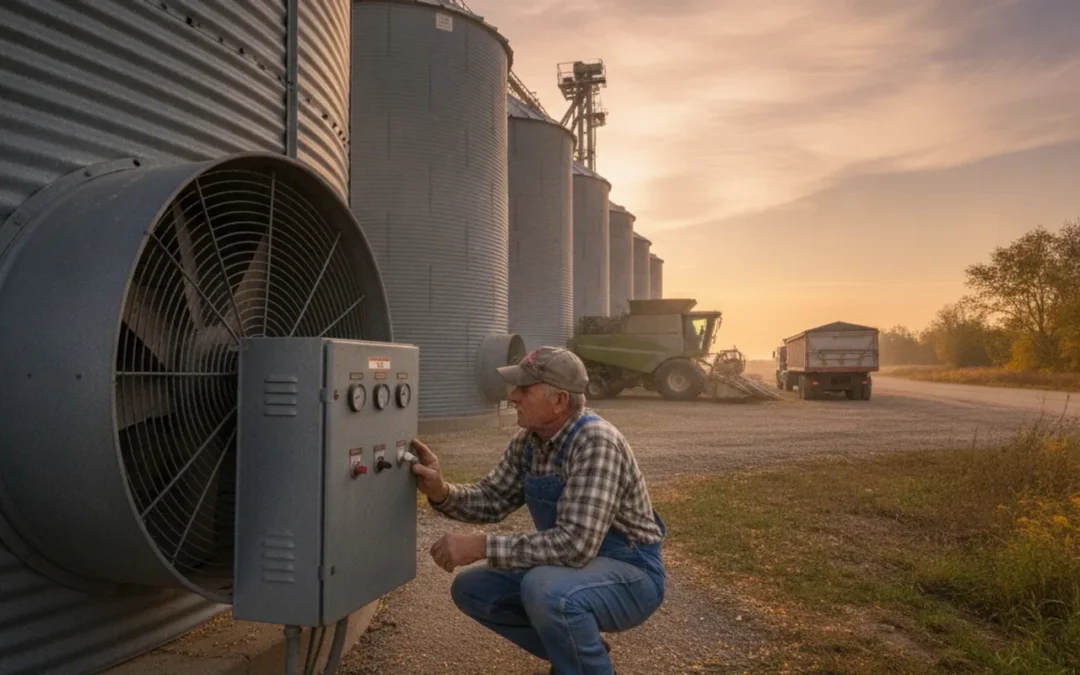
Choosing grain bin fan control for corn is not just a question of buying a timer or an automatic switch. The right setup helps you make repeatable decisions about when to run a fan, while keeping the crop, bin, weather, and your own monitoring routine in view. For many farms, the best fit is the simplest control approach that gives enough information to act reliably.
Talk through your grain fan setup
What is the best grain bin fan control for corn?
The best grain bin fan control for corn is the one that helps you run aeration intentionally, based on the condition of the grain and the air, without making you dependent on an unattended system you cannot verify. A manual control can be a good fit when someone can check conditions and operate the fan consistently. A sensor-informed or automated control can reduce routine guesswork, but it still needs an operator who understands the readings, follows a storage plan, and responds when conditions change.
There is no one control setting that works for every corn bin. The right decisions depend on such factors as harvest moisture, grain temperature, bin size and condition, airflow capacity, outdoor temperature and humidity, and the length of storage. A controller cannot make poor airflow or uneven grain conditions disappear. Start with a clear monitoring and aeration plan, then choose equipment that supports it.
Farm Shop MFG’s EndZone fan control system is one option for farms looking to automate grain-bin fan operation. Before choosing any setup, compare what it monitors, how it decides to switch a fan, what it can control, and what checks still fall to you.
What should a corn-bin fan control help you manage?
Fan operation is one part of grain management, not a substitute for it. A useful control arrangement should fit into decisions about grain condition, airflow, and storage duration. Think through the following before comparing products.
- Grain condition: Know the condition of the corn as it goes into storage and any changes you observe. Do not assume a fan controller measures the entire grain mass unless the product documentation specifically says so.
- Temperature: Temperature information helps you see trends and identify areas that need attention. A sensor reading represents its location, so sensor coverage and placement matter.
- Air conditions: Outdoor air temperature and humidity affect whether a particular aeration run suits your goal. A simple on/off schedule cannot account for every changing condition.
- Airflow and equipment: Fan capacity, ducts, grain depth, and bin setup affect how air moves through the crop. Controls do not correct blockages, equipment problems, or poor distribution.
- Operator checks: Plan who will check readings, inspect the bin, and decide what to do if a sensor, fan, or power supply is not working as expected.
Purdue Extension’s Managing Dry Grain in Storage discusses practical storage management, including the importance of fan and airflow considerations. Purdue’s discussion of temperature and pest management in grain storage also notes that improper cooling is a common source of storage problems. These are useful reminders that control logic works best as part of a broader storage routine, not as a set-it-and-forget-it promise.
Which fan-control approach fits your farm?
Most farms can begin by comparing three broad approaches: manual operation, scheduled operation, and sensor-informed or automated control. Features vary by product, so use this table as a decision framework rather than an assumption about a particular controller.
| Approach | How it works | Potential fit | What to verify |
|---|---|---|---|
| Manual switching | An operator turns the fan on or off after checking conditions. | One or a few bins, frequent on-site checks, and a person available to make decisions. | Who checks the bin, what guidance they follow, and how operation is recorded. |
| Timer or schedule | A fan runs at preselected times or for set periods. | A consistent routine where a fixed schedule is appropriate for the management plan. | Whether the schedule accounts for changing conditions, and how the operator can pause or change it. |
| Sensor-informed control | Readings from selected sensors inform the operator or control response. | Farms that want more visibility into monitored conditions and can interpret the readings. | Which sensors are included, where they measure, how readings are shown, and what happens if a sensor fails. |
| Automated fan control | A system operates a fan according to its documented control method. | Operations seeking more consistent fan operation and a defined way to reduce routine manual switching. | What inputs and thresholds it uses, what equipment it can operate, override options, power needs, and required checks. |
Automation is not automatically the right choice for every bin. A well-managed manual routine can be more useful than a controller whose readings no one reviews. Conversely, when someone is responsible for several bins or cannot be at each site often, automation may help standardize a part of the routine. The goal is to make the decision path clearer, not to remove responsibility for grain condition.
If comparing equipment, review the EndZone product information alongside the main EndZone system page. Confirm current product details directly rather than assuming all automated controllers use the same sensors, thresholds, or switching logic.
How do corn storage conditions shape fan decisions?
Storage decisions begin with the crop and your intended storage period. Grain harvested at different moisture levels or temperatures may require different handling. Your local weather also changes over time, so a decision that made sense last week may need another look today. Follow reliable grain-management guidance for your crop, bin, and conditions rather than relying on a single generic temperature or humidity setting.
Start with what went into the bin
Record what you know at filling: the measured grain moisture, approximate grain temperature, date, and any observations about the load or bin. Those details provide context when later readings change. If a reading seems inconsistent with what you observe, verify it before making a major operating decision. Measurement equipment and sensor placement both affect what a reading tells you.
Watch trends, not one number in isolation
A sensor can show a condition at its location, but a single point does not prove that the whole bin is uniform. Review trends over time and compare them with other available checks. If readings rise, differ unexpectedly, or change quickly, investigate instead of assuming the control system will resolve the cause. A fan can move air, but the operator still needs to determine whether running it under current conditions supports the storage objective.
Consider outside air and the purpose of a run
Before operating a fan, consider what you want that run to accomplish and whether the current air conditions support that purpose. Do not treat a fixed clock schedule as a substitute for evaluating the air and crop. Purdue Extension notes that when the fan is not being used, covering the intake can help limit air movement through the fan and grain by natural chimney effect. Check the guidance applicable to your equipment and bin, and keep openings and components in a safe condition.
Recheck after operation
After an aeration run, review the available readings and inspect the bin according to your normal safety practices. Record the date, run duration, and any relevant observations. This simple log helps distinguish a useful change from a sensor anomaly and makes handoffs between operators more dependable.
How can you turn monitoring into a dependable routine?
A controller is easier to use well when the farm has a repeatable process around it. Set up a short checklist that answers three questions: what gets checked, who checks it, and what requires follow-up. Keep the process simple enough to continue during busy harvest periods rather than creating a complicated form that no one completes.
- Establish a starting record. When filling each bin, note the date, crop, available moisture and temperature information, approximate fill level, and any known fan or duct concerns. Label each bin consistently so notes are not mixed up when you manage more than one structure.
- Check the same information each time. Review current sensor values and recent trends, fan and controller status, and any relevant outside conditions. Use the same sequence on each visit or remote review. A consistent sequence makes it less likely that an important status indicator will be skipped.
- Write down the decision, not just the reading. Record whether the fan was run, paused, or left off, and briefly note the reason. If another operator takes over, they can see what was done and why instead of guessing from a control setting.
- Set a follow-up trigger. Decide in advance which observations prompt another check or a call for help. Examples include an unexpected reading, a fan that does not respond as expected, a power interruption, or a change that is inconsistent with the rest of the information available.
For example, imagine a farm has two corn bins filled at different times. A single calendar reminder may be convenient, but the bins do not necessarily have the same starting condition, sensor coverage, or operating history. Separate records make it easier to recognize that a reading in one bin is a change from its own baseline rather than assuming both bins should always match. This is a practical reason to keep decisions specific to each bin, even when the same person oversees all the equipment.
Make the record useful to the next person who may check the site. Include the bin identifier, date and time, readings reviewed, fan status, action taken, and any follow-up needed. You do not need an elaborate data system to gain value from orderly notes. A clear log supports continuity; it does not replace qualified advice when you see a potential grain-quality or equipment problem.
What should you check before buying a controller?
Product names can sound similar while the actual control methods differ. Ask practical questions and get answers for your specific bin and fan instead of buying based on the word “automatic” alone.
- What does the system measure? Identify whether it uses grain temperature, air conditions, time, or another input. Do not infer sensor capability from a product category.
- What causes the fan to turn on and off? Ask about the documented logic and whether settings can be adjusted to match your management plan.
- What fans and electrical setup are compatible? Confirm voltage, switching capacity, connections, and whether additional hardware is required with a qualified person where needed.
- What can you see remotely or at the bin? Find out how status and readings are displayed, and whether internet access, a subscription, or a particular device is necessary.
- What happens when power or a sensor is lost? Understand the system’s response, how you will know there is a problem, and how you can safely take manual control.
- How much monitoring remains your responsibility? Clarify which inspections and decisions remain with the operator. No control system should be treated as a guarantee against spoilage.
- Can it grow with your operation? If you expect to add bins or fans, check how the system handles more equipment and whether the added components change installation or operating requirements.
When you speak with a supplier, describe your actual setup rather than asking only whether a controller works with “a grain bin.” Share the fan nameplate details, the number of fans and bins, available power, the control location, and any existing sensors. Ask which information the supplier needs to confirm a match and request the answer in writing if compatibility is not straightforward. This keeps the purchase decision tied to real equipment rather than a general product description.
Also consider whether fan control is your main need or whether you first need better visibility into storage conditions. Farm Shop MFG’s Grain Temp Guard grain monitoring information describes a separate monitoring option. Monitoring and fan control address related but different tasks; compare what each system actually does before deciding whether you need one or both.
How can you choose a setup for one bin or several?
Make the decision bin by bin. A small operation with one accessible bin may value a straightforward process and clear manual checks. A farm with multiple storage sites may place more weight on consistent monitoring, fewer trips, or standardized fan operation. Neither situation automatically requires a specific level of automation.
List each bin’s capacity, fan and electrical details, access, expected storage period, and current monitoring method. Then note how often someone can visit and who is responsible when the main operator is away. This exposes practical constraints early. For example, a system that depends on frequent local inspections may not solve a problem if the bin is far from the operator, while remote information is of limited value if no one is assigned to act on it.
Compare the cost of the proposed setup with the value of the problem it is meant to address. Include installation, any additional sensors or wiring, maintenance, and the time required to check the system. Avoid treating a possible benefit as guaranteed savings. Your actual outcome depends on the crop, weather, bin, operating decisions, and other factors.
A useful way to compare two options is to write down the task each one improves and the work it leaves unchanged. A timer might reduce the need to switch a fan manually, but it may not help you determine whether conditions still suit the planned run. A controller with additional inputs could offer a different kind of assistance, but it may require setup, interpretation, and ongoing checks. Compare the whole routine—including installation and operator time—not just the number of features on a product page.
Review Farm Shop MFG’s product options and grain and equipment resources as part of that comparison. If your situation involves an unfamiliar fan or wiring arrangement, get compatibility questions answered before ordering or installing equipment.
What common mistakes make fan control less effective?
- Assuming automation means no checks: Continue reviewing conditions and investigating readings that do not make sense.
- Using one schedule for every bin: Bins differ in crop condition, airflow, size, and exposure. A routine should reflect those differences.
- Ignoring sensor location: Readings only describe what the sensor measures. Check placement and coverage when interpreting changes.
- Forgetting the fan and duct system: Control cannot compensate for a mechanical fault, obstruction, or unsuitable airflow.
- Failing to document operation: Without a log, it is harder to understand what changed and why.
- Leaving fan intakes exposed when idle: Follow appropriate storage guidance and equipment instructions for limiting unwanted airflow when the fan is off.
- Buying before checking compatibility: Confirm fan specifications, control capacity, power, and installation requirements before purchase.
These checks are basic, but they help keep equipment selection grounded in the actual job. If a problem appears in the crop or bin, investigate it promptly and consult appropriate grain-storage expertise. Do not depend on a controller to diagnose every storage issue.
Frequently Asked Questions
Can I control a corn-bin fan with a timer?
A timer can operate a fan on a schedule, but it does not necessarily respond to changing grain or air conditions. Whether it is appropriate depends on your storage plan and how you will monitor the bin. Confirm that a schedule fits your management guidance and equipment instructions.
Does automatic fan control prevent corn spoilage?
No controller can guarantee that grain will not spoil. Fan control may support a consistent operating routine, but results also depend on grain condition, airflow, sensor coverage, weather, maintenance, and operator checks.
Should a controller use grain temperature or outdoor conditions?
That depends on the system and its intended use. Temperature trends and outside air conditions can both be relevant to storage decisions, but the exact control inputs vary. Ask the manufacturer what is measured, how control decisions are made, and what readings you must check yourself.
Is grain monitoring the same as fan control?
No. Monitoring provides information about selected conditions. Fan control operates or helps manage a fan. Some farm plans use both, but compare each product’s documented functions and do not assume a monitor automatically controls equipment.
Choose a control approach you can manage
The right grain bin fan control for corn should match your crop, bin, fans, weather decisions, and available time for checks. Compare manual, scheduled, and automated approaches against those needs; verify compatibility and control details; and keep a clear record of readings and fan operation. For questions about whether Farm Shop MFG’s EndZone fits your setup, contact the team to discuss your bins and fan requirements.
Review the EndZone fan control system
Make the final choice around a dependable storage routine, with equipment that supports the decisions you and your team can consistently make.