
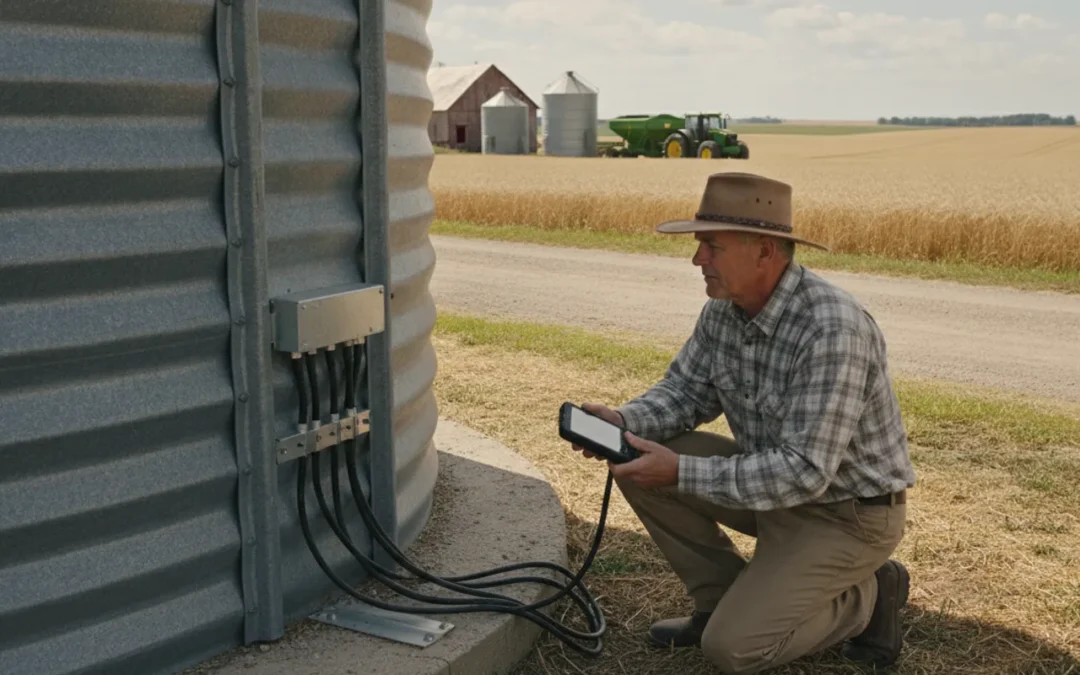
A moisture sensor can help a grain farmer make better storage decisions before a small change becomes a large quality or revenue problem. The right system does more than display a number: it gives you useful information about conditions in the bin, helps you decide when to aerate, and supports a repeatable monitoring routine. This practical guide explains what to look for, where sensors fit, how to read the information, and which questions to ask before choosing equipment.
What does a moisture sensor do in grain storage?
A moisture sensor measures moisture conditions at a selected point or across a selected part of a grain storage system. Depending on the equipment, the reading may describe the grain directly, the air around the grain, or conditions inferred from a combination of sensors. That distinction matters. A sensor is useful only when you understand what it measures and how its location affects the reading.
Stored grain is not a completely uniform mass. Grain may enter the bin at different temperatures or moisture levels. Fines can collect in particular areas. Airflow can vary from the center to the edge, and a warm or damp area may develop even when a sample from the surface looks acceptable. A sensor cannot replace good management, but it can reveal a change that deserves a closer look.
For a broader look at the related information available from Farm Shop MFG, see the Grain Temp Guard monitoring system. Farmers comparing grain storage tools can also review the guide to grain bin sensors for corn and the guide to grain bin humidity monitoring.
Why should farmers monitor moisture after grain enters the bin?
Harvest moisture is only one part of the storage decision. Grain can gain or lose moisture as air moves through it, and changing temperatures can shift the conditions inside a bin. Monitoring gives you a way to compare what you expected with what is actually happening.
- Protect quality: A developing wet area can be investigated before it spreads or leads to spoilage.
- Guide aeration: Moisture information is more useful when considered with grain temperature, outdoor conditions, and airflow.
- Reduce unnecessary fan time: Better information can help you avoid running equipment without a clear reason.
- Support marketing decisions: A consistent record can help you understand the condition of stored grain when delivery or movement is being considered.
- Prioritize inspections: If several bins are in service, a sensor can help identify which one needs attention first.
The University of Minnesota Extension explains that soil moisture sensors can support irrigation scheduling when they are selected, installed, and interpreted correctly. The same general lesson applies to grain monitoring: the value comes from using a suitable sensor in a sensible location and acting on a trend rather than treating one isolated reading as the whole story. Read its practical discussion of sensor selection, installation, and use.
What should a moisture sensor measure?
Start by defining the decision you want the equipment to support. “I need a moisture sensor” can mean several different things on a grain farm. You may want to spot a wet pocket, understand humidity in a bin, check conditions before turning on a fan, or watch a stored crop over time. These goals do not always require the same sensor arrangement.
| Monitoring goal | Information to prioritize | Questions to ask | Useful follow-up |
|---|---|---|---|
| Find changing conditions in stored grain | Moisture trend at a representative location | Where is the sensor installed, and how often is it read? | Inspect the area if the trend changes |
| Plan aeration | Moisture together with grain and ambient temperature | Can the readings be viewed alongside temperature? | Use the readings with your aeration plan |
| Watch bin air conditions | Humidity and temperature near the grain | Does the device measure grain, air, or both? | Compare with a physical inspection |
| Manage several bins | Consistent readings and easy access | Can one person check each bin on a routine? | Record observations by bin and date |
| Investigate a suspected problem | Location-specific information | Can the sensor be checked or moved as needed? | Verify the reading with another method |
Do not choose based on the word “moisture” alone. Ask whether the product measures grain moisture directly, senses humidity in the air, or is intended to be paired with temperature information. A clear answer will make the system easier to use and will prevent you from expecting a single number to answer every storage question.
Where should a moisture sensor be installed?
Placement is one of the most important parts of a monitoring plan. A sensor located in an unrepresentative spot may give a precise reading that says little about the rest of the bin. Before installation, consider how grain flows into the bin, where fines tend to settle, how air moves during aeration, and which locations are practical to reach or inspect.
Use the equipment instructions as the starting point. Then consider the way your own bins are filled and managed. A sensor near a high-risk area may be useful for early warning, while a sensor in a more typical area may help you understand overall conditions. In larger or irregular storage setups, one location may not answer every question.
Questions to answer before installation
- What crop will be stored, and are readings expected to vary by crop?
- Will the sensor be exposed to airflow, condensation, dust, or vibration?
- Can you reach it safely for inspection or service?
- Will the location remain useful after the bin is filled and unloaded?
- How will you identify the sensor location in your records?
Installation should also fit the rest of your workflow. If a reading requires a difficult trip to the bin every time, it may not be checked consistently. The best location is one that provides useful information and supports a routine your team can actually maintain.
How should farmers interpret a moisture sensor reading?
Think in terms of patterns, not isolated values. A single reading can be affected by location, temperature, crop condition, sensor design, or a temporary change in the surrounding air. A sequence of readings taken under comparable conditions is more useful for deciding whether conditions are stable or changing.
Record the bin, crop, date, time, recent weather, fan activity, and any unusual observation. If you changed the aeration schedule, note that too. Over time, these simple notes help separate a normal response to management from a trend that requires attention.
Three practical reading checks
- Check the context. Note whether the fan has been running, whether the grain temperature is changing, and whether the reading was taken at the same location as before.
- Look for direction. Ask whether the reading is stable, gradually changing, or moving sharply. A sudden difference deserves a closer look, not an immediate assumption about the cause.
- Verify before acting on an unusual result. Compare the sensor information with a physical inspection, a separate measurement, or another relevant observation when practical.
A moisture sensor is an input to a decision. It is not a substitute for safe bin entry practices, regular inspection, or following the operating guidance for your grain handling and aeration equipment.
What features matter when comparing moisture sensors?
Farm conditions are hard on equipment. Dust, temperature swings, moisture, vibration, and seasonal storage demands all affect the value of a sensor. Compare the complete system rather than focusing only on the sensor itself.
Measurement purpose
First, confirm what the sensor measures and whether that information matches your decision. If you want to monitor air conditions around stored grain, a humidity-and-temperature system may be appropriate. If you need a direct grain moisture measurement, ask how that measurement is made and what conditions can affect it.
Durability and protection
Look for construction that fits the environment where the device will operate. Ask about protection from dust and moisture, cable or connection durability, seasonal temperature range, and the process for replacing a damaged component. A low purchase price is less useful if the equipment cannot tolerate the conditions of a working grain system.
Installation and service
Simple installation can matter as much as a long feature list. Find out whether the equipment is intended for farmer-friendly installation, what tools are needed, and how much access is required. Also ask how you will test the system after installation and what normal maintenance involves.
Access to information
Decide how often you need to see readings and who will review them. Some operations need a straightforward local check. Others may prefer information that can be reviewed from a central location. Choose the approach that matches your labor, connectivity, and management habits rather than paying for functions nobody will use.
Ongoing cost
Include more than the initial equipment price. Consider installation, replacement parts, batteries, connectivity, subscriptions, and labor for checking the system. Farm Shop MFG positions its equipment around practical, accessible monitoring without ongoing cloud subscriptions or fees. Confirm the current product details before ordering.
For a related comparison of grain monitoring equipment, review the guide to choosing a grain moisture meter. If your priority is temperature and humidity information in a bin, see the Grain Temp Guard product information.
How does a moisture sensor fit with temperature monitoring?
Moisture and temperature tell different parts of the storage story. Moisture helps identify the water condition you are trying to manage. Temperature can show how the grain mass is changing and can help you investigate areas where biological activity or air movement may be a concern. Looking at both sets of information gives you more context than relying on either one alone.
This is why a grain monitoring plan should state which readings are collected, how often they are reviewed, and what action follows a meaningful change. For example, a change may prompt a visual inspection, a repeat measurement, an aeration decision, or a call for technical help. The exact response depends on the crop, bin, conditions, and equipment instructions.
Farmers who are comparing related storage tools can read grain drying versus aeration and how to keep grain from spoiling. Those resources address management choices that should accompany, rather than be replaced by, sensor information.
What mistakes reduce the value of a moisture sensor?
Many monitoring problems come from the process around the sensor. Avoid these common mistakes:
- Choosing a device before defining the decision. A product may have impressive specifications but still measure the wrong thing for your storage question.
- Installing only where it is convenient. Convenience matters, but a convenient location that does not represent the risk area may provide limited value.
- Ignoring the baseline. Without an initial record, it is harder to recognize a meaningful change later.
- Reacting to one unexplained number. Repeat the check and consider temperature, airflow, location, and recent management before drawing a conclusion.
- Skipping physical inspections. A sensor supports inspection; it does not make inspection unnecessary.
- Failing to plan for service. Know how the system is powered, how components are checked, and who will respond if a reading is missing.
- Buying more complexity than the operation can use. A simpler system that is checked consistently may be more useful than a complex system that is ignored.
What is a practical monitoring routine?
Build the routine around the storage calendar. At filling, record the crop, approximate condition, bin, sensor location, and any relevant management information. During storage, check readings on a schedule that fits the crop and conditions. Increase attention when weather changes, fans run, grain is moved, or a reading begins to depart from its baseline.
Use a short written or digital log. A useful entry can include:
- Bin identification and crop
- Date and time
- Sensor reading and location
- Grain or ambient temperature, when available
- Fan or aeration status
- Weather or other relevant conditions
- Action taken and the next planned check
When a reading changes, document what happened next. This creates a record that can improve decisions in the current season and help with planning for the next one. It also makes it easier for another person on the farm to understand the situation.
How much does a moisture sensor system cost?
Cost depends on the number of monitoring points, the measurement type, installation needs, communications, and whether the system includes other sensors or controls. Compare total ownership cost rather than using the price of one component as the deciding factor.
Farm Shop MFG describes its Grain Temp Guard as an accessible grain monitoring option for farm storage and lists a $499 price point. Product prices and configurations can change, so verify the current price, included components, and compatibility before making a purchase. You can also review the Farm Shop MFG product range to compare storage and farm equipment options.
Questions to include in a price comparison
- What is included in the base system?
- How many bins or monitoring points can it support?
- Are installation materials included?
- Are there recurring service, cloud, or connectivity charges?
- What happens if a sensor or cable needs replacement?
- Can the system be expanded if storage needs change?
What should farmers ask before buying?
Use these questions when comparing a moisture sensor with other monitoring options:
- What exactly does the system measure?
- Is the reading intended to represent grain, air, or a specific sensor location?
- How should the sensor be installed in my bin and crop?
- How do I establish a baseline and check an unusual reading?
- How often should the sensor be inspected or maintained?
- Can I review the information in the way my operation already works?
- What are the complete upfront and ongoing costs?
- What support is available for product questions and ordering?
Bring your bin size, crop, storage practices, current monitoring method, and desired decision to the conversation. The more specific the question, the easier it is to determine whether a particular system is a good fit.
Ask about grain monitoring equipment
Frequently asked questions about moisture sensors
Is a moisture sensor the same as a grain moisture meter?
Not necessarily. A meter may be used to test a sample, while a sensor may monitor conditions at a fixed location or as part of a larger system. Ask what the product measures and how it is intended to be used.
Can one sensor represent an entire grain bin?
It may provide useful information about its installation point, but one reading may not describe every area of a bin. Grain flow, fines, airflow, and temperature can create differences, so placement and interpretation are important.
Should a sensor replace regular bin checks?
No. Sensor information can help prioritize checks and identify changes, but it should be used with safe inspections, operating procedures, and the equipment maker’s guidance.
What is the first step if a reading looks wrong?
Check the context and repeat or verify the reading when practical. Review the sensor location, recent fan activity, temperature, connections, and any physical signs before deciding what action is needed.
What is the best next step?
Begin with the storage decision you want to improve, then match the measurement, placement, access, and cost to that decision. A moisture sensor is most valuable when it becomes part of a clear routine: establish a baseline, watch for trends, verify unusual information, and respond before a developing storage issue becomes harder to manage. For help comparing a practical grain monitoring setup, contact Farm Shop MFG with your bin and crop details.