
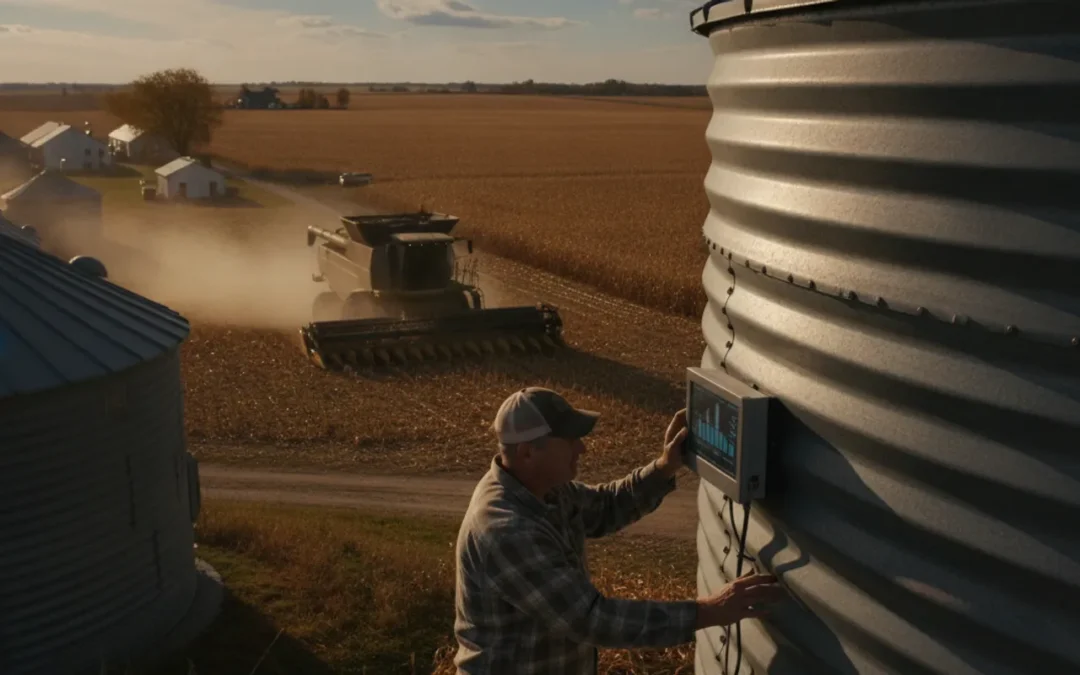
Grain bin humidity monitoring gives you another useful view of stored grain conditions, but it works best alongside temperature readings and regular inspection. Humidity can help flag a change in the air around stored grain; it is not, by itself, a verdict on grain quality or a command to run a fan. Here is how to use humidity information as part of a practical storage routine.
Ask a grain monitoring question
What does grain bin humidity monitoring tell you?
Humidity describes how much water vapor is in the air relative to the amount that air could hold at its current temperature. A sensor reading inside a grain bin is therefore a clue about the air in the area being measured. It can add context to a temperature reading and help you notice that conditions are changing.
It does not directly measure the moisture content of every kernel in the bin. Nor does one reading establish that grain is safe, spoiled, drying, or ready to move. Grain condition depends on more than a single point in the bin: grain type, moisture, temperature, airflow, weather, bin design, and how long conditions persist all matter. Treat the reading as one part of the picture, then verify with appropriate checks.
Temperature and relative humidity are connected. As air temperature changes, the amount of water vapor it can hold changes too, so relative humidity can move even when the amount of water vapor has not changed. A research paper on grain condition information discusses the relationship between temperature and relative humidity fields; that is one reason to interpret the two measurements together rather than in isolation (research on temperature and relative humidity in grain condition monitoring).
For farmers already tracking temperature, humidity can help describe the local air conditions and make unusual changes easier to investigate. It does not replace checking grain moisture with an appropriate method, inspecting the bin, or following safe storage guidance. Farm Shop MFG’s Grain Temp Guard grain bin monitoring information describes a monitoring option that includes temperature and humidity sensors.
Why look at humidity alongside temperature?
Temperature is a key part of stored grain management because a changing temperature pattern may indicate conditions that deserve attention. Humidity adds another signal. Looking at both may help you distinguish a simple temperature fluctuation from a broader change in the air around the grain, and it can prompt a closer look before a small concern becomes harder to manage.
That additional context is useful, but it is important not to overread it. A high relative humidity reading does not automatically mean the grain is wet or spoiled. A low reading does not prove the whole bin is in good condition. Sensor placement, local conditions, calibration, and the temperature at the sensor can affect what the number means. A sensor only reports conditions where it is installed, not a perfect average of every layer and location.
Think of monitoring as an early-warning and decision-support tool. Readings help you ask better questions: Is the change isolated or repeated? Is temperature moving in the same area? Does the reading make sense given recent weather and fan use? Should you inspect the grain or verify moisture? The answers guide the next check; they do not come from a single number alone.
How do temperature and relative humidity work together?
Relative humidity is expressed as a percentage of the air’s water-vapor capacity at a given temperature. Because the capacity changes with temperature, the same amount of water vapor can correspond to a different relative humidity at a different temperature. This is why an RH value should be read with its paired temperature and the direction of change, not treated as a stand-alone moisture percentage.
Within a grain mass, conditions may vary by location. Air moving through a bin, changes in outside conditions, and differences in grain temperature can all produce variation. Measurements near one sensor can therefore tell you something about that zone without describing every zone. A gradual rise, a sharp jump, or readings that differ across monitored locations are cues to investigate in context, not universal diagnoses.
Humidity monitoring is also different from grain moisture testing. A moisture meter provides a grain moisture estimate for the sample tested. A humidity sensor measures the air’s relative humidity where the sensor is located. If you need help separating those tools, see this guide to what a moisture meter is and what it measures, and the overview of grain moisture meters for harvest decisions.
What can a humidity reading tell you—and what can’t it?
| Reading or observation | What it may help you notice | What it does not establish by itself | Useful next check |
|---|---|---|---|
| Humidity changing over time | Conditions in the monitored zone may be shifting | That the entire grain mass has changed equally | Compare the paired temperature, other sensor locations, and recent conditions |
| Humidity high at one sensor | A local air condition worth reviewing | That grain is spoiled or that a fixed action is required | Verify the sensor and inspect or sample grain as appropriate |
| Humidity and temperature both changing | A broader pattern may be developing | The cause, extent, or urgency without more information | Review fan operation, weather, bin history, and grain condition |
| Humidity appears steady | No obvious change at that measurement point | That all areas of the bin are stable or that grain is safe indefinitely | Continue routine monitoring and scheduled inspection |
Use the table as a starting framework, not a threshold chart. There is no single humidity number in this guide that can account for every crop, storage condition, sensor location, or management plan. For storage guidance specific to your grain and situation, consult a qualified local advisor or extension resource.
How should you build a grain bin humidity monitoring routine?
A simple routine is more useful than collecting readings without a plan. Set a consistent schedule, record what you see, and decide in advance what combination of readings or observations will prompt a closer inspection. Your plan should fit the bin, crop, monitoring equipment, and established grain-management practices.
- Know what each sensor measures. Confirm whether a device reports relative humidity, temperature, grain moisture, or more than one of these. Record the sensor’s location and avoid treating different measurements as interchangeable.
- Establish a baseline. At the beginning of the storage period, note conditions and sensor locations. A baseline makes it easier to distinguish a meaningful trend from an isolated number.
- Read paired measurements together. Review humidity and temperature from the same area at the same time. If the equipment provides more than one monitored point, compare them rather than relying on a single reading.
- Log context. Note dates, fan operation, recent weather, inspections, and any changes you made. Context can help explain why a reading moved and helps you avoid acting on a number without understanding it.
- Look for trends and exceptions. A repeated change, a sudden shift, a difference between zones, or a reading that conflicts with what you observe deserves a closer look. Check the sensor and verify conditions before deciding what to do.
- Verify grain condition when needed. Use appropriate sampling and moisture-testing practices. Air humidity monitoring does not substitute for a grain sample, a visual inspection, or professional advice when the situation is unclear.
- Keep a response plan. Know who will inspect the bin, how you will check fan and sensor operation, and which reliable storage guidance you will consult if the pattern raises concern.
For a broader look at equipment and monitoring approaches, Farm Shop MFG’s grain management resources provide a place to continue researching. The company also offers an overview of temperature transmitters and their role in measurement; be sure to check what a specific device actually measures before comparing it with humidity data.
When is humidity monitoring especially useful?
Humidity monitoring may be particularly useful when you want more context than a temperature-only reading provides, or when you want to review conditions over time rather than relying on occasional walk-around checks alone. It can support a more informed conversation about what is happening in a monitored area of the bin.
It may also help when evaluating storage routines that involve aeration. Purdue Extension explains that aeration moves air through grain and is used to manage grain temperature. That is different from assuming a fan should run whenever a humidity value is high. Fan decisions depend on the purpose of operation and the conditions; consult the full Purdue Extension guidance on managing dry grain in storage and follow recommendations appropriate to your grain and equipment.
Humidity is not a substitute for deciding whether a fan’s job is drying or aeration. Those goals are different and call for different operating considerations. Review the difference between grain drying and aeration before making an operating plan. If you use automated fan controls, see the EndZone fan controller information and confirm that the approach fits your bin, fan, and management requirements.
How do you choose a grain bin humidity monitoring setup?
Start with the decision you want the system to support. Are you looking for readings inside one bin, multiple measurement points, or a combination of temperature and humidity? How often do you need to check? Who will review the readings and act on an exception? Clear answers help you compare systems on practical fit instead of feature lists alone.
- Measurements: Verify the exact variables reported. If humidity and temperature matter to your process, confirm that both are measured and how they are displayed.
- Placement: Understand where the sensors will be located and what area each measurement represents. Do not assume one sensor represents the entire bin.
- Access: Consider how readings are reviewed and whether the method works for the people responsible for monitoring.
- Installation and maintenance: Ask what installation requires, how to check sensors, and what routine care is expected.
- Operating fit: Match the system to your bin and existing grain-management practices. Consider whether you need monitoring only or a separate fan-control function.
- Costs and ongoing obligations: Compare purchase and installation needs, any recurring charges, and the support available. Confirm current details directly with the supplier.
Farm Shop MFG’s Grain Temp Guard product page is one option to review when considering bin temperature and humidity monitoring. For a wider comparison of bin sensing considerations, see the guide to grain bin sensors for corn and the setup guide to grain bin sensors for soybeans. Check current product specifications and fit for your bins before making a purchase decision.
How should you respond when a reading changes?
Build a repeatable response sequence before a concerning pattern appears. That reduces the chance that a hurried decision rests on a number that has not been checked. Begin by recording the time, location, paired temperature and humidity, and any relevant fan or weather context. Then compare the result with previous readings from that same zone. A reading that differs from its own trend may deserve attention even when it does not cross a number you expected.
Next, check whether the measurement is credible. Confirm that you are looking at the correct sensor and unit, that the sensor is installed as intended, and that the display or connection is operating normally. If there are multiple monitored positions, compare them. Agreement across points may suggest a broader pattern; a difference may tell you to inspect the local area more closely. Neither pattern identifies the cause without additional checks.
Consider recent operating conditions. Did the fan run? Did outside conditions change? Was grain added, moved, sampled, or otherwise disturbed? These details can help explain what the sensor is reporting. Keep observations factual in the log rather than recording a diagnosis before you have evidence.
If the change persists or conflicts with what you expect, inspect the bin using safe procedures and check grain condition with appropriate methods. Follow equipment instructions and established storage guidance. If you are unsure how to interpret a persistent pattern, ask a qualified grain-storage professional or local extension specialist. Avoid entering a bin or taking an unsafe measurement to resolve uncertainty; grain handling and bin entry have serious hazards.
Finally, document what you checked and what happened next. A record of readings, checks, and decisions helps you recognize recurring patterns and assess whether your monitoring routine is working. It also makes it easier for another person on the farm to understand the history instead of starting from a single unexplained number.
What mistakes should you avoid?
- Reading RH as grain moisture. Relative humidity describes air, while grain moisture testing concerns a grain sample. One is not a substitute for the other.
- Acting on one number. An isolated value may reflect a local condition, a sensor issue, or a temporary change. Compare trends, temperature, and other observations.
- Assuming a sensor describes the whole bin. Conditions can differ across locations. Understand the monitored zone and follow an inspection routine.
- Using a universal trigger without context. A single threshold may not account for crop, temperature, storage history, or equipment. Use crop-appropriate guidance.
- Confusing monitoring with control. A system that reports conditions does not necessarily control a fan. Confirm the functions of the equipment and set a separate operating plan where needed.
- Ignoring sensor checks. If readings do not fit other observations, inspect the sensor and its installation rather than assuming the grain or the instrument must be correct.
Avoiding these mistakes keeps humidity data in its proper role: useful evidence for monitoring and follow-up, not a standalone diagnosis or guarantee.
What should you review before the storage season?
Use the period before filling or before the busiest part of storage season to confirm that the monitoring process is ready. Check that you know which bins are monitored, what each sensor measures, where it is placed, and how the readings are accessed. Make sure the people responsible for checking the system understand how to recognize a missing or implausible reading and who should be notified if the equipment appears not to be working.
Review your recordkeeping method, too. A simple dated log can include sensor location, temperature, relative humidity, fan activity, recent weather, inspection notes, and follow-up. The purpose is not to create paperwork for its own sake. The record lets you compare conditions over time and provides useful context if you need to ask an advisor or equipment supplier for help.
Also make sure the monitoring plan fits the rest of your storage practices. Decide how often readings will be reviewed, what kind of change prompts a verification check, and what source of crop-specific guidance you will use. Keep fan operation and monitoring responsibilities clear, especially if more than one person manages the bins. Monitoring is only useful when someone sees the information and knows what reasonable next step to take.
Farm Shop MFG’s guide to keeping grain from spoiling offers additional storage context. For a product-fit question or help reviewing the available monitoring information, you can also contact Farm Shop MFG.
Frequently asked questions
Can humidity monitoring replace grain moisture testing?
No. A humidity sensor measures relative humidity in the air at its location. Grain moisture testing measures a sample of grain. Use the right tool for the question, and follow appropriate sampling and testing practices.
Does high humidity in a bin mean the grain is spoiling?
Not on its own. A high reading is a reason to consider the location, paired temperature, trend, sensor accuracy, and other evidence. Inspect and verify grain conditions before drawing a conclusion.
Should I run a fan when humidity rises?
Not based on that reading alone. First determine whether the fan’s job is drying or aeration and consider the grain, air, equipment, and storage plan. Purdue Extension’s guidance on managing dry grain in storage can help frame the aeration role; consult local expertise for your specific conditions.
Do I need both temperature and humidity sensors?
That depends on what you need to monitor and how you will use the information. Temperature and humidity can provide complementary context, but sensor count and placement should suit your bin and monitoring plan. Compare the measurements and specifications before choosing a system.
Review Grain Temp Guard for bin monitoring
Make the readings part of a storage plan
Grain bin humidity monitoring is most useful when paired with temperature trends, sensor checks, grain inspection, and sound storage practices. Set a routine, keep the context with your readings, and verify unusual changes before acting. A monitoring system can support better-informed decisions, but it cannot replace good measurement and careful management.