
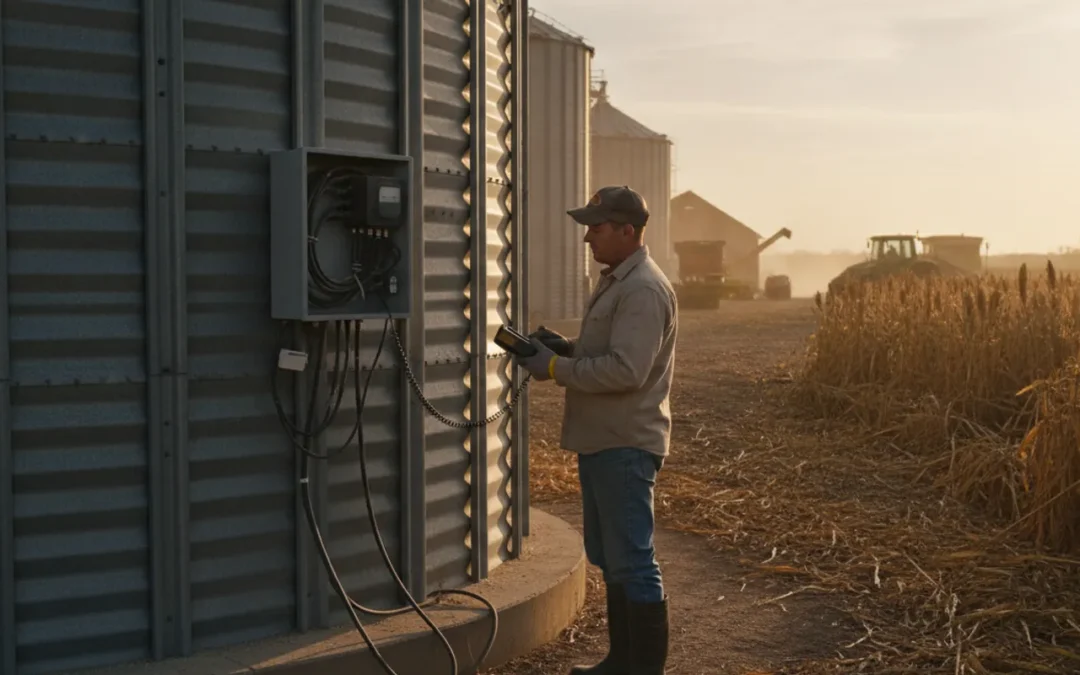
Sorghum grain bin monitoring is more than checking a temperature display now and then. A useful routine combines grain temperature, moisture condition, airflow, bin condition, and records of what has changed. These checks help you notice a developing issue early enough to investigate it, rather than treating one sensor reading as a complete picture.
Ask about grain monitoring options
Sorghum in storage needs attention for the same broad reasons as other cereal grains: grain can warm, moisture can vary, air may not move as intended, and weather or a bin defect can change conditions. The exact monitoring plan depends on the grain’s condition at storage, how long you expect to hold it, the bin and aeration setup, and local weather. This guide offers a practical checklist, not a substitute for grain-specific storage guidance from an extension specialist or other qualified adviser.
What should farmers monitor in a sorghum bin?
Build your checks around five categories. First, monitor temperature at more than one relevant point when the system allows it; a single reading may not represent the whole grain mass. Second, track moisture condition with a meter intended for the crop and use its instructions. Third, confirm whether aeration fans are running when you expect them to and whether the airflow path appears unobstructed. Fourth, check the bin’s roof, walls, doors, vents, and surrounding area for signs of water entry or damage. Finally, note odors, visible grain changes, insects or other pests, and any unusual sounds or equipment behavior.
Monitoring is most useful when it connects a reading to a decision. For each observation, record the date, where it was taken, the reading or sign, recent weather or fan activity, and what you did next. This makes it easier to distinguish a one-time fluctuation from a continuing trend. The Grain Temp Guard grain bin monitoring page describes a system with temperature and humidity sensors, which can be considered as part of a monitoring plan.
Why does temperature deserve regular attention?
Temperature is an important signal because localized warming can indicate that conditions in part of the grain mass are changing. It does not, by itself, identify the cause. A reading can be affected by location, the sensor’s placement, the outside temperature, recent fan operation, and the condition of nearby grain. Compare readings over time and across available sensor locations instead of reacting to an isolated number without context.
Establish a baseline after the grain is placed in storage and the bin has settled into its normal operating state. Record the sensor locations and readings, then use a consistent schedule to check them. Look for a rise that persists, a difference that grows between locations, or a pattern that differs from previous checks. If a reading is unexpected, verify it when possible and inspect the surrounding conditions. Do not assume that a sensor reading represents every part of the bin.
Temperature checks also need interpretation alongside the season and airflow. A change following a fan run may have a different explanation from a change with no recent airflow. Likewise, the top, center, and lower portions of a bin may not respond alike. Keep notes about fan operation and outside conditions so that the readings tell a more complete story. The goal is to identify changes worth checking, not to treat one universal temperature number as the answer for every bin.
How should you check moisture in stored sorghum?
Start with a representative sample and a meter that supports sorghum. Follow the meter’s instructions for sample preparation, calibration, temperature correction, and repeat readings. A quick sample from one convenient location can miss variation across the load, so use a sampling approach that reflects how the grain was filled and how it is stored. Record where each sample came from, the meter used, the reading, and the date.
A moisture reading should be treated as an input to a storage decision, not a guarantee that every kernel is at the same condition. Moisture can differ between loads or within a bin. It can also change where air movement or moisture migration is uneven. If a reading is surprising, check the meter procedure, take another representative sample, and compare it with prior records. Avoid relying on a displayed value without knowing whether the instrument is suitable for sorghum and being used as directed.
Keep grain moisture measurement distinct from air humidity. A sensor that reports humidity in the bin headspace can add useful context, but it is not a direct replacement for a grain sample measured with an appropriate meter. The farm moisture meter guide and grain moisture meter guide can help you think through equipment and measurement questions. For a decision involving safe storage duration or a specific moisture target, consult crop-specific guidance suited to your storage conditions.
What signs in the bin and grain should prompt a closer look?
Instrument readings are only one part of a check. Look for damp areas, roof leaks, condensation, water around the foundation, damaged seals, blocked vents, or evidence that pests have entered. Where it is safe and practical, inspect grain surfaces and accessible areas for unusual discoloration, clumping, crusting, or other changes from the condition you recorded at filling. Notice any musty or otherwise unusual odor, but do not enter a bin or take an unsafe position to investigate it.
Some warning signs can appear outside the bin before a sensor makes the problem obvious. Check roof and wall seams, eaves, doors, ladders, and the ground around the bin after severe weather. Make sure vents and fan openings are not blocked by debris or other obstructions. If there is visible water entry or structural damage, address the source and get qualified help as needed; moving air through wet or damaged grain is not a substitute for finding the cause.
Use a safe access plan. Grain bins present serious hazards, including engulfment and moving equipment. Do not enter a bin to inspect a suspected problem while grain is flowing or equipment could start. Follow applicable safety procedures and seek trained assistance for any inspection that requires entry.
How do fans and airflow fit into sorghum monitoring?
Monitoring should include whether the aeration system is doing what you expect. Record when fans are switched on and off, the reason for operation, and any relevant conditions you use to guide the decision. Confirm that the fan and controls behave normally, that the intake and exhaust paths are clear, and that air appears to move through the intended route. A fan running is not proof that the whole grain mass is receiving the expected airflow.
Separate aeration from drying in your notes and decisions. Their purposes and operating requirements are not interchangeable. Whether airflow is appropriate depends on the grain condition, the system design, and the conditions outside the bin. Do not operate a fan solely because a temperature changed; first understand the system guidance and the likely effect of the air being introduced. The article on grain drying versus aeration explains why those terms should not be treated as the same job.
If you use automated controls, include their settings and behavior in the record. Note what conditions the system uses, how it indicates operation, and what you do if a sensor or control appears inconsistent. An automated reading can make checks easier, but it does not remove the need to inspect equipment and grain condition. To compare the role of bin sensors with other monitoring tools, see the grain bin sensor overview; confirm that any tool you select is appropriate for the crop and application.
How often should you check stored sorghum?
Set a schedule before storage begins, then adjust it to the grain condition, expected storage period, weather, bin design, monitoring equipment, and any changes you observe. The important thing is to check consistently and more closely when there is a reason for concern. A scheduled look at trend data and a physical inspection answer different questions, so include both where feasible.
- At filling: Record the source or lot, date, available moisture readings, initial temperatures, bin condition, and the sensor locations.
- During routine storage: Review available temperature and humidity data, sample moisture as appropriate, inspect accessible bin areas, and record fan operation.
- After a major weather event or equipment change: Check for water entry, blocked airflow, damaged components, or unexpected changes in sensor readings.
- When a reading or observation changes: Verify the measurement, check related locations and equipment, document what you find, and decide whether an expert or corrective action is needed.
- Before moving or using the grain: Reassess its condition and review the history rather than relying only on the last reading.
These are categories of checks, not a fixed calendar for every farm. If you are unsure how frequently to sample or what conditions require action, ask a local extension service or grain-storage professional for guidance that fits the grain, bin, and season. The guide to keeping grain from spoiling offers additional storage-maintenance context. For general U.S. agriculture information and access to agency resources, consult the U.S. Department of Agriculture website; use crop-specific guidance for operational decisions.
How should you set up a monitoring routine for each bin?
Make the routine specific to the bin rather than assuming every storage unit has the same risks or equipment. Label each bin and sensor clearly, keep a simple map of sensor locations, and record which fans or controls serve that bin. If bins hold different lots or were filled under different conditions, keep their notes separate. A clear label helps prevent a reading from being attributed to the wrong bin during a busy workday.
Establish a starting record as soon as practical after filling. Note the date, the grain condition you can measure, the sensor readings available, whether the bin has aeration or automated controls, and any known concerns such as a weather interruption during filling. Write down which data are direct measurements and which are observations. This baseline does not prove that the entire grain mass is uniform; it gives you something to compare later.
Decide in advance who will check each bin and how the findings will be shared. A paper sheet, spreadsheet, or digital log can all work if the information is consistent and accessible to the people responsible for action. Include a place to record missing readings, equipment faults, and follow-up. If a check is skipped, note that too. Gaps matter because they affect how confidently you can interpret a change between two readings.
Finally, define escalation steps in plain language. For example: verify an unexpected measurement, inspect the related sensor and fan equipment, record what you find, and contact a qualified grain-storage adviser if the reading remains unexplained or the grain shows concerning changes. Do not invent a one-size-fits-all alarm threshold when the appropriate limit depends on grain condition, storage goals, and equipment. Use the sensor maker’s instructions and crop-specific professional guidance to set any system alerts.
What should you compare when choosing a monitoring approach?
Before buying equipment, identify the decision you need the system to support. Are you trying to see temperature changes at several points, check humidity conditions, measure grain moisture, or verify fan operation? No single sensor necessarily answers every one of those questions. A useful system should fit the bin and your routine, give readings you can interpret, and make it clear when a value comes from a sensor versus a sample.
Monitoring method: Temperature sensors
What it can help you observe: Temperature readings at the installed sensor points and changes over time
What it cannot establish by itself: Condition of every part of the grain mass or the cause of a change
Practical check: Record sensor locations and compare readings over time
Monitoring method: Humidity sensor
What it can help you observe: Humidity conditions at the sensor location
What it cannot establish by itself: Grain moisture content throughout the bin
Practical check: Interpret with grain samples and system instructions
Monitoring method: Grain moisture meter
What it can help you observe: Moisture reading from the sample tested
What it cannot establish by itself: Uniform moisture across all grain or bin locations
Practical check: Use a sorghum-compatible method and representative samples
Monitoring method: Visual and equipment inspection
What it can help you observe: Leaks, damage, obstructions, unusual grain appearance, and equipment condition
What it cannot establish by itself: Hidden conditions that are not visible or accessible
Practical check: Use a safe checklist and record findings
Monitoring method: Fan-operation log
What it can help you observe: When the system ran and what operating conditions were noted
What it cannot establish by itself: That airflow reached every area or achieved a specific result
Practical check: Compare run records with sensor trends and inspections
Also compare installation requirements, power and connectivity needs, number and placement of sensors, how readings are displayed, and the maintenance routine. Ask what happens if a sensor stops reporting or gives an implausible value. Make sure you know how to verify readings and whether an ongoing connection or service is required. For product details and fit questions, review the Grain Temp Guard product information or contact the manufacturer before deciding.
How can you turn readings into a simple record?
A useful log does not need to be complicated. Use one row per check and make the same fields available each time. If multiple people check the bin, agree on how to record sensor names, units, sampling locations, fan status, and actions. Consistent records help prevent a reading from being misread later or separated from the conditions that explain it.
- Date and time, bin identifier, crop and lot if applicable.
- Temperature and humidity readings, with sensor locations and any unavailable sensor noted.
- Moisture sample result, sampling point, meter, and any relevant meter instructions followed.
- Fan and control status, operating times, and conditions considered in the decision.
- Weather event, visible inspection findings, odors or other unusual observations.
- Next action, person responsible, and date for rechecking.
Write down uncertainty instead of filling gaps with guesses. For example, note that a sensor was not reporting or that the sample came from an accessible point rather than a full-bin composite. A record that honestly states its limits is more useful than a precise-looking number without context. Review trends as a whole and escalate persistent or unexplained changes.
What should you do when readings disagree?
Do not average away a warning or assume that the device you trust most is always right. First confirm the basics: correct bin and sensor, units, power or communication status, meter procedure, sample location, and recent fan activity. Repeat a measurement when practical, compare nearby or other available locations, and inspect the equipment. If independent methods still disagree, retain both results and seek qualified advice rather than choosing the more reassuring value.
A trend across several checks often provides more context than a single reading, but persistent change still calls for investigation. Consider whether the sensor is placed where it can give a representative reading, whether maintenance is due, or whether airflow and weather explain part of the difference. If you detect water, abnormal odor, visible deterioration, or a continuing temperature change, respond promptly under your farm’s safety and grain-handling procedures.
When conditions change, follow a repeatable sequence rather than jumping straight to a control adjustment. Confirm the bin identity and reading, check other sensor points, note whether a fan recently ran, and inspect the equipment and accessible bin exterior. If a grain sample is appropriate and safe to obtain, use the same careful method and meter procedure as previous samples so the comparison is meaningful. Write down each check and the reason for any action. If the concern persists, share the record with someone qualified to advise on that grain and storage system.
Keep the response proportional to what you know. A single unexpected reading may need verification, while multiple signals that point in the same direction deserve prompt attention. Do not delay investigating clear water entry, equipment damage, or signs of deteriorating grain just because another sensor looks normal. Conversely, do not assume that changing airflow or starting equipment is automatically the right correction; follow the system instructions and seek advice where the cause or safe response is uncertain.
What is a practical next step?
Start with an inventory of each sorghum bin: capacity and design, aeration equipment, sensors and their locations, grain moisture measurement method, and the person responsible for checks. Then write down your baseline and a schedule for readings, physical inspections, and record review. Identify who you will call if a reading changes and what safe verification steps are available without entering the bin.
Discuss grain monitoring for your bins
A repeatable routine that combines measurements, inspection, and clear records gives you a stronger basis for decisions about stored sorghum than any one reading alone.