
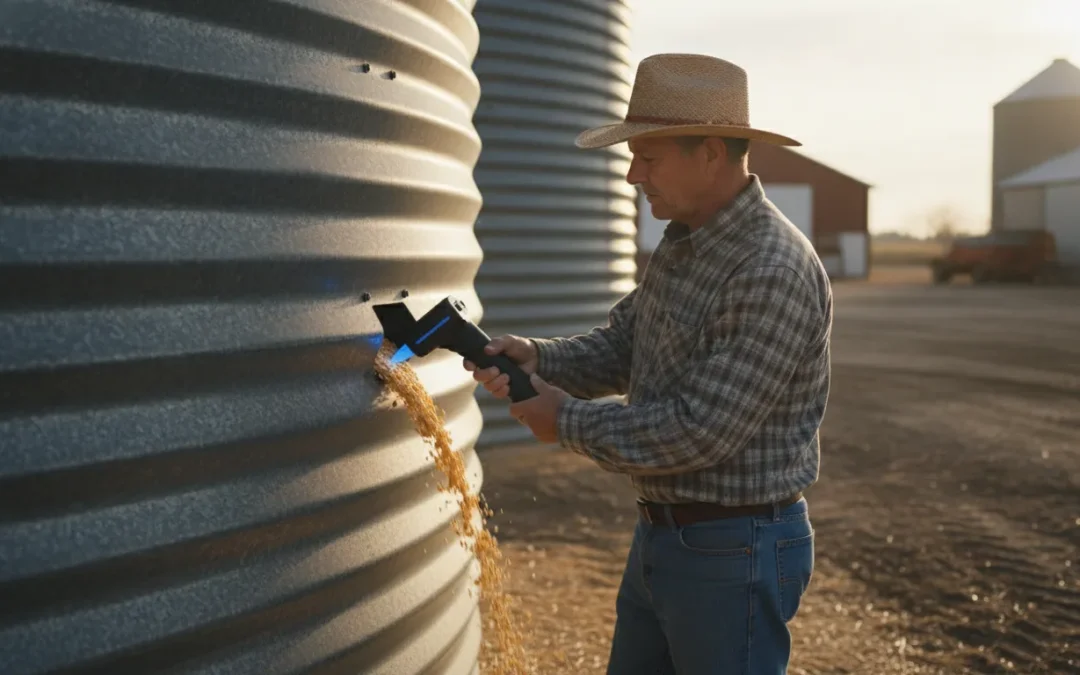
A grain bin can lose value long before a problem is obvious from the outside. A small area with rising temperature can pull moisture toward it, restrict airflow. And create conditions where fines, mold, and heat damage build faster than a routine inspection catches them.
The missed hot spot grain damage cost depends on the crop, bin size, moisture change, and how long the problem develops. A temperature rise is a warning signal, not a guaranteed dollar loss. But earlier visibility gives you more time to aerate, turn or core grain when appropriate, and protect market-grade quality. Grain Temp Guard tracks bin temperature and humidity and provides visual and audio alarms when readings move outside normal conditions.
That matters in a 3,000- to 45,000-bushel operation, where a localized issue can become a larger handling, quality, or moisture problem. Understanding how quickly heat moves through stored grain helps clarify why timing matters.
Contact Farm Shop MFG about earlier hot-spot detection
How Fast Can a Missed Hot Spot Spread Through a Grain Bin?
There is no reliable countdown from the first warm reading to a specific dollar loss. A missed hot spot can develop at different rates because moisture, grain temperature, fines, airflow, crop condition, and the size of the affected area all change the outcome. The financial risk is not only spoiled kernels. It can also include extra aeration, unloading, coring, drying, handling, and grain that no longer meets the quality standard you expected to sell.
Why the center of the bin deserves attention
Fine material commonly collects near the center of a bin as grain is loaded. Those fines can restrict air movement, making it harder to cool the grain evenly during aeration. They may also contain a higher concentration of diseased or moldy kernels. That combination creates a localized area where heat and moisture problems can become more difficult to correct. Farm Progress describes how fines can interfere with aeration and contribute to hot spots, especially when grain is peaked over the center.
As conditions change, a warm area can affect nearby grain through moisture movement and uneven airflow. Warmer grain may increase the chance of condensation in cooler portions of the bin. Restricted airflow can leave the problem concealed between routine checks. A temperature rise is an important warning signal. But it does not prove that a particular percentage of grain is damaged or that a specific loss has already occurred.
That is why the cost of a missed hot spot depends on what happens next. If the problem is identified while the affected area is limited, a farmer may be able to respond with appropriate aeration, coring, or grain movement. If detection comes after quality has deteriorated, the response may require more labor and may still leave grain downgraded, rejected, or harder to market. The right response depends on the crop, moisture condition, bin design, temperature pattern, and current weather. Review what causes hot spots in grain bins for the broader storage conditions behind this progression.
Put simply, early visibility protects options. A farmer who sees a changing temperature pattern can investigate before a localized issue becomes a larger quality and handling problem. Monitoring does not guarantee that every loss will be prevented. But it can reduce the time a developing hot spot remains hidden and help protect the value already sitting in the bin.
What Does Moldy or Heat-Damaged Grain Look Like?
A hot spot does not always announce itself with an obvious patch of ruined grain. By the time damage is easy to see, the affected area may already have quality and handling consequences. Use visual checks as one part of a routine inspection, not as proof that the entire bin is safe.
Warning signs to look for
- Musty, sour, or unusually warm odors: An odor that is different from the rest of the bin can signal changing grain conditions. It does not identify the cause by itself, so treat it as a reason to investigate.
- Caking and crusting: Grain that bridges, clumps, or forms a hard crust may have experienced moisture migration, heating, or restricted airflow. A crust can also hide looser or wetter grain underneath.
- Discoloration: Darkened, stained, visibly moldy, or heat-affected kernels deserve attention. However, discoloration is not present in every developing problem, and a few damaged kernels do not establish the condition of the whole bin.
- Unusual condensation: Moisture on the roof, walls, or other surfaces can point to temperature differences and moisture movement. Condensation is a warning condition, not a diagnosis of spoilage.
- Changed grain flow: Bridging, poor unloading, unexpected clumping, or a flow pattern that differs from normal can indicate fines or consolidated grain. Fine material commonly collects near the center of a bin, where it can restrict aeration. Farm Progress also reports that fines may contain a higher concentration of diseased or moldy kernels, making this area worth checking carefully: Farm Progress explains how fines contribute to bin hot spots.
Why a clean-looking surface is not enough
Heat and moisture problems can develop below the surface or in a localized section of the grain mass. A quick look from the roof hatch may miss a concealed hot spot, especially when the problem is near the center, wall, or another area with limited visibility. A temperature rise is a warning signal, not a guaranteed measurement of spoilage or a specific financial loss. Compare readings over time, check for changes in odor and flow, and record where each observation occurred.
Do not enter a grain bin to investigate a suspicious area. Bridging and crusted grain can collapse without warning, and flowing grain can engulf a person. Follow your farm’s confined-space procedures, shut down unloading equipment before anyone works near an opening, and use trained personnel and proper safety equipment. If conditions are questionable, call a qualified grain-handling professional.
For a safe response, confirm the reading, assess whether aeration conditions are suitable, and ask an experienced operator whether coring or controlled grain movement is appropriate. The goal is to expose and manage the problem before quality declines further. Monitoring provides earlier visibility, not a guarantee that every loss will be prevented.
Where Does the Missed Hot Spot Grain Damage Cost Show Up?
The cost of a missed hot spot is rarely one clean line on a settlement sheet. It can show up as less saleable grain, more work around the bin, reduced flexibility at delivery, or a quality problem that forces a different marketing decision. A temperature rise is a warning signal, not proof of a specific dollar loss. The actual impact depends on the crop, moisture, affected volume, severity, and how quickly the problem is found.
| Cost area | What may happen | Why it matters |
|---|---|---|
| Saleable weight | Dry matter and product weight can decline as grain loses moisture or deteriorates. | Each 1% moisture loss reduces product weight by approximately 1.5%, according to Farm Shop MFG’s qualified storage example. That relationship is not a guaranteed hot-spot loss calculation. |
| Quality downgrade or rejection | Heating, mold, fines, or damaged kernels can affect whether grain meets a buyer’s specifications. | A lower grade, added handling requirement, or rejected load can reduce market options. Elevator discounts vary by crop, location, contract, and inspection results, so they should be confirmed with the actual buyer. |
| Aeration and handling labor | The response may require checking the bin, running fans under suitable conditions, turning grain, or coring concentrated fines. | Fines can collect near the bin center, restrict airflow, and include a higher concentration of diseased or moldy kernels. Farm Progress describes aeration and coring as practical responses to this condition: see the reported hot-spot mechanics. |
| Moisture reconditioning | Grain may need additional drying, blending, or conditioning before it can be marketed. | Those steps consume time and energy and can delay delivery. The cost depends on the amount affected and the condition of the grain, not simply on the fact that a temperature changed. |
| Market flexibility | A farmer may lose the ability to hold, deliver, blend, or sell grain on the original schedule. | Less flexibility can matter when contracts, basis opportunities, storage plans, or available hauling capacity change. |
Keep large-bin examples in context. Farm Shop MFG documents that, for a 30,000-bushel bin, preventing 1% of overdrying can protect saleable value. That example assumes a stated crop, bin size, and moisture change. It is not a promised savings figure or an estimate of what every missed hot spot will cost.
The practical takeaway is to find abnormal conditions while the response is still manageable. Early visibility can help protect market-grade grain and preserve choices, even though no monitoring system eliminates every storage risk.
How Should Farmers Respond When Bin Temperature Rises?
A rising reading is a warning to investigate, not proof that the entire bin is damaged. The right response depends on where the increase appears, how quickly it changes, grain condition, and whether airflow can be used safely. Follow your crop-specific storage plan and local extension guidance when those sources call for a different procedure.
- Verify the reading and its location. Check the sensor, probe connection, and recent readings before changing equipment settings. Note whether the increase is isolated to one probe or occurring across several locations. Compare the reading with your normal operating range and use this guide to review safe grain storage temperatures. A single high reading can reflect a sensor issue, while a repeated rise in the same area deserves prompt attention.
- Keep people out of an unsafe bin. Do not enter simply to investigate a hot spot. Flowing grain can engulf a person, and grain dust creates additional hazards. Keep the unloading system stopped unless you are operating it under your established safety procedures. If entry is ever necessary, use the required lockout, atmospheric testing, harness, attendant, and rescue controls. Temperature data should help you decide what to do next without creating a second emergency.
- Assess moisture, grain condition, and airflow. Review harvest moisture, recent weather, fan operation, and any history of uneven filling or heavy fines. Fine material can collect near the center of a bin, restrict air movement, and include more damaged or moldy kernels. Look for crusting, caking, unusual odors, condensation, or changes in airflow from outside the bin. These clues help distinguish a localized problem from a broader storage issue.
- Aerate only when conditions fit. Aeration can bring grain toward a safer, more uniform temperature, but running a fan at the wrong time can add moisture or move the problem through the bin. Use the temperature, humidity, grain moisture, and local storage recommendations together. Confirm that the fan, ducts, roof vents, and power supply are working before starting. Do not treat aeration as an automatic response to every alarm.
- Core or turn the grain when appropriate. If fines are concentrated in the center, controlled coring may remove some of that material and improve airflow. Follow the bin manufacturer’s operating instructions and your farm’s unloading safety procedures. Whether coring, turning, or moving grain is appropriate depends on bin design, grain condition, and the severity of the heating. Do not improvise an unloading plan around a suspected bridge or crusted surface.
- Recheck and document the result. Continue watching the affected probe and nearby readings after the response. Record the date, temperature, location, moisture observations, fan conditions, grain movement, and follow-up readings. If the temperature keeps rising, odors or visible damage increase, or the system cannot move air effectively, contact a grain-storage professional or local extension specialist promptly. The record gives you a practical basis for the next decision and helps identify recurring trouble spots.
How Grain Temp Guard Helps Catch a Hot Spot Earlier
A missed hot spot becomes expensive when a farmer does not know conditions are changing until quality has already declined. Grain Temp Guard is built to improve that visibility. It tracks bin temperature and humidity, helping identify abnormal temperature increases before a localized problem becomes harder to manage.
See changing conditions instead of relying only on spot checks
A manual check can tell you what is happening at the time of inspection. It may not show how conditions changed between checks, especially when a hot spot develops in one area of the bin. Grain Temp Guard monitors conditions inside the bin and provides a warning when readings move outside the normal range. That gives the farmer a signal to confirm the reading, inspect the bin safely, and decide whether aeration, coring, or turning is appropriate.
The system is not a guarantee against spoilage. A temperature increase is a warning signal, not proof of a specific dollar loss. Its value is earlier awareness, which can give the operator more time to respond while the issue is still localized. For broader guidance on using temperature data to protect stored grain, see this grain bin temperature monitoring guide.
Choose the information your bin requires
Farm Shop MFG offers Grain Temp Guard in Dual-Temp and Humidity-Temp configurations. The right configuration depends on the conditions you need to watch and the way you manage that bin. Tracking humidity alongside temperature can add useful context when readings change, while a temperature-focused setup may fit an operation with a simpler monitoring need.
Grain Temp Guard uses 110V external power with an internal battery backup. That arrangement supports ongoing monitoring while providing backup power if the external supply is interrupted. Visual and audio alarms notify the farmer when readings move outside the normal range, so the system does not depend on someone constantly watching a screen.
Turn earlier visibility into a practical decision
When an alarm occurs, use it as a prompt to verify conditions and follow your farm’s safe grain-handling procedures. Look at the reading in context, consider recent weather and aeration activity, and avoid treating one alert as an automatic diagnosis. The goal is to reduce the time between a developing problem and a deliberate response.
That matters when the alternative is discovering damage at unloading or delivery. Grain Temp Guard helps farmers maintain market-grade status longer by making changing bin conditions easier to see. Learn more about the Grain Temp Guard grain bin monitoring system and how it can fit your storage setup.
What Is the Cost of Waiting Compared With Early Detection?
The cost of a missed hot spot is not one fixed number. It depends on the crop, the size of the affected area, how long the condition continues. The moisture pattern, and whether the grain can still be brought back to marketable condition. A temperature rise is a warning signal, not a guaranteed dollar loss. That distinction matters when deciding what early detection is worth.
One documented Farm Shop MFG example shows the exposure from a different but related storage problem: overdrying. In a 30,000-bushel bin, preventing 1% of overdrying can protect saleable value. The example assumes the stated crop, a 30,000-bushel bin, and a 1% moisture change. The underlying rule is that each 1% moisture loss reduces product weight by approximately 1.5%.
That example is about overdrying, not the guaranteed dollar cost of a missed hot spot. It should not be applied to every bin or crop. Instead, it illustrates avoided-loss logic.
Earlier information gives you more time to decide whether to aerate, turn or core grain. Inspect safely, or adjust your marketing plan before quality and weight losses become harder to recover.
Early information protects more than grain weight
Waiting can narrow your options. A developing problem may require an unplanned trip to the bin, extra fan operation, grain handling, or labor during a busy stretch of harvest and marketing. If grain quality changes, you may also lose flexibility in when and where you sell it. A timely warning does not eliminate those costs, but it can help you address a localized condition while the response is smaller, more targeted, and easier to schedule.
That is the practical value of monitoring. Grain Temp Guard tracks bin temperature and humidity and is designed to identify abnormal increases, with visual and audio alarms when readings move outside the normal range. It gives you information to act on earlier. It does not guarantee that every loss will be prevented, and it does not replace sound aeration, inspection, and grain-management decisions.
For a closer look at your storage setup and whether earlier visibility fits your operation, reach out directly.
Contact Farm Shop MFG about Grain Temp Guard
Frequently Asked Questions
What does a missed hot spot grain damage cost?
There is no single dollar figure. The outcome depends on crop, bin size, moisture, how long the heating continues, and whether the grain is downgraded or must be cleaned and handled again. A useful benchmark is weight loss: each 1% moisture loss reduces product weight by approximately 1.5%, according to Farm Shop MFG’s cited storage guidance (source). Treat any example as a planning estimate, not a guaranteed hot-spot loss.
How does a hot spot turn into grain damage?
Heating often develops where fines collect, commonly near the center of the bin. Fines restrict airflow and can contain more diseased or moldy kernels, creating conditions that are harder to cool with aeration. As temperature and moisture conditions worsen, spoilage and quality problems can spread. The timing varies with grain condition, weather, airflow, and the size of the affected area.
Can farmers see a hot spot before the grain is damaged?
Not reliably through a visual check alone. Surface observations may miss a problem deeper in the mass, and a temperature rise is a warning signal, not proof of a specific loss. Regular inspections still matter, but continuous temperature monitoring can add earlier visibility into changing conditions inside stored grain.
How does Grain Temp Guard help with early detection?
Grain Temp Guard tracks bin temperature and humidity and is designed to detect abnormal temperature increases. Visual and audio alarms notify the farmer when readings move outside the normal range, giving you earlier visibility to confirm conditions and choose a response. It helps reduce risk, but it does not prevent every storage loss. See the Grain Temp Guard details for available configurations.
Contact us about protecting stored grain
Earlier visibility can help you investigate changing bin conditions before a localized problem becomes a larger quality or handling issue. Grain Temp Guard is designed to help farmers track temperature and humidity changes, so you can make a more informed decision about inspection, aeration, or grain movement. To discuss your storage setup and whether it fits your operation, contact Farm Shop MFG.