
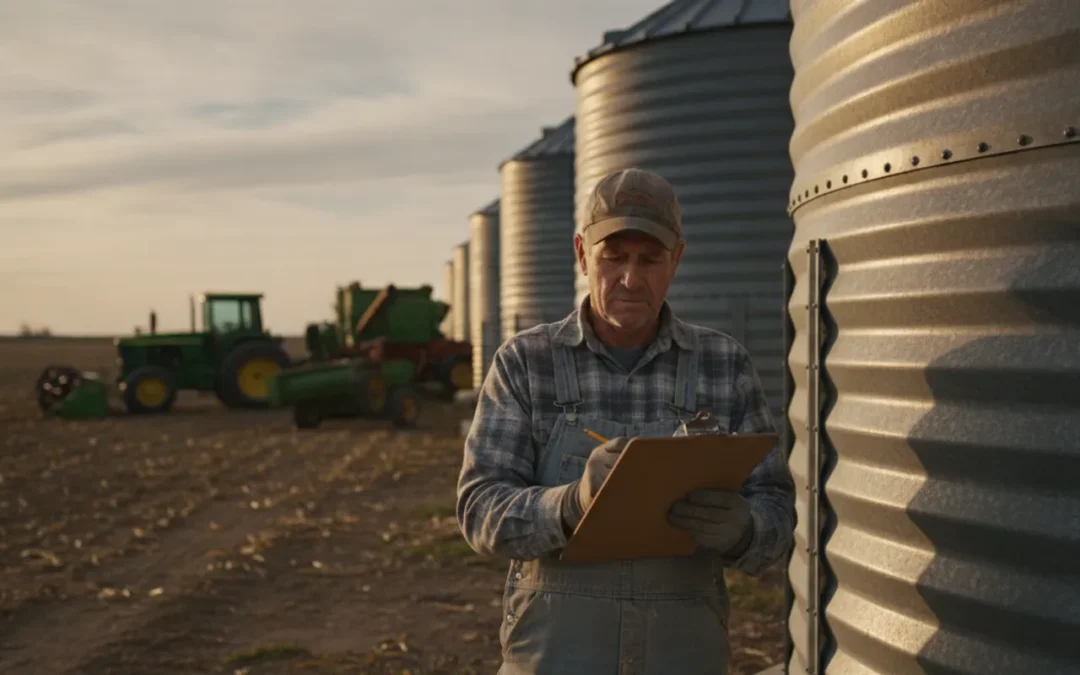
A useful grain storage monitoring template does more than collect numbers. It gives you a consistent place to record which bin you checked, what you measured, what you observed, and what you did next. That makes it easier to notice a change, compare checks over time, and hand off a clear record when someone else is helping with the bins.
Ask a question about grain monitoring
What should a grain storage monitoring template include?
Start with a separate entry for each check, not just one running note for the entire site. The record should identify the bin and the check date, preserve the readings in their original units, and leave room for context. A number without a bin name, location, or time is hard to use later.
A practical log can be a paper sheet, a spreadsheet, or a digital record. Choose the format people will actually use. Keep the same field names from check to check, and make sure every person who records information understands what each field means. If you have several bins, use a stable bin ID that appears on the log and on the bin itself.
| Template section | What to record | Why it helps |
|---|---|---|
| Bin identity | Bin ID, crop, approximate capacity or fill level, and location | Connects each observation to the right storage unit |
| Check details | Date, time, person checking, and check method | Makes entries comparable and clarifies who gathered them |
| Measurements | Temperature readings and moisture readings when taken, with units and measurement location | Preserves the actual result rather than an undocumented impression |
| Conditions | Weather or ambient conditions, fan status, and unusual sounds, odors, or visible signs | Adds context that may help explain a change |
| Response | Action taken, reason, time started, and person responsible | Shows what happened after a concern was noticed |
| Follow-up | Next check date or trigger, new reading, and whether the concern changed | Closes the loop instead of leaving an unresolved note |
Use the table as a starting point, not a substitute for the operating instructions for your equipment or the practices appropriate for the crop and storage conditions. The template organizes information. It does not determine a safe storage limit or decide what action is right for every bin.
A copyable entry format
Set up a blank entry with labels that prompt a complete record: Bin ID; crop and fill date; check date and time; person checking; measurement source and location; reading and units; fan or equipment status; conditions or observations; action taken; person responsible; and next check or follow-up. Keep these labels together in one row or one clearly separated section. A short prompt beside a field can reduce guesswork, such as “location / sensor point” rather than “temperature.”
Before the first routine check, fill in stable identifying details such as the bin ID and crop, then add the new details each time. Do not prefill a measurement or mark a check complete in advance. If a field does not apply, use a consistent note such as “not applicable”; if the check was not done, write “not checked” and explain why when useful. This distinction keeps an empty cell from being mistaken for a normal result.
At the end of each entry, scan for four basics: the right bin, a dated reading with its source and units, a plain description of anything unusual, and a named next step when needed. That quick review catches missing context while the person who performed the check can still clarify it.
How should you identify each bin and each check?
Give every bin a short, unique identifier, such as a number or a location-based label. Avoid relying only on descriptions such as “north bin” if there is more than one possible interpretation. Write the ID at the top of every page or in every spreadsheet row. If a bin’s use changes, add a note rather than reusing its old record without explanation.
Record the crop and any details that help distinguish the stored grain, such as the date it was filled or a lot name used on your farm. Keep those notes factual and concise. The purpose is to tell future readers what is in the bin and which period of storage an entry belongs to, not to create a second harvest ledger.
For every entry, capture the date and time, the name or initials of the person checking, and the method or equipment used. If readings come from a sensor system, identify the system or sensor location. If someone took a manual measurement, note where and how it was taken. Consistent methods make comparisons more meaningful; when the method changes, say so in the notes.
A simple row could read: “Bin B; corn; Nov. 20, 8:15 a.m.; checked by AB; sensor reading, upper cable.” That example is a format, not a recommended reading or a safety threshold. Add an exact date instead of “today,” and avoid shorthand that another person may not recognize.
Which readings belong in the monitoring log?
Record the readings your monitoring routine actually takes. For temperature, preserve the value, units, time, and location or sensor point. If a system provides several points, do not collapse them into one average unless the system or your established procedure calls for that calculation. Individual points may help show where a change occurred.
When you take a moisture reading, note the value, units, sampling location, and the instrument or method used. A moisture reading taken at one spot should not be described as though it represents every part of the grain mass. Be clear about what was sampled. If your farm uses a handheld meter for a specific decision, a guide to farm moisture meters can help distinguish the measurement tool’s role from ongoing bin monitoring.
Do not erase an earlier number simply because a later reading differs. Keep both readings, and add a note about what changed: location, method, instrument, sensor, or conditions. If you correct a typo, leave a visible correction trail in a paper log or use the spreadsheet’s version history when available. A clean-looking record is less valuable than an honest one.
Choose a unit convention and use it consistently. If equipment displays a different unit than the written log, record the displayed value and unit first, then document any conversion separately. That prevents later readers from mistaking a converted figure for the instrument’s original reading.
What observations should you add beside the numbers?
Numbers are more useful when the record captures relevant operating conditions. Note whether a fan was off, running, or recently operated, if that information is part of your routine. Record unusual weather or a major change in conditions when it could provide useful context. Keep observations specific: “fan ran from 6:00 to 8:00” says more than “fan used.”
Write down unusual odors, visible condensation, signs of moisture, changes around access points, or other conditions that prompt a closer look. Do not enter a conclusion as if it were a measurement. For example, distinguish “odor noticed near access opening” from “grain spoiled.” If a condition is uncertain, mark it as an observation to verify.
Record the status of equipment you checked, such as whether a sensor was reporting or a fan control appeared to be operating as expected. Note a warning, lost connection, or other irregularity in plain language. The log should help someone understand what the equipment showed and what the person checking actually observed, without assuming that monitoring equipment can detect every issue.
If a reading seems inconsistent with the previous one, record the discrepancy and repeat or verify the check according to your normal procedure. Keep the first value as well as the follow-up result. More detail about selecting and understanding monitoring equipment is available in this grain moisture sensor guide.
How do you record an action and make sure it gets followed up?
A monitoring note should not stop at “concern found.” Record the next step, who is responsible, and when the situation will be reviewed again. If an action is started, note its start time and the equipment involved. When it ends, record the end time or the point at which it was stopped, if known.
- What prompted the action: identify the reading or observation, including the location and time.
- What was done: describe the check, adjustment, or other response in plain terms.
- Who handled it: use a name or initials that can be understood by the people who use the log.
- What happens next: assign a follow-up check or a specific question to resolve.
- What the follow-up showed: add the new reading and state whether the condition changed, remained, or needs more attention.
Use an open-item marker for issues that have not been resolved, such as “follow-up due” or “verify sensor.” Remove the marker only after the follow-up is recorded. This small habit helps keep a temporary concern from disappearing between shifts or during a busy work period.
Keep the wording neutral. Instead of writing “fixed,” say what was checked or changed and what result was observed. If the response did not resolve the concern, state that plainly and record who will decide the next step. Follow the equipment instructions and your farm’s established safety procedures; a log is not a substitute for either.
How often should you use the template?
Set the schedule based on your storage plan, crop, conditions, equipment, and the instructions you follow. There is no single frequency that fits every bin. Write down the schedule you intend to use before the season or storage period begins, and record the actual check time each time you complete an entry. If a check is delayed or missed, say so rather than filling in a reading from memory.
Some farms may use more frequent checks when conditions are changing or a concern needs follow-up. The log can make that decision visible: record why the schedule changed, who made the change, and when the routine should be reviewed again. Do not let a monitoring schedule imply that a particular bin is safe simply because a check was completed.
When several people share monitoring duties, agree on a consistent handoff. The person finishing a check should identify unresolved items and the next expected action. The next person should review open notes before recording a new result. Clear ownership matters more than a complicated form that nobody completes.
How can you compare changes without overreading the data?
Compare readings from the same bin, location, method, and unit whenever possible. Look at the sequence over time, not just one isolated number. A change may deserve attention, but the record alone may not explain why it happened. Note possible context, then verify the measurement or investigate according to your established procedure.
Separate facts from interpretation in the template. A useful format is “Reading/observation” followed by “Follow-up or interpretation.” The first field holds what was measured or seen; the second holds a question, decision, or action. That separation makes the record more useful when a different person reviews it later.
Do not assume that a temperature or moisture value at one location describes the full bin. Sensor position, sampling method, and conditions can affect what a reading represents. For crop-specific monitoring considerations, see the page on grain bin sensors for corn. The page is a starting point for understanding monitoring coverage, not a replacement for your own storage plan.
When you need to review how readings relate to broader storage practices, keep the log alongside your grain storage guidance. Use it to organize the checks you perform and the questions you need to answer, rather than treating a single reading as a complete diagnosis.
How should you organize a template across multiple bins?
For a small number of bins, a printed page per bin can be simple to use. For a larger group, a spreadsheet may make it easier to sort by bin, date, open follow-up, or person responsible. Either way, keep one entry per check and preserve a separate record for every bin. Avoid putting a long series of dates into one cell or compressing several locations into one reading.
Use a consistent set of columns: bin ID, crop, date and time, checker, reading type, value, unit, location, conditions, observation, action, owner, and follow-up date or trigger. You may not fill every field for every check. Leave a clear blank or write “not checked” where relevant instead of leaving uncertainty about whether the field was overlooked.
Keep records where the people responsible can find them, and decide how long to retain them based on your farm’s recordkeeping needs. If using a digital file, make a backup and avoid a naming scheme that changes every time the file is updated. A filename such as “Bin B monitoring” is easier to find than an unnamed attachment or a note buried in a personal device.
Do not make the template unnecessarily elaborate. If a field does not help identify the bin, understand a reading, document a response, or plan follow-up, it may not belong on the routine form. Start with the essentials, use the form for a storage period, and then adjust it based on missing details or repeated confusion.
What tools can support the record?
A monitoring template works with manual checks or with equipment that records readings. A system that measures grain-bin temperature and humidity can provide a consistent source of readings, while the log still captures dates, context, observations, and decisions. Learn more about Grain Temp Guard monitoring and consider how its readings fit your own recordkeeping routine.
Fan operation is another distinct part of the record. Note what ran and when, and do not assume that a fan-control system replaces every other check. Farm Shop MFG describes its EndZone fan control system as a tool for bin fan management. The log can record control status and follow-up while you continue to use equipment instructions and your farm’s plan.
For a general federal resource, the U.S. Department of Agriculture is a starting point for agricultural information. This homepage is not a bin-specific operating guide; use equipment documentation and appropriate crop-storage guidance for decisions about your own grain.
What common recordkeeping mistakes should you avoid?
- Leaving out the bin ID: a reading that cannot be assigned to a bin is difficult to act on.
- Writing only a conclusion: preserve the measured value or observed condition, not just “okay” or “bad.”
- Mixing units or methods without explanation: label the original unit and make changes in method visible.
- Overwriting history: retain earlier readings and correct errors transparently.
- Using vague dates and times: enter actual dates and times so entries can be compared later.
- Recording action without follow-up: assign the next check and document its outcome.
- Treating an empty field as a negative result: say “not checked” when an observation was not made.
A log can help identify patterns and support communication, but it cannot guarantee grain quality or replace inspecting equipment and stored grain. If a condition raises concern, use the response process appropriate to your operation rather than relying on a blank or completed form to make the decision.
Frequently Asked Questions
Can I use one monitoring sheet for every bin?
You can use one standard form, but each entry should identify one specific bin. If a sheet covers several bins, give each bin its own clearly separated entry. Avoid combining readings or follow-up actions in a way that makes ownership unclear.
Should I record readings from sensors and manual checks together?
They can appear in the same log if each entry identifies the source, location, method, and units. Keep separate readings separate, and explain any difference in method. Do not present them as directly interchangeable unless your established procedure supports that comparison.
What if a reading changes sharply or does not match another reading?
Record both results, including the time, location, and method for each. Note the discrepancy and verify it according to your normal procedure or equipment instructions. Add the follow-up result and any action taken; do not erase the initial reading.
Does a monitoring template tell me when grain is safe?
No. A template organizes information and follow-up. It does not establish a universal safe temperature or moisture limit, diagnose a problem, or replace crop-specific storage guidance and equipment instructions.
Explore grain storage best practices
Start with a record you can complete consistently, review unresolved notes at every handoff, and update the template when your monitoring routine changes.