
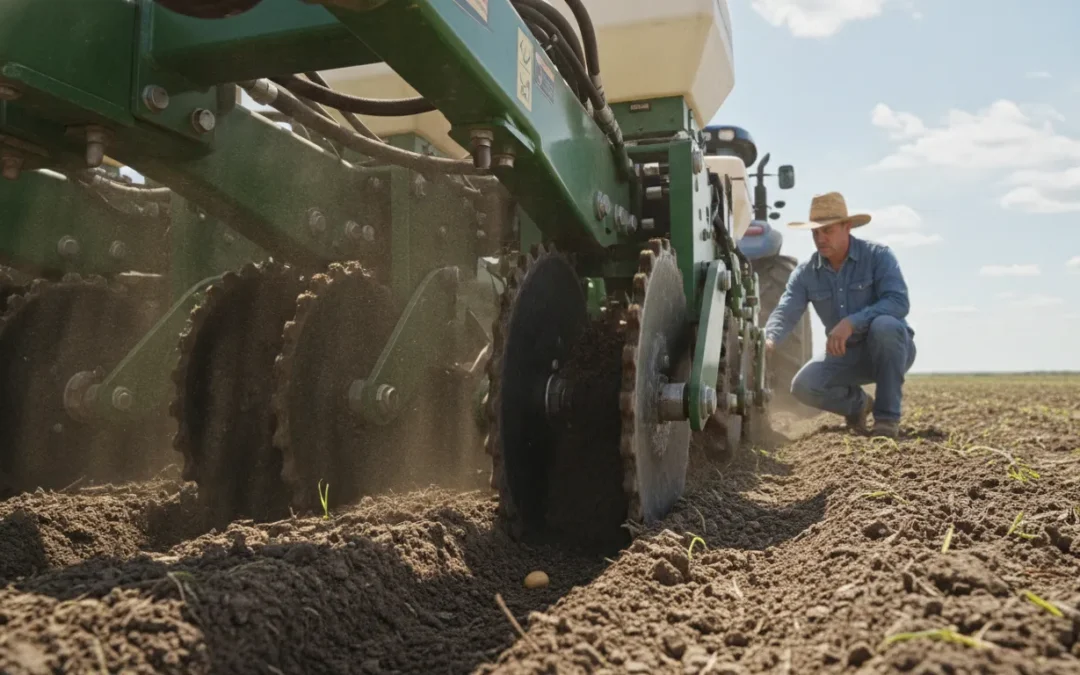
A planter can place every seed at the right depth and still set up a weak stand if the opener smears the furrow wall in wet soil. That compacted wall can restrict root growth, reduce seed-to-soil contact, and turn a planting pass into a yield problem that is difficult to correct later.
Sidewall compaction planter problems start when wet soil is compressed instead of fractured around the seed. The fix is to plant at workable moisture, manage row-unit down pressure, and use closing wheels that break the furrow wall without excessive compression. Farm Shop MFG reports a documented 3-5 bushels per acre increase with Germinator closing wheels compared with standard OEM equipment.
The economics deserve attention, too. At roughly $212 per row, Germinator closing wheels cost far less than Precision Planting wheels listed at about $1,208 per row. While premium 50-grade steel is built for repeated field use. First, it helps to see what is happening inside the furrow and why the damage can remain hidden after the soil surface looks normal. For a broader equipment overview, see how closing wheels can prevent destructive sidewall compaction.
Sidewall Compaction Planter: What Is Sidewall Compaction?
Sidewall compaction happens when the planter opener discs smear and compress the walls of the seed furrow, especially when planting into wet soil. Instead of leaving a friable path for roots to move into, the opener can press the furrow sides into a dense, polished barrier. South Dakota State University Extension identifies this smearing of the trench walls as a central risk of planting when soil moisture is too high. SDSU Extension explains the wet-soil risk in more detail.
That damage is easy to miss because the row can look finished from above. The seed may be covered, the surface may be level, and emergence may appear acceptable. Down in the seed zone, however, the soil structure at the furrow wall can still restrict the plant’s next move. A sidewall compaction planter problem is not simply a cosmetic mark in the row. It is a root-zone problem created at planting.
The root-in-a-slot pattern
Iowa State University Extension describes one of the clearest consequences: a “root-in-a-slot” pattern. Rather than spreading laterally into the surrounding soil, roots follow the compacted furrow downward. That limits the volume of soil the root system can explore during a critical part of crop establishment. The plant may have a good-looking stand while its roots remain confined to a narrow path.
Restricted root exploration can reduce access to water and nutrients later in the season, even after the soil surface dries and field conditions improve. In other words, better weather does not automatically erase the damage done inside the furrow. Iowa State Extension’s guidance on sidewall compaction connects the compacted root zone with reduced access to the surrounding soil volume.
Why the problem stays hidden
Surface improvement can hide an internal barrier. Once the seed furrow is closed, the affected sidewall is out of sight, and normal emergence can make the row look healthy. But a plant with restricted roots has less room to reach moisture and nutrients when demand increases. That is why inspecting only the surface can give a false sense of security. Digging a few plants and checking whether roots spread outward or track down the furrow tells you more about what happened at planting.
Good seed zone conditions help protect early crop development, but prevention starts with the interaction between soil moisture, opener pressure, and the closing system. Understanding that interaction is the first step toward choosing equipment and settings that prevent destructive sidewall compaction before it limits the crop’s root system.
What Causes Sidewall Compaction in Row Crop Planters?
The hardest planting decision is often deciding whether a field is truly ready or merely “fit enough” to keep the planter moving. A dry-looking surface can hide wet soil at opener depth. When the seed trench is opened in those conditions, the discs can smear and compress the furrow walls instead of making a clean seed zone.
Planting when the soil is too wet
Soils at or near field capacity have the greatest potential for sidewall compaction, according to SDSU Extension. That risk is not the same in every field. Soil texture, including the percentages of sand, silt, and clay, changes how susceptible the soil is at a given moisture level. A field may carry equipment well on top while the seed zone is still plastic enough to smear.
This is why the pressure to beat an approaching storm or finish a planting window can be expensive. If the soil forms a slick, continuous wall around the seed, waiting for conditions to improve would have been the better agronomic choice. Once created, that compacted wall cannot be cured later in the season.
Using more down pressure than the soil needs
Down pressure helps keep the row unit in the ground, but excessive pressure increases the likelihood of compaction in damp conditions. Damp residue can make the problem worse because the row unit needs more force to cut through it. That added force can transfer pressure into the seed furrow when the soil is already vulnerable.
Set pressure for actual field conditions, not a worst-case assumption. Check whether the opener is maintaining depth without forcing the row unit into wet soil. A sidewall compaction planter problem can begin with an adjustment that seems helpful from the cab but is too aggressive in the seed zone.
Closing wheels that do not fracture the sidewall
Closing wheels are the final mechanical factor. Iowa State Extension identifies planting too wet, excessive row-unit down pressure, and closing wheels that fail to fracture the sidewall as primary contributors to the problem. A wheel that simply presses the furrow shut can leave a dense slot around the seed rather than breaking the smeared wall and restoring loose soil structure.
The combination matters: wet soil creates the vulnerability, excess pressure increases the damage, and poor closing action leaves the compacted wall in place.
How Much Does Sidewall Compaction Cost You Per Acre?
The cost of a sidewall compaction planter problem is not limited to what you can see at emergence. Compacted furrow walls restrict root exploration and can leave roots following the furrow downward instead of spreading laterally. That limits access to water and nutrients later in the season, even when the soil surface looks fit again. Iowa State Extension describes this as a season-long root restriction, not a temporary planting issue: sidewall compaction can limit soil-volume exploration.
Start with the yield you never get back
AGCO Crop Tour data reported a 9 bushels-per-acre loss in pinch rows, equal to about 2 bushels per acre when averaged across the planter. The exact field impact depends on soil, weather, hybrid, planter setup, and how much of the field is affected. That range still shows why a few bushels of lost yield deserve a hard look.
At $4 corn, a 5-bushel-per-acre loss costs $20 per acre. On a 1,000-acre farm, that is $20,000 in forgone revenue. It can also show up as reduced stand uniformity and uneven emergence. Plants that emerge late do not compete on the same schedule as the rest of the field, and the unevenness can compound through pollination, grain fill, and harvest.
Account for the costs that do not show on the yield monitor
Replanting adds seed, fuel, labor, machinery hours, and calendar pressure. Even when a stand does not require replanting, weak or uneven plants can demand more scouting and complicate harvest decisions. Once sidewall compaction occurs at planting, it cannot be physically cured later in the season. The real decision is whether to prevent the restriction before the planter leaves the field.
Farm Shop MFG customer data documents a 3- to 5-bushel-per-acre yield increase with Germinator closing wheels compared with standard OEM equipment. That is customer-reported ROI data, not a guaranteed result for every field, but it gives farmers a practical benchmark for evaluating the investment. Germinator wheels are listed at approximately $212 per row, compared with about $1,208 per row for Precision Planting wheels. The difference is $996 per row before considering the potential value of protecting seed-to-soil contact and root development.
Evaluate the cost against your own acreage, crop price, and observed emergence. A few lost bushels per acre can exceed the equipment cost quickly, especially on a large operation.
Can Better Closing Wheels Prevent Sidewall Compaction?
Yes, if the closing wheel does more than press the seed trench shut. Iowa State Extension explains that sidewall compaction is more likely when closing wheels fail to fracture the sidewall. That fracture matters because it breaks the smeared surface left by the opener and helps restore loose soil around the seed. A wheel that simply compresses the trench can leave a hard channel that restricts early root growth.
That is the mechanical difference to look for when evaluating a sidewall compaction planter problem. The goal is not maximum pressure. It is reliable seed-to-soil contact without creating a root-in-a-slot condition. The right wheel must match the field conditions, stand up to acreage and rocks, and keep doing its job after the first few hundred acres.
| Closing wheel type | Strengths | Limitations | What it does at the seed trench |
|---|---|---|---|
| Rubber OEM wheels | Low initial cost and familiar fit | Can perform poorly in wet conditions and wear quickly | Often presses the furrow without adequately fracturing the sidewall |
| Plastic aftermarket wheels | Lightweight and easy to handle | Can wear out on rocks and may be less effective as the edge wears | Performance depends heavily on edge condition and soil moisture |
| Steel Germinator wheels | Premium 50-grade steel, documented 4,500-plus-acre service life, approximately $212 per row | Requires an equipment investment rather than the lowest upfront price | Designed to fracture the sidewall, improve seed-to-soil contact, and reduce root-in-a-slot growth |
Farm Shop MFG reports a documented 3 to 5 bushels-per-acre advantage versus standard OEM closing wheels. That result is customer-reported performance, not a guarantee for every field. Actual results depend on soil moisture, down pressure, opener condition, crop, and adjustment.
The Germinator approach is to use durable 50-grade steel instead of plastic or rubber that can lose its working edge. When the wheel fractures the sidewall and closes the trench without excessive compression, roots have a better path into surrounding soil instead of following a compacted slot. See the guide to closing wheels that prevent destructive sidewall compaction for fitment and setup details, or review the Germinator closing wheels for current product information.
How to Test Your Planter for Sidewall Compaction
You cannot cure sidewall compaction after it is created during planting. So the best test is one that catches risky conditions before and immediately after the planter enters the field. Purdue Extension confirms that compaction formed at planting cannot be cured later. Use these checks to find problems while you can still prevent the next pass.
-
Check soil fitness before planting
Take soil from the planned seed depth, roughly 3 to 4 inches, and squeeze it into a ball. Drop the ball. If it fractures easily, or will not hold together, conditions are generally fit for field work. Next, press the soil into a ribbon. A ribbon that reaches 3 inches or more before breaking means the field is too wet to plant. These simple tests, documented by Bayer Crop Science, are more useful than judging moisture from the road or by the calendar.
-
Verify depth after the first pass
Stop after the first pass and dig several seeds across the row. For corn, confirm the seed is consistently 1.75 to 2 inches deep. That depth helps the press wheels create seed-to-soil contact around the seed instead of below it, where shallow-planted roots may develop poorly. Adjust row-unit settings before covering more acres.
-
Inspect the furrow 24 to 48 hours later
Dig up a few seeds one to two days after planting. Look at the furrow walls and the closing action. A shiny, smooth, smeared wall indicates the opener worked soil that was too wet. Check whether the furrow was closed without leaving a hard slot around the seed. If the sidewall is sealed, stop and correct field timing, down pressure, or closing-wheel performance before continuing.
-
Watch early emergence and roots
Walk representative areas as seedlings emerge. Uneven emergence, delayed plants, or corn leafing out underground deserve investigation. Dig several plants and look for the “root-in-a-slot” pattern, where roots follow the compacted furrow downward instead of spreading laterally. Iowa State Extension describes this pattern as a hidden barrier to early root growth and crop establishment.
-
Complete a stand count after emergence
Two to three weeks after emergence, conduct plant population checks in multiple field zones. Compare the count with your intended population and note skips or weak areas. Iowa State Extension recommends early-season population assessments to determine whether establishment problems may require replanting. Treat the results as a management signal for the next field pass, because prevention remains the only reliable answer once sidewall compaction forms.
For the planting science behind these checks, see Purdue Extension’s sidewall compaction guidance.
Frequently Asked Questions
What is sidewall compaction in planters?
Sidewall compaction happens when planter opener discs smear and compress the walls of the seed furrow, usually in wet soil. The compacted slot can force roots downward instead of allowing them to spread laterally, limiting access to water and nutrients later in the season. SDSU Extension explains the condition.
How does too much down pressure cause sidewall compaction?
Down pressure pushes the row unit into the soil. When conditions are damp, excessive pressure increases the force that packs the furrow walls instead of creating a clean, friable seed zone. Check row-unit settings against actual field conditions, and avoid using extra pressure simply to maintain depth when the soil is not fit.
What are the effects of sidewall compaction on crop emergence?
Compaction can contribute to uneven emergence, weaker early growth, and restricted root development. Roots may follow the compacted furrow downward in a root-in-a-slot pattern. That hidden restriction can reduce access to water and nutrients even after the soil surface dries and looks fit. Iowa State Extension details the root-growth effects.
How can I reduce sidewall compaction when planting?
Start by waiting for fit soil conditions, then set only enough down pressure to maintain consistent depth. Test soil from 3 to 4 inches deep: it should fracture when dropped rather than hold together. A ribbon reaching 3 inches or more indicates conditions are too wet, according to Bayer’s field test guidance. Use closing wheels that fracture the sidewall and restore firm seed-to-soil contact.
Can sidewall compaction be fixed after planting?
Not completely. Once the furrow walls are smeared and compacted during planting, the damage cannot be physically cured later in the season, according to Purdue University. Prevention through fit soil, correct down pressure, and effective closing-wheel action is the practical solution.
Contact us about your planter
If sidewall compaction is limiting seed-to-soil contact, the right closing-wheel setup can help you address the problem at the row. Contact Farm Shop MFG to discuss your planter, field conditions, and whether Germinator closing wheels fit your operation. Contact Farm Shop MFG to talk through the next step.