
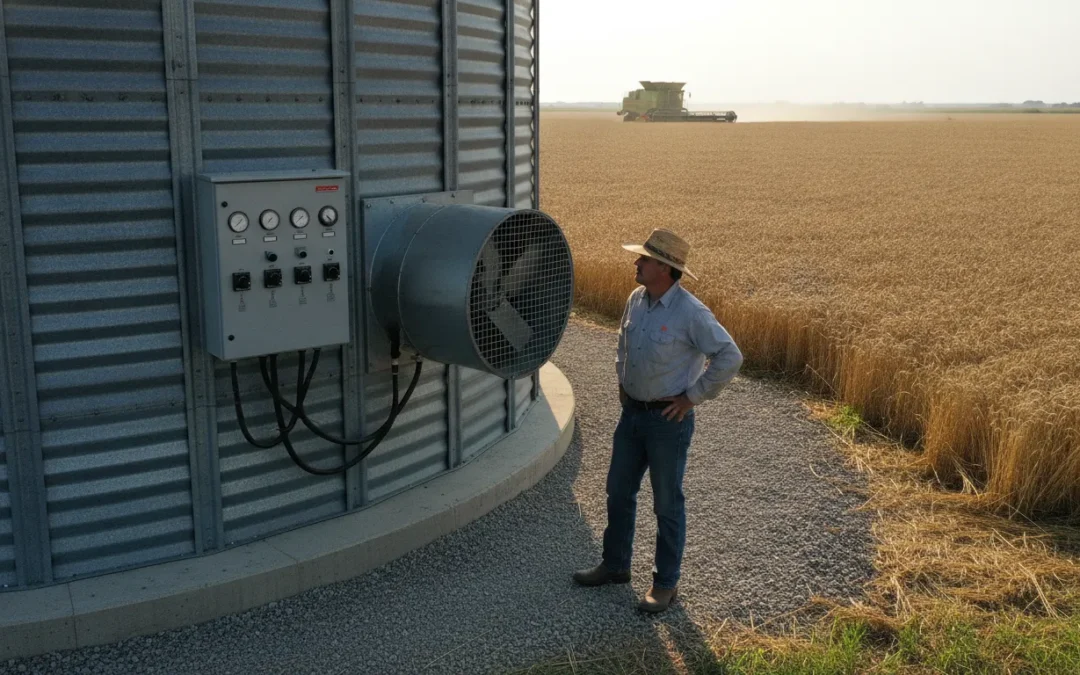
The right question is not simply, “What does an automated fan controller cost?” It is what your complete setup needs to control, monitor, install, and operate. A budget built around bin size, fan capacity, electrical work, grain depth, and crop can tell you far more than a standalone equipment number.
Talk with Farm Shop MFG about your bin and fan setup.
Automated grain bin fan control cost is farm-specific: compare the installed system scope with realistic value from better fan timing, possible electricity savings, reduced monitoring labor, and less moisture loss. Use conservative assumptions, then confirm compatibility and current pricing for your bins.
EndZone is designed to run grain-bin fans according to temperature and humidity conditions, but the fit depends on the equipment already on your farm. Start by separating the items that change the quote from the operating benefits you can reasonably count.
What makes automated grain bin fan control cost vary?
There is no useful universal price for automated grain bin fan control cost. A controller is only one part of the decision. Your actual budget depends on the bins it will serve, the fans and electrical equipment already in place, the monitoring you want, and whether installation requires new wiring or other site work. The right question is not, “What does automation cost?” Instead, ask, “What will this system cost on my farm?” Then ask what value you can reasonably measure.
Separate the installed system from the operating value
Start with the total installed system cost. List the controller, required sensors or monitoring, electrical work, mounting, setup, and any labor needed to connect the equipment safely. Confirm whether one control unit covers your intended fan configuration or whether the quote assumes additional components. Farm Shop MFG does not establish a current standalone EndZone price in the available customer information. So a current quote should identify the exact configuration rather than rely on an old number or a generic online estimate.
Then build a separate operating-value worksheet. EndZone controls when grain-bin fans run using temperature and humidity conditions. Running fans only when conditions are suitable may reduce electricity use, but the result depends on fan horsepower, runtime, local weather, and your operating decisions. Do not treat a possible reduction as guaranteed savings.
Use farm-specific inputs, not a headline number
Record each bin’s capacity, crop, grain depth, fan size, normal runtime, electricity rate, monitoring coverage, and labor currently devoted to checking or switching fans. Add the moisture risk you are trying to manage, such as avoidable overdrying or moisture movement. For a separate calculation method, use this guide to calculate overdrying cost per bushel.
Your conservative payback estimate should compare the installed system cost with attributable moisture value retained or gained, potential electricity reduction, avoided overdrying, and labor value. Keep corn and soybean assumptions separate. A quote that shows these line items makes the cost easier to test against your own records and easier to challenge before purchase.
Which line items belong in an automated fan-control budget?
A useful automated fan-control budget is more than the controller on the wall. Build it around the equipment, monitoring, installation, operating conditions, and upkeep your bins actually require. Farm Shop MFG does not establish a universal current standalone EndZone price, so request a configuration-specific quote instead of treating a published example as your final number.
Controller scope and monitoring
Start with the control hardware and the number of fans or bins it will manage. EndZone controls fan operation using temperature and humidity conditions, which can reduce unnecessary manual operation when conditions are not right. Confirm whether your plan covers one bin, multiple bins, or a staged expansion.
Then separate monitoring from control. If you want grain information to trigger an automatic response, include the required monitoring equipment and integration scope. Grain Temp Guard can integrate with EndZone to respond to hotspots. Farm Shop MFG also lists moisture-management packages that combine one EndZone with Grain Temp Guard units and vary by bin capacity. Ask whether the quote includes probes, communications, alarms, and commissioning, or only the controller.
Electrical and installation
List the electrical work as its own line. The estimate may need to account for existing disconnects, control-panel space, wiring distance, weather protection, and the way each fan is switched. Include any electrician, mounting, setup, and startup labor rather than assuming installation is part of the equipment cost.
Fit matters before price. Farm Shop MFG describes an ideal range of 3,000 to 45,000 bushels, with larger bins requiring consultation. Grain depth, fan capacity, and the number of controlled fans should be documented in the quote. A controller that does not match the existing setup is not a savings.
Electricity, labor, and maintenance
Estimate electricity from fan horsepower, local rates, and expected runtime. EndZone may reduce electricity use by operating fans only when conditions are optimal, but the result depends on weather and the farm’s operating pattern. Add the labor value of fewer manual checks and fan changes, while keeping that estimate conservative. Finally, budget for inspection, sensor checks, wiring repairs, and seasonal recommissioning.
To measure the moisture-loss side of the decision, use the guide to calculate overdrying cost per bushel. That figure belongs beside equipment, electricity, labor, and maintenance, not in place of them.
How do bin size, fan capacity, and installation change the estimate?
A controller quote starts with fit, not a universal equipment number. Bin capacity, grain depth, existing fan capacity, monitoring scope, and the work needed at the electrical panel can all change what belongs in the estimate. Gather those details before asking for a recommendation, so the quote reflects your actual setup.
Start with bin capacity and grain depth
Farm Shop MFG describes EndZone’s stated ideal range as 3,000 to 45,000 bushels. Larger bins require a consultation rather than an assumption that the same configuration will work. The company also advises grain depth of 25 feet or less, with 30 feet as the maximum guidance. Record both the rated bin capacity and the depth of grain you normally carry. A partially filled bin can have a different operating profile from a full bin, and the quote should account for the conditions you actually manage.
Package configurations that combine one EndZone with Grain Temp Guard units are listed by bin-capacity ranges, from 3,000-6,000 through 52,000-59,000 bushels. That does not replace a fit check. It tells you to ask which package or monitoring arrangement matches each bin, especially when an operation has several different sizes.
Verify fan capacity and installation scope
Existing fan horsepower matters because the controller can only manage equipment that is properly sized for the bin and airflow demand. Farm Shop MFG gives guidance of 1 horsepower per 1,000 bushels, with a minimum of 0.5 horsepower per 1,000 bushels. Use the size a grain aeration fan guide to organize fan, airflow, grain-depth, and static-pressure information before requesting a quote.
Also ask what installation includes: controller placement, wiring, disconnects, sensor locations, weather exposure, and whether existing components need inspection or modification. If monitoring is part of the scope, clarify how Grain Temp Guard units integrate with EndZone and whether hotspot response is included. The grain bin aeration controller guide can help you compare control features and failure-planning questions.
| Fit input | What to record | Quote implication |
|---|---|---|
| Bin capacity. | Bushels per bin. | Package or consultation range. |
| Grain depth. | Typical and maximum feet. | Compatibility review. |
| Fan capacity. | Horsepower and airflow. | Control and sizing check. |
| Installation. | Wiring, sensors, and panel access. | Labor and electrical scope. |
What operating value belongs in the payback model?
A payback model should count more than the controller invoice. The operating value comes from making better aeration decisions, keeping conditions more uniform, and reducing the chance that a storage problem turns into a quality or marketing loss. USDA defines aeration as forcing air through stored grain to maintain grain condition. It also explains that low airflow can replace turning grain to equalize temperatures and remove hot spots. Read the USDA aeration guidance when building your assumptions.
Put timing and weather conditions on the worksheet
Fan runtime is not automatically valuable. The value depends on whether air conditions support the job you need done. Temperature, grain moisture, and relative humidity are closely related to spoilage risk, according to USDA. NDSU recommends cooling grain when grain temperature and average outdoor temperature differ by 10 to 15 degrees. That makes timing a real operating line item, not a minor scheduling detail. Record when fans normally run, how often someone checks conditions, and which opportunities are missed when labor is tied up elsewhere.
For a practical reference, use this grain bin aeration temperature management guide alongside your own fan logs. Do not assume every season produces the same runtime or savings.
Value uniform temperature and moisture conditions
USDA says keeping grain cool and maintaining uniform temperatures and moisture contents greatly reduces storage-loss risk. That benefit belongs in the model because uneven conditions can create costs that do not appear on an electric bill. USDA identifies moisture migration, mold growth, and insect infestation as major causes of spoilage in dry-stored grain. Moisture migration can create a high-moisture zone near the surface, and it can occur even when corn enters storage at a seemingly safe 12% to 13% moisture.
Price the risk of delayed action carefully
NDSU reports that moisture migration can occur when grain and average outdoor temperatures differ by about 20 degrees. That difference can increase moisture near the bin top by several percentage points and cause crusting. It also reports that each 10-degree increase in grain temperature cuts allowable storage time by about half. Those facts support tracking avoided overdrying, reduced spoilage exposure, preserved marketing flexibility, and labor saved from repeated checks. Keep each estimate conservative. Treat storage-risk value as attributable only when your records show what the operating decision changed, rather than counting the full value of every bushel in the bin.
How can you calculate a conservative farm-specific payback?
Payback should start with your own bins, crop mix, fan setup, and operating conditions, not a universal promise. Build the estimate around the system cost, then count only benefits you can reasonably attribute to automated control: moisture value retained or gained, avoided overdrying, electricity, and labor. Confirm the current system price and installation scope in your quote. The selected Farm Shop MFG materials do not establish a current standalone EndZone price.
Use a documented worksheet, not a best-case guess
- Write down the full cost. Include the controller, any monitoring equipment, installation or electrical work, and other required configuration items. Record bin capacity, grain depth, fan horsepower, crop, and the season being modeled.
- Estimate the annual benefit by line item. Use your own electricity rate and realistic fan runtime to estimate possible power savings. Add only measurable labor that automation could avoid. For moisture, calculate the value of grain retained or gained under your actual marketing and quality assumptions. For the overdrying portion, calculate overdrying cost per bushel using shrink, drying charges, and energy.
- Apply a conservative haircut. Remove benefits that depend on perfect weather, full utilization, or an unverified moisture outcome. Keep an evidence note beside each remaining line, such as a scale ticket, energy bill, labor log, or historical drying record.
- Divide cost by annual attributable benefit. This gives a planning payback estimate in years. Run a low-benefit case and a base case, and label both as estimates rather than guarantees.
Keep the corn case separate
For corn, model avoided overdrying as its own case. Farm Shop MFG describes a company-stated example in which overdrying 20% of 100,000 bushels by three moisture points could represent a significant loss. The company says the system may pay for itself in one year with as little as 30,000 bushels under that example. That is a conditional scenario, not a universal payback period. Replace those assumptions with your measured volume, moisture spread, grain price, and actual drying economics.
Keep the soybean case separate
For soybeans, do not add a moisture-addition scenario to the corn calculation. Farm Shop MFG cites a conditional example involving one semi load of water added to 20,000 bushels, representing additional saleable value. Treat that as a company-stated scenario only. Results depend on conditions and grain economics. Test the soybean assumptions independently, document what moisture change is commercially usable, and never present the example as guaranteed revenue.
What does EndZone add to the cost equation?
EndZone belongs in the budget as more than a fan switch, but it should not be treated as a guaranteed payback machine. The right question is whether its control, monitoring connections, and fit with your bins address a cost you can measure. Current standalone pricing is not established in the available Farm Shop MFG material, so use the EndZone product information or request a configuration-specific quote instead of relying on a universal number.
Separate the corn case from the soybean case
For corn, EndZone is positioned to control fan operation for moisture removal when temperature and humidity conditions are suitable. That can make the system relevant where overdrying, unnecessary runtime, or missed aeration windows are recurring concerns. Farm Shop MFG describes a company-stated example in which overdrying part of a large corn inventory could represent a meaningful loss and says one-year payback may be possible at a stated volume. That is a scenario, not a promise. Your estimate still needs bin records, moisture readings, fan runtime, electricity, drying costs, and grain value. Calculate overdrying cost per bushel before assigning value to automation.
For soybeans, the use case is different. EndZone is described as supporting moisture addition, with moisture adjustment accuracy stated at plus or minus 0.5 percent. Farm Shop MFG cites a soybean water-addition example, but actual value depends on grain condition, market economics, storage decisions, and whether the operating conditions support the target. Do not add a soybean moisture scenario to a corn overdrying estimate. Treat each crop as its own worksheet.
Value the control and monitoring scope
EndZone uses temperature and humidity conditions to determine when fans run, which may reduce unnecessary manual operation and electricity use. When paired with Grain Temp Guard monitoring, it can trigger an automatic response to hotspots. That pairing changes the budget because you are evaluating both control and visibility, not just a controller. The EndZone automated fan controller review can help frame the buyer questions.
Check whether the system fits
Farm Shop MFG states an ideal range of 3,000 to 45,000 bushels, with larger bins requiring consultation. Grain depth should generally be 25 feet or less, with 30 feet as a maximum, and fan guidance ranges from 0.5 to 1 horsepower per 1,000 bushels. Review the moisture-management package when you need EndZone and monitoring together, then confirm capacity, depth, fan size, installation, and crop-specific goals before comparing the quoted system cost with measurable value.
What should you ask before buying automated fan control?
A good quote starts with your bin and grain, not a controller sticker price. Use this checklist to give the supplier enough detail to confirm fit, identify installation work, and explain what the quoted system includes.
Confirm the bin, crop, and fan fit
- What is the bin capacity? EndZone’s stated ideal range is 3,000 to 45,000 bushels. Ask for a review if the bin is larger.
- What crop will you manage? Explain whether the primary job is removing moisture from corn, adding moisture to soybeans, or managing more than one crop. Those are different operating goals and should not be combined into one payback assumption.
- How deep will the grain be? Farm Shop MFG guidance is 25 feet or less, with 30 feet as the maximum. Provide the expected fill depth, not only the bin’s rated capacity.
- What fan horsepower and airflow are available? Share each fan’s horsepower, motor information, and existing controls. The stated guidance is 1 horsepower per 1,000 bushels, with 0.5 horsepower per 1,000 bushels as a minimum. If you need more background, use this grain bin aeration controller guide.
Define the control and monitoring scope
- Which fans should the controller operate? Ask whether the quote covers one fan, multiple fans, a full bin, or several bins. Clarify what happens when conditions change and whether the system can stop or resume operation based on temperature and humidity.
- What monitoring is included? Grain Temp Guard can integrate with EndZone to trigger an automatic response to hotspots. Confirm sensor quantity, placement, alerts, and whether monitoring is included in the package or quoted separately.
- What installation is required? Ask who handles wiring, electrical changes, commissioning, and troubleshooting. Request any added labor or hardware as separate line items.
- How is the current price confirmed? Do not rely on an old quote or a general online estimate. Request the current price, package capacity, installation scope, and any recurring costs in writing. Then ask what happens if crop, grain depth, fan horsepower, or weather conditions change.
Contact Farm Shop MFG to review your bin and fan setup.
Frequently Asked Questions
How much does automated grain bin fan control cost?
There is no universal price for automated grain bin fan control. The estimate depends on the controller, the number and size of fans, electrical work, installation, monitoring, and the bin configuration. Farm Shop MFG’s customer materials do not establish a current standalone EndZone price, so confirm the current price and included equipment in a farm-specific quote. A useful quote should show the equipment scope separately from installation and any monitoring components.
What changes the estimate for an automated fan-control system?
Bin capacity, grain depth, fan horsepower, wiring, control scope, and site access can all change the estimate. Farm Shop MFG describes an ideal EndZone range of 3,000 to 45,000 bushels, with larger bins requiring consultation. Its guidance also calls for grain depth of 25 feet or less, with 30 feet as a maximum. And fan capacity of about 1 horsepower per 1,000 bushels, with 0.5 horsepower per 1,000 bushels as a minimum. Share those details before requesting a quote.
Is grain monitoring separate from automated fan control?
Yes. Monitoring and fan control are related but separate functions. A monitoring system tracks conditions such as grain temperature, while a controller manages when fans run. Grain Temp Guard can integrate with EndZone to trigger an automatic response to hotspots. And Farm Shop MFG also offers moisture-management packages that combine EndZone with Grain Temp Guard units. Ask whether your estimate covers the controller only, monitoring only, or both.
How can I estimate payback for automated grain bin fan control?
Start with the complete system and installation cost. Then estimate only the benefits your operation can reasonably attribute to the system, including avoided overdrying. Count retained or gained moisture value, electricity changes from better fan timing, and reduced monitoring labor as separate potential benefits. Keep corn and soybean cases separate. A corn estimate might model avoided overdrying under your actual bin conditions. A soybean estimate might model potential moisture addition only when conditions support it. Neither scenario is guaranteed, and the figures should not be added together. Divide the installed cost by the net annual attributable benefit for a simple payback estimate in years, then test a conservative and a weaker season case.
Build a fan-control plan for your bins
Ready to put the numbers to work? Contact Farm Shop MFG to review your bin capacity, fan sizing, and moisture-management goals, then discuss an EndZone configuration that fits your operation.