
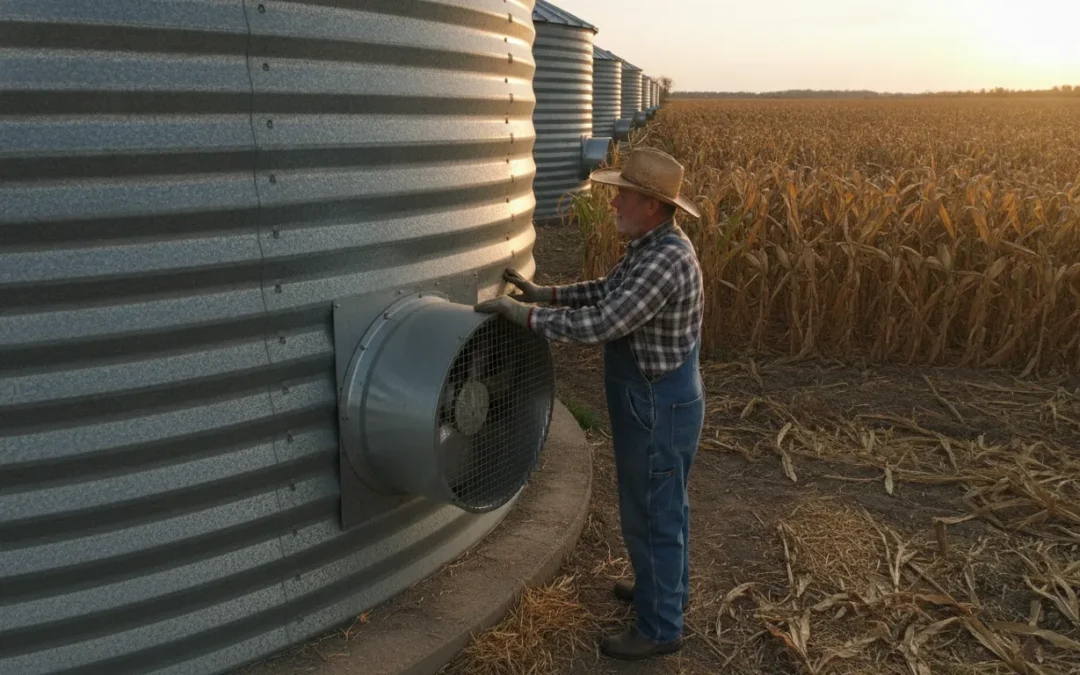
Turning on a bin fan is easy. Knowing when the available air will actually cool grain, move it toward the right moisture condition, and justify the energy use takes more judgment. A controller should help you make that decision consistently, not simply run a fan on a timer.
A practical grain bin aeration controller buying guide starts with the control inputs. These may include outside air temperature, relative humidity, and grain temperature. Those inputs matter because aeration air can add moisture or remove it. Running fans is not cost efficient when the available air cannot move grain toward its desired condition. Look for a system that fits your bin size, fan setup, power availability, manual override needs, alarms, maintenance plan, and budget.
The right choice is less about buying the most complicated controller and more about matching control, monitoring, and backup plans to the grain you store. Here is what to evaluate first, including the features that separate useful automation from another piece of equipment to babysit. For broader context, see this grain fan automation guide.
Ask Farm Shop MFG which grain bin control setup fits your operation.
How This Grain Bin Aeration Controller Buying Guide Helps You Choose
A good controller should help you cool and condition stored grain without running fans simply because someone remembered to flip a switch. The right choice depends on how much control you need, what information the system can use, and how clearly it handles conditions that are not favorable for aeration.
Automation that uses the right inputs
Start by asking what the controller actually senses. Basic systems may use a thermostat to read outside air temperature, then require periodic resetting. More advanced controllers can sense grain temperature, air temperature, and relative humidity. That distinction matters because the air’s temperature and relative humidity determine whether aeration adds moisture to grain or removes it. Grain moisture also takes time to stabilize, so a controller should support a deliberate operating plan rather than encourage short, arbitrary fan cycles.
Oklahoma State University notes that final grain moisture depends on the temperature and relative humidity of aeration air. Running fans is not cost efficient when available air cannot move grain toward the desired condition. Read the university’s aeration management guidance before deciding which inputs your operation needs. Ask the vendor whether the controller is intended for cooling and conditioning only. The Kansas State reference cautions that simple controllers cannot be used for grain drying.
Practical controls and coverage
Automation is only one part of a reliable setup. Ask whether the system provides a manual override, what alarms are available, and how an operator is notified when a temperature or moisture condition needs attention. Confirm the power requirements, backup plan, and what happens after an outage. Ask how many probes are included, how they are positioned, and whether their lengths reach the areas that matter in each bin. Probe coverage should match the bin’s size and shape, not just the controller’s label.
Finally, ask how the system scales across your bins and what support is available during installation, harvest, and a troubleshooting call. A controller that fits one small bin may not be the right answer for a larger or differently configured system. Request a bin-by-bin recommendation, including fan setup, probe placement, alarm coverage, and the limits of the automation. Farm Shop MFG’s temperature monitoring and fan control information is a useful place to compare monitoring needs with your own storage plan.
Wired vs Wireless Aeration Controllers: Pros and Cons
Wired and wireless control can both be useful, but neither is automatically the right answer for every bin site. The better choice depends on distance, construction, power availability, signal conditions, service access, and what happens when a component stops communicating. Treat connectivity as one part of a larger grain bin aeration controller buying guide, not as the whole buying decision.
| Buying factor | Wired approach | Wireless approach | Question to verify |
|---|---|---|---|
| Reliability | Physical connections can provide a consistent path, but cable damage or a failed connection still needs attention. | Reduces some cable runs, but performance depends on the actual signal path and equipment environment. | What alarm appears when communication is lost, and does the system continue safely? |
| Installation | Plan routing, protection, entry points, and distance from the controller to the fan or sensors. | May simplify some runs, but requires careful placement, pairing, and signal testing at the bin. | Who handles installation, commissioning, and troubleshooting? |
| Power and communications | Ask which components need power and what happens during a power interruption. | Ask about battery life, charging, signal loss, interference, and restart behavior. | Is there a manual override, local status indicator, or backup power option? |
| Serviceability | Technicians can inspect visible wiring, connections, and protective routing. | Diagnosis may require checking batteries, pairing, antennas, and signal strength. | Can a farmer replace a component and restore operation without a subscription or specialized visit? |
The control logic matters more than the label. A basic thermostat controller may turn a fan on when outside air falls below a set point and off when it rises above it. More advanced systems can consider grain temperature, air temperature, and relative humidity. Kansas State notes that simple controllers cannot be used for grain drying, so ask whether the system is intended for cooling, conditioning, drying, or some combination: review the aeration controller guidance.
Also ask how the controller handles conditions that are not favorable for the grain. Oklahoma State explains that running fans is not cost efficient when available air cannot move grain toward its desired condition. And final moisture depends on air temperature and relative humidity. Before choosing wired or wireless, have the vendor explain the sensors, override process, communication-loss behavior, power plan, maintenance steps, and support path for your specific bins.
Does Your Aeration Controller Need a Subscription?
Not necessarily. A subscription can make sense when a system depends on cloud storage, remote alerts, or a software platform you use every day. But it should be an informed choice, not a requirement hidden in the purchase price. In a grain monitoring ROI guide, the right comparison is the value protected over the storage season against the full cost of owning and operating the system.
Calculate the total cost, not just the equipment price
Ask what you will pay after installation and through the next several harvests. Include recurring software or cellular charges, required gateways, replacement hardware, service calls, and any fees needed to keep alerts active. Then compare those costs with the work the controller is supposed to perform: running fans when conditions are suitable, limiting unnecessary runtime, and helping protect grain quality.
That last point matters because air temperature and relative humidity determine whether aeration air adds or removes moisture. If the available air cannot move grain toward the desired condition, running the fans is not cost efficient. A controller should support better decisions, not simply add another monthly bill to the bin.
Look for control that works when the internet does not
Ask whether the fan can be controlled locally. Confirm whether there is a manual override. Ask what happens if a network, cloud account, or phone connection is unavailable. Confirm how alarms are delivered and whether you can inspect the system during a communications outage. These questions reveal the difference between useful automation and dependence on a vendor’s platform.
Farm Shop MFG positions its grain equipment without cloud subscriptions or ongoing fees, with direct support and farmer-friendly installation. EndZone is designed as an automated fan-control system for grain-bin moisture management. That approach avoids vendor lock-in, but every farm should still verify installation requirements, local controls, alarm coverage, and support before buying. The best system is the one you can operate, maintain, and understand throughout the storage season.
What Happens When the Controller Fails?
A controller failure is manageable when the farm already has a response plan. The goal is to protect the grain and keep unsafe conditions from going unnoticed. Do not run fans when the available air cannot move grain toward the condition you want. Oklahoma State notes that fan operation is not cost efficient when temperature and relative humidity will not support the desired result. Use this grain bin aeration management guidance alongside the equipment manual and storage records.
- Put the system in a known manual state. Confirm whether the fan is off, running, or cycling unexpectedly. If the controller permits manual operation, use the documented manual control procedure rather than guessing at terminals or bypassing safety equipment. A basic controller is installed between the power source and the aeration fan, so disconnect power before inspecting wiring or opening an enclosure. Do not leave a fan running simply because the grain needs attention. First confirm that current outdoor conditions can help rather than add unwanted moisture.
- Verify the alarm and the actual grain condition. An alarm is a signal to investigate, not a diagnosis. Check the grain temperature at the affected bin and compare it with readings from other points or a second instrument when available. Grain temperature and air temperature both matter to an aeration decision. Stored-grain problems, including mold, insects, fungi, and spoilage, can worsen when moisture and temperature are poorly controlled. Record the reading, time, bin location, and recent fan activity so the next decision is based on a trend.
- Separate power failure from communication failure. Check the disconnect, breaker, contactor, controller display, sensor connections, and any communication path included in the system. A dark controller may indicate lost power. A controller that has power but no useful sensor data may point to a probe, connection, or communication problem. Treat each failure mode differently. Do not claim that a specific controller has failover unless the manufacturer documents it for that model.
- Inspect backup power and verify what it supports. If your monitoring equipment uses backup power, check its condition and confirm whether it keeps alarms and readings available or also supports fan control. Grain Temp Guard is documented with 110V external power and internal battery backup, but the backup function should still be tested before harvest and after any service work. Never assume a monitoring battery can operate an aeration fan.
- Keep access points and the grain surface serviceable. Maintain bin openings, guards, and access routes so a person can safely inspect the equipment, probes, and grain condition. Do not seal or obstruct an opening needed for inspection or emergency service. Once the fault is corrected, confirm the fan starts and stops as intended, verify the alarm, and continue checking grain temperature until readings are stable. Moisture stabilization takes time, so one normal reading is not proof that the problem is over.
EndZone Feature Checklist: How It Compares to the Ideal
The ideal controller does more than switch a fan on and off. It should help you make aeration decisions around actual grain conditions, fit the size of the bin, and leave you with a system you can understand and maintain. EndZone is an automated fan control system for grain-bin moisture management. Pairing it with Grain Temp Guard adds temperature and humidity monitoring, so the controller manages fan operation while you watch the stored grain conditions that matter.
Use the checklist below to compare the system to your operation. A good fit still depends on your crop, fan setup, power supply, probe placement, and storage plan.
| What to evaluate | Ideal buyer requirement | How the Farm Shop MFG setup fits |
|---|---|---|
| Control purpose | Automated fan control should support moisture management. It should not rely on guesswork or run fans whenever someone has time. | EndZone is positioned as an automated fan control system for grain-bin moisture management. Confirm the control approach matches your crop and aeration plan before installation. |
| Monitoring | The controller should be paired with information about grain conditions, not treated as a substitute for monitoring. | Grain Temp Guard monitors grain-bin temperature and humidity. Its visual and audio alarms can give you a clearer reason to check the bin and decide what action is needed. |
| Bin-size fit | Equipment coverage should scale with the amount of grain being protected. | Farm Shop MFG recommends one EndZone with one Grain Temp Guard Alarm HT for 3,000 to 6,000 bushels. For 7,000 to 15,000 bushels, the recommendation is one EndZone with two alarms. Larger or differently configured bins should be reviewed with the manufacturer. |
| Ownership model | Farmers should know whether ongoing cloud fees or a required subscription will be part of the operating cost. | Farm Shop MFG positions its equipment with no cloud subscription or ongoing fees. Confirm what is included in your specific equipment package and installation plan. |
| Installation and support | Installation should be understandable for the farm, with direct help available when the bin layout or fan setup raises questions. | The company emphasizes farmer-friendly installation and direct support. Ask about your exact fan arrangement, power requirements, sensor locations, and manual operating procedure before purchase. |
For a closer look at the product’s intended role, review the EndZone automated fan control page. The right choice is not simply the controller with the longest feature list. It is the setup that matches your bin size, gives you useful monitoring, and fits the way your farm handles aeration decisions.
Frequently Asked Questions
What features should you prioritize when choosing a grain bin aeration controller?
Start with the inputs it can use, including outside-air temperature, grain temperature, and relative humidity. Look for clear set points, fan run-time tracking, alarms, manual override, and a practical power-backup plan. The right controller should also fit your bin size, fan arrangement, probe coverage, and ability to service the system during harvest.
How do automatic and manual grain aeration controls differ?
Manual control depends on someone checking conditions and deciding when to start and stop the fans. Automatic control applies programmed conditions consistently, which can reduce missed cooling windows and unnecessary run time. A thermostat-based controller may start a fan when outside air falls below its set point and stop it when air rises above it, according to Kansas State University guidance.
How do you select fans and airflow for a grain bin?
Match the controller to the fan motor, electrical service, bin capacity, and the airflow your grain and management plan require. Do not choose a controller in isolation. Ask the vendor to confirm the switching capacity, installation requirements, probe placement, and whether the system supports your specific fan setup.
How should aeration controls account for local climate?
Temperature and relative humidity determine whether incoming air adds moisture to grain or removes it. That means a setting that makes sense in a dry climate may not fit a humid region or a different crop. Ask how the system handles changing conditions, and do not run fans when available air cannot move the grain toward its desired condition, as Oklahoma State University explains.
Can an automated controller recover its investment?
It can, but payback depends on bin size, energy rates, operating habits, crop value, and how much overdrying or spoilage risk it prevents. University elevator studies found that automatic fall-cooling management sometimes saved more energy in the first year than the controller cost, according to Kansas State University. Build your estimate from your own fan hours and grain value rather than a guaranteed payback claim.
Contact us to plan the right grain bin setup
The right fan-control and grain-monitoring combination depends on your bins, fans, power availability, and operating plan. Farm Shop MFG can help you sort through those details and compare where EndZone or Grain Temp Guard may fit.
Contact Farm Shop MFG before you buy and plan a practical setup for your operation.