

Every moisture point removed past the sale or storage target takes more than water out of the bin. It can reduce saleable weight and add energy, labor, and equipment cost to the drying bill. University of Minnesota guidance defines overdrying as removing moisture below what is needed for safe storage, marketing, or the crop’s intended use.
The overdrying grain cost per bushel loss has two parts: the value of saleable grain weight removed and the cost of drying moisture that did not need to come out. For corn. An illustrative extension estimate of 0.02 gallons of LPG per bushel per moisture point means three unnecessary points could use about six cents per bushel in gas at one dollar per gallon. Before labor, equipment, or shrink.
Contact Farm Shop MFG to review your grain drying costs.
The right calculation starts with your crop, target moisture, grain price, and actual drying conditions. From there, the grain fan automation and drying control guide helps connect the math to better fan timing, while EndZone provides automated control to help reduce avoidable drying loss.
What Is the Overdrying Grain Cost Per Bushel Loss?
The overdrying grain cost per bushel loss has two separate parts: the value of saleable grain weight that disappears and the money spent removing moisture that did not need to be removed. Looking at only the dryer bill understates the result. Looking only at shrink misses the energy, labor, and equipment expense tied to each extra moisture point.
1. Lost saleable weight
Overdrying is drying grain below the moisture content needed for safe storage, marketing, or its intended use. The University of Minnesota Extension definition matters because the target is not always “as dry as possible.” Once grain is drier than the buyer or storage plan requires. Some of the water removed could have been sold as part of the grain load.
Most crops are sold by total weight, which includes both dry matter and water. Removing that water reduces the weight available for sale. Wisconsin Extension estimates that drying below the required moisture removes water that could otherwise be sold at approximately 0.65 pounds per percentage point per bushel. That is a physical loss before assigning any local grain price to it. The dollar effect depends on the crop, the number of unnecessary moisture points removed, the quantity stored, and the price at sale. Source: Wisconsin Extension grain-drying guidance.
2. Added drying expense
The second component is the cost of doing the extra work. Artificial drying uses energy, labor, and equipment for every percentage point of moisture removed. If the dryer runs past the moisture target, those operating costs continue even though the additional drying may not improve the sale or storage outcome. Fuel is only one part of that calculation. Electricity, labor time, dryer wear, handling, and the opportunity cost of tying up equipment can also belong in the farm-level total.
A practical calculation therefore starts with two lines:
- Weight loss: unnecessary moisture points removed multiplied by the resulting saleable weight reduction and the applicable grain value.
- Drying cost: energy, labor, and equipment expense required to remove those unnecessary points.
For example, if a load is dried below its required target, do not call the entire result a fuel loss. The complete overdrying loss is the grain value no longer available for sale plus the extra cost of drying it. Wisconsin Extension states the outcome directly: drying more than necessary raises drying costs while reducing grain-sale income. Your actual per-bushel figure still requires your crop price, moisture readings, dryer cost, and sale standard. These are calculation inputs, not universal savings assumptions.
How Does Overdrying Grain Cost Per Bushel Loss Show Up in Saleable Weight?
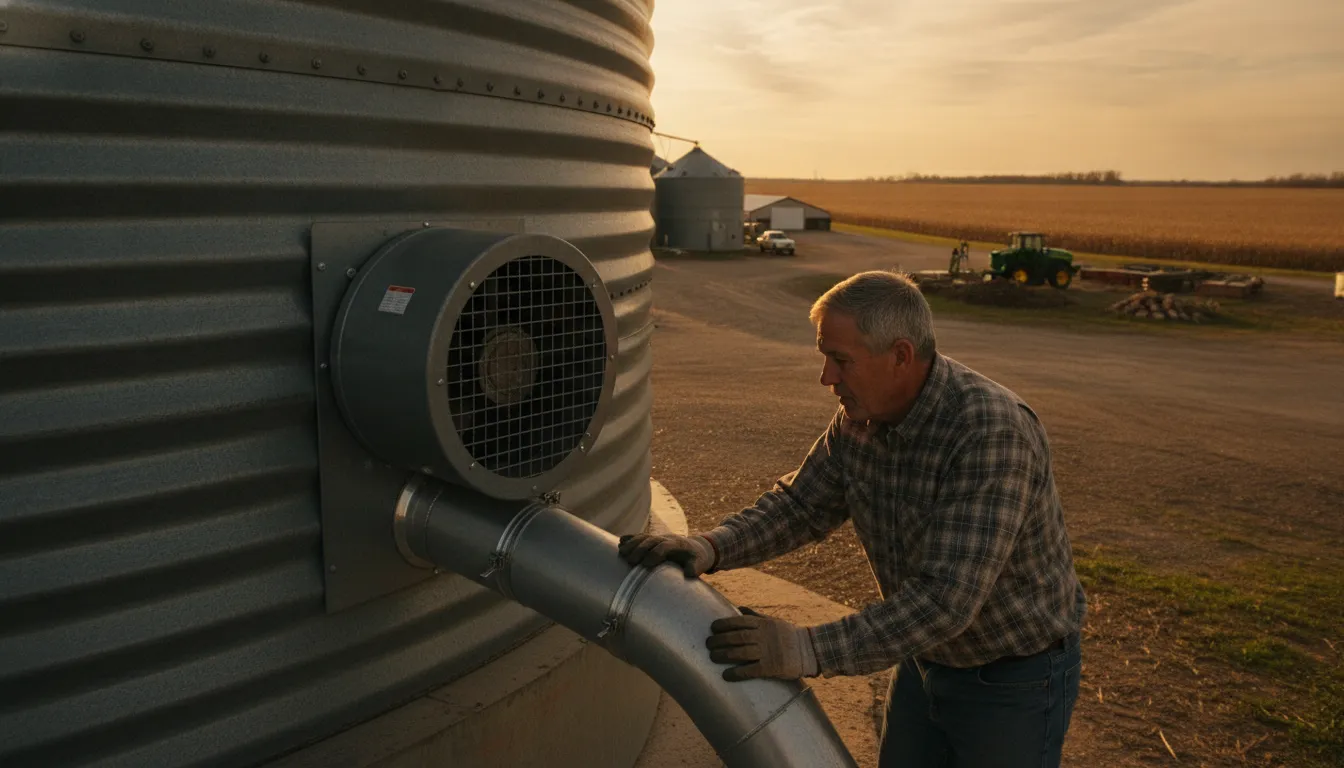
Overdrying costs more than the energy required to run the dryer. It also removes water that could have remained part of the grain sold by weight. That reduction is called water shrink. The practical question is not only how many moisture points came out of the bin, but how much saleable grain weight went with them.
The basic calculation is straightforward:
Water shrink (%) = water weight removed / initial grain weight x 100
Dry matter does not disappear during ordinary drying. The weight changes because water is removed. Purdue Extension illustrates the math with 1,000 pounds of corn dried from 25% moisture to 15.5% moisture. The original load contains 750 pounds of dry matter. At 15.5% moisture, that same dry matter represents 887.57 pounds of grain. The difference, 112.43 pounds, is water removed during drying.
Clearly labeled example: 1,000 bushels
For a field-scale reference, Wisconsin Extension gives a direct example: drying 1,000 bushels of corn to 12% instead of 15% creates a 3.4% shrink loss. In that example, the saleable quantity is reduced by 34 bushels. That is not a universal result for every crop, starting moisture level, or buyer specification. It is an illustration of what can happen when grain is dried three points below the stated target.
Another way to understand the loss is by moisture point. Wisconsin Extension estimates that drying below the required moisture removes approximately 0.65 pounds of water per bushel for each percentage point. Across 1,000 bushels, even a small extra drying margin can add up. The exact result depends on the grain’s starting moisture, the target moisture, the crop, and how the elevator or buyer calculates shrink.
That is why the overdrying grain cost per bushel loss should be tracked separately from the dryer bill. A sound estimate includes both the cost to remove the extra moisture and the value of the weight no longer available for sale. Use the buyer’s moisture requirement as the target, then compare the measured final moisture against it. A lower number is not automatically better if it only means you paid to remove saleable water.
Sources: Purdue Extension’s water-shrink calculation and Wisconsin Extension’s overdrying example.
What Does Grain Drying Cost at Four Dollars Per Bushel?
Illustrative example, not a current market quote: Use four dollars per bushel to see how drying charges and lost saleable grain work together. That figure is simply a planning assumption. Your actual result depends on moisture at harvest, the moisture target, elevator deductions, energy, labor, equipment, and the value of the grain when it is sold.
For a clean comparison, assume 1,000 wet bushels of corn arrive at 20.5% moisture and must be dried to 15%. That is 5.5 moisture points. Iowa State’s methodology shows how to separate the moisture discount, drying charge, shrink, and variable drying cost rather than treating the whole deduction as one number. The table below applies that method to a four-dollar illustrative grain value. The rates are labeled assumptions for this example, not Farm Shop MFG pricing or a claim about what any elevator currently charges.
| Item. | Formula or assumption. | Illustrative result. |
|---|---|---|
| Moisture to remove. | 20.5% minus 15%. | 5.5 points. |
| Starting grain value. | 1,000 bushels x four dollars. | Four thousand dollars. |
| Shrink assumption. | 5.5 points x 1.4% x 1,000 bushels. | 77 bushels. |
| Value of shrink. | 77 bushels x four dollars. | Three hundred eight dollars. |
| Variable drying cost. | 5.5 points x 0.045 dollars x 1,000 bushels. | Two hundred forty-seven dollars and fifty cents. |
| Illustrative combined impact. | Three hundred eight dollars shrink value plus two hundred forty-seven dollars and fifty cents drying cost. | Five hundred fifty-five dollars and fifty cents. |
Under these assumptions, the 1,000 wet bushels become 923 saleable bushels after the modeled shrink. The combined five hundred fifty-five dollars and fifty cents is not a universal overdrying grain cost per bushel loss. It is a transparent example of the two buckets to measure: approximately 0.308 dollars per starting bushel in modeled shrink value. Plus 0.2475 dollars per starting bushel in variable drying cost. That equals 0.5555 dollars per starting bushel before fixed costs and other deductions.
The practical lesson is to calculate from your own load tickets and invoices. A moisture discount may reflect both actual drying cost and weight loss, while the correct shrink method can vary. If your target is 15%, drying below it adds cost without automatically adding saleable value. Measure the moisture points removed, the bushels delivered, and the dollars charged so your overdrying decision is based on your farm’s numbers.
How Do You Calculate Your Annual Overdrying Loss?
-
Set the starting point. Record the wet bushels entering the dryer, their incoming moisture, the moisture level required by your buyer. And the moisture level at which the grain was actually sold or stored. Do not assume the elevator’s moisture schedule is universal. There is no single standard method for calculating pencil shrink, so keep the actual settlement sheet and moisture ticket with your calculation. Purdue Extension explains the limits of pencil-shrink calculations.
-
Calculate saleable grain value. First estimate the bushels or pounds lost because the grain was dried below the required endpoint. Water shrink is calculated by dividing the water removed by the initial grain weight, then multiplying by 100. For a quick check, Wisconsin Extension reports that drying below the required moisture removes about 0.65 pounds of water per percentage point per bushel. Multiply the lost saleable bushels by your documented sale price per bushel. Leave the price blank or mark it unknown until you have the relevant settlement price. A market quote from another date is not a valid current assumption.
-
Add the drying charge. Separate the charge for moisture points removed from the value of the grain that disappeared through shrink. As a calculation example only, Iowa State uses a drying fee of 0.048 dollars per wet bushel per moisture point. Your annual worksheet should use the actual elevator invoice or your documented on-farm rate instead. Formula: wet bushels x moisture points removed x drying charge per bushel-point.
-
Account for energy and labor. For on-farm drying, total the fuel, electricity, and other energy used for the relevant loads. Then add paid labor or a clearly stated owner-operator labor rate. Iowa State gives an illustrative variable drying cost of 0.045 dollars per bushel per moisture point, which equals 0.2475 dollars per bushel when 5.5 points are removed. That is a methodology example, not a current Farm Shop MFG price. If your fuel consumption, utility rate, or labor value is unknown, label it unknown rather than filling in a convenient number.
-
Include equipment cost. Add the annualized cost of the dryer, burner, fans, controls, repairs, maintenance, and depreciation that belongs to the drying operation. Divide the annual equipment total by the annual bushels dried to produce an equipment cost per bushel. Artificial drying carries energy, labor, and equipment costs for every moisture point removed, so this line should not be folded into a vague overhead estimate.
-
Review the total before changing your target. Add saleable grain value lost, drying charges, energy, labor, and equipment. Compare that total with the cost of better-timed aeration or control. Get more than one price quote when evaluating sale alternatives, and keep the calculation qualified. Drying more than necessary can raise drying costs while reducing grain-sale income, but the annual result depends on your crop, buyer, weather, equipment, and actual operating records.
Why Manual Fan Timing Creates Avoidable Overdrying Losses
Grain drying is not only a question of whether the fan is running. It is also a question of when the fan is running and what the outdoor air can accomplish at that moment. Warmer air generally reduces the energy required for both natural-air and high-temperature drying. Higher relative humidity or colder air increases drying costs, according to University of Wisconsin Extension grain-drying guidance.
That makes manual timing difficult during harvest and storage. A farmer may start a fan because the grain needs attention, then leave it running through changing weather, overnight humidity, or a cooler temperature window. The fan may continue moving air after the useful drying work has slowed. If the target moisture has already been reached, those extra hours can remove saleable water from the grain while adding energy and equipment operating costs.
Weather changes the value of every fan hour
Outdoor conditions can shift faster than a manual schedule. Air that is useful for drying in the afternoon may be less effective after temperatures fall or relative humidity rises. The result is not always an obvious problem at the bin. Grain can look and handle normally while the operation quietly pays for extra fan time, additional moisture removal, and lower saleable weight.
Manual control also depends on someone checking conditions, making the decision, and remembering to shut the system down. That is a demanding process when harvest work, truck scheduling, dryer operation, and bin management are competing for attention. A consistent control strategy helps turn weather information into a timely operating decision instead of relying on a clock or a best guess.
Control and monitoring are different jobs
EndZone is the control component. It manages fan operation for moisture-management and aeration decisions. Grain Temp Guard is the monitoring component. It tracks temperature and humidity and provides visual and audio alarms when readings move outside the normal range. Grain Temp Guard does not operate the fan, and EndZone does not replace the need to monitor grain conditions. Used together, they connect the information from the bin with the action needed at the fan.
For a practical overview of how weather, aeration decisions, and grain condition fit together, review this grain bin aeration management guide. The goal is not to run fans blindly or promise that automation removes every drying expense. It is to reduce avoidable fan hours and make moisture decisions with better timing.
How EndZone Reduces Overdrying Risk
Overdrying usually starts with a reasonable goal: protect stored grain and reach a marketable moisture level. The risk comes when a fan keeps running after the grain has received enough drying or cooling for the conditions. That extra runtime can remove saleable water, add energy use, and increase wear on drying and aeration equipment. EndZone is designed to help manage that fan operation so the decision is not based only on a manual timer or someone remembering to shut the system off.
EndZone controls fan operation based on the farm’s moisture-management strategy and operating conditions. It does not promise that every bushel will dry to one identical result, and it does not eliminate the need to set appropriate targets or inspect grain. Instead, automation helps apply those decisions consistently. When weather, humidity, or grain conditions change, more disciplined fan control can reduce the chance of running a cycle longer than necessary. Warmer outdoor air can reduce drying energy, while colder or more humid air can raise drying costs, so timing matters as much as runtime.
Farm Shop MFG’s ROI summary uses an estimate of approximately seventeen dollars in energy savings per 12-hour fan operation cycle. Treat that figure as a company estimate, not a universal savings guarantee. Actual results depend on the fan, fuel or electricity rate, operating conditions, moisture level, and whether the cycle would otherwise have run unnecessarily. On a farm where several cycles are mistimed or extended, those avoidable costs can add up. On another farm, the benefit may be more about consistent management and reduced risk than a fixed dollar amount.
The potential grain-value impact also depends on bin size, crop, moisture target, and local pricing. Farm Shop MFG illustrates this with examples such as preventing 1% moisture loss in a 20,000-bushel bin. Estimated at eight hundred twenty-five dollars for corn or one thousand nine hundred twenty-five dollars for soybeans under the company’s stated assumptions. A separate 30,000-bushel example estimates one thousand six hundred fifty dollars for corn or three thousand eight hundred fifty dollars for beans. These figures show why an EndZone automated fan control system should be evaluated against your own grain value and operating records, not treated as a guaranteed return.
EndZone and Grain Temp Guard serve different roles. EndZone controls the fan. Grain Temp Guard monitors temperature and humidity and provides alerts when readings move outside the normal range. Used together, monitoring can inform the management decision while automated control helps carry it out. For more detail on the control strategy and operating logic, review Farm Shop MFG’s grain fan automation and drying control guide.
Review your grain drying setup with Farm Shop MFG.
Frequently Asked Questions
How much weight does corn lose when it is dried?
The answer depends on starting and ending moisture. In a Purdue Extension example, 1,000 pounds of corn dried from 25% to 15.5% moisture finished at 887.57 pounds, removing 112.43 pounds of water. That water shrink is separate from any handling loss or drying charge. Purdue Extension explains the calculation.
How do you calculate grain drying cost per bushel?
Add the value of saleable weight lost to the energy, labor, and equipment cost of removing moisture, then divide the total by the number of bushels dried. Use your actual moisture readings, sale price, fuel rate, and facility charge. A quoted moisture discount may include both drying cost and weight loss, so check the calculation before comparing delivery options. Iowa State Extension outlines the moisture-discount method.
What moisture target helps prevent overdrying?
Set the target based on the buyer’s specification and the storage conditions, not simply on the lowest moisture number your dryer can reach. The University of Minnesota notes that shelled corn buyers commonly request 15% moisture and that properly aerated corn can be safely stored through winter at that level. Requirements vary, so confirm the target with your buyer and storage plan. Review the University of Minnesota guidance.
How can farmers reduce avoidable overdrying losses?
Track moisture and temperature, set a clear target, and run fans when conditions support the intended result. EndZone controls fan operation, while Grain Temp Guard monitors temperature and humidity. Automation can improve timing, but it does not eliminate drying cost or spoilage risk. Compare the moisture saved, saleable weight retained, and energy used over each operating cycle.
Contact us to review your grain drying setup
Every farm’s bins, fans, weather patterns, and harvest schedule are different. A conversation with Farm Shop MFG can help you look at where fan timing and moisture decisions may be adding avoidable drying cost. Then consider whether EndZone fits your operation.