
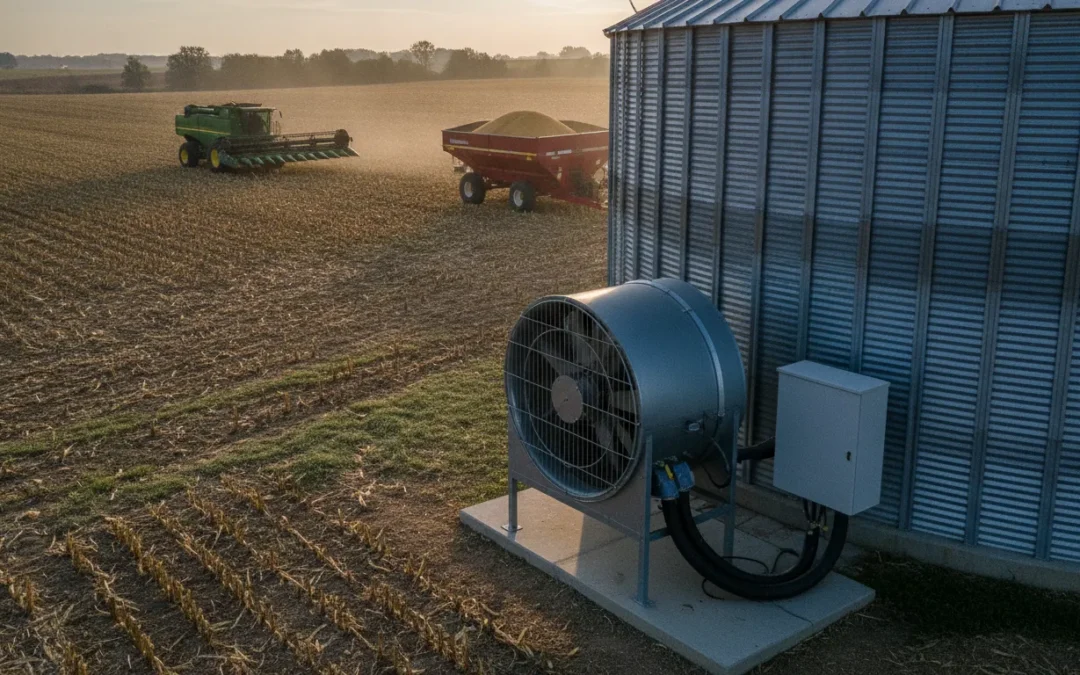
Farmers searching for an EndZone automated grain fan controller review usually want more than a product list. They want to know whether automatic fan control can reduce late-night checks, limit unnecessary electricity use, and protect grain from over-drying. Farm Shop MFG’s published customer feedback points to those practical benefits, while the product documentation makes clear that airflow, grain depth, and operator settings still determine the result. This review separates documented farmer experience from claims that need to be measured on your own bins, and links to Farm Shop MFG’s EndZone grain fan automation and drying-control information.
Contact Farm Shop MFG to discuss your bin size, fan capacity, and EndZone setup.
What Do Farmers Think of the EndZone Automated Grain Fan Controller?
Farmers value EndZone most when it removes guesswork from fan timing: the controller can run fans inside selected temperature and relative-humidity limits, shut them off when conditions move outside those limits, and work with Grain Temp Guard alarms. The feedback is strongest on labor savings, fewer unnecessary fan cycles, and better control of moisture objectives, not on a universal savings guarantee.
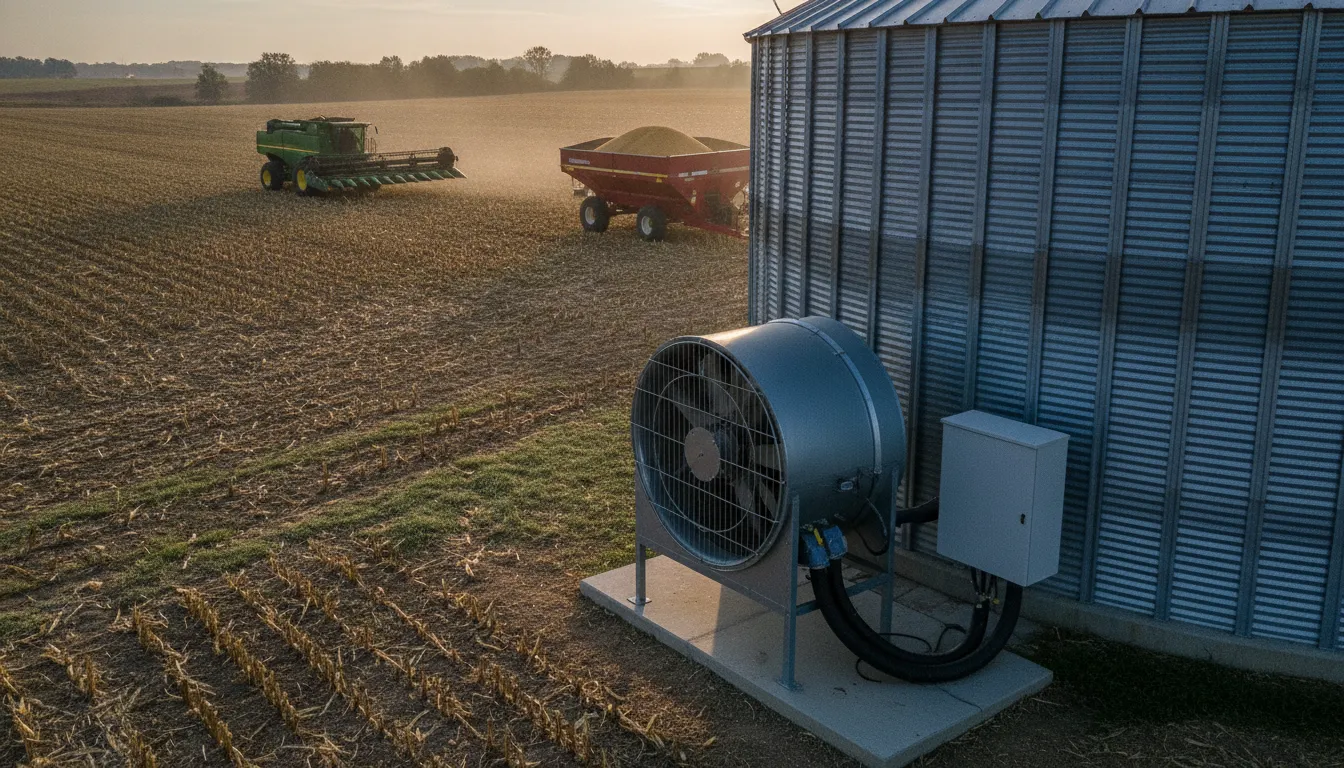
That distinction matters. EndZone does not create airflow, correct an undersized fan, or replace regular grain checks. It acts as a control layer between the weather and the fan. The operator selects the acceptable range, uses the fan in automatic, manual-on, or off mode, and can track fan hours. When paired with a Grain Temp Guard, a temperature or humidity alarm can trigger fan operation when the programmed outdoor conditions are also suitable.
Farm Shop’s published customer material describes a complete system as a way to add moisture to wheat or soybeans when conditions are favorable and reduce the risk of over-drying corn. One customer says the system eliminated manually starting fans in the evening and rushing back to shut them off before weather became too hot. The same account describes checking temperature and humidity at different levels and recording readings weekly. That is useful social proof because it explains the operating habit, not just the outcome.
The strongest review takeaway is simple: EndZone is a practical automation tool for a farmer who already understands the bin, fan, crop, and target moisture. It is not a set-it-and-forget-it substitute for that knowledge. For technical background, Oklahoma State University explains that aeration is used to cool grain and equalize temperatures, while the fan and airflow rate must match the storage system. See the university’s aeration and cooling guidance.
Iowa Corn Farmer: First-Season Results Worth Tracking
An Iowa farmer evaluating EndZone in the first season should track fan hours, moisture change by grain level, avoided manual trips, and the number of times the controller stopped a fan during poor conditions. Those measurements are more defensible than promising a fixed dollar return before the farm’s bin, motor, electricity rate, and crop moisture are known.
Farm Shop’s published customer feedback includes an Iowa farmer with 40 years of experience who values reading the monitor from ground level instead of climbing bins in frost, ice, or rain. That story is primarily about monitoring and safety, rather than a corn-only EndZone trial, so it should not be presented as a measured first-season corn savings claim. It does show why a complete moisture-management setup can appeal to an experienced operator.
For a corn bin, the first season should begin with a baseline. Record the starting moisture, grain temperature at each monitored level, fan horsepower, approximate airflow, electricity rate, and the number of manual fan starts. Then compare those figures with the EndZone hour meter and the final moisture distribution. If the controller prevents a fan from running during air that is too dry or too warm, the value may appear as avoided shrinkage rather than a lower monthly power bill.
Farm Shop’s corn guidance describes over-ventilation at the bottom of a bin as a source of moisture-weight loss and says EndZone for Corn can pay for itself in one year with as little as 30,000 bushels under its stated assumptions. Treat that as a scenario, not a promise. Actual payback depends on grain value, moisture spread, fan size, run time, bin depth, and the conditions available during the season.
South Dakota Wheat Grower: How Would Fan Runtime Reduction Be Measured?
A South Dakota wheat grower can measure runtime reduction by comparing the fan hours required to reach a target condition with the hours that would have been used under manual or timer-based operation. The useful result is not fewer hours at any cost; it is fewer unsuitable hours while still reaching safe, uniform grain temperature and moisture.
Farm Shop’s customer research identifies a South Dakota customer who describes the monitoring equipment as cost-effective for smaller bins and a source of peace of mind. The available story does not publish a controlled wheat trial with before-and-after fan-hour totals. That is an important limitation, but it also gives prospective buyers a clear test plan instead of an invented testimonial.
Wheat is a good example of why control settings and airflow must be considered together. A customer account published by Farm Shop describes cooling hot wheat overnight and adding humidity back to the bin, while the product instructions caution operators to leave room for grain expansion. The operator still has to confirm the crop condition and avoid excessive humidity. EndZone can close the circuit when conditions are outside the selected range, but it cannot determine every storage decision for the farm.
University guidance supports this measurement approach. Oklahoma State University notes that many farm aeration systems use about 0.1 CFM per bushel and may require roughly 120 hours of continuous operation for clean grain, with more time for grain containing foreign material. It also says automatic controllers and higher-capacity fans can take advantage of short cool-weather windows. Compare your own fan curve and bin conditions before interpreting a runtime change as a savings figure. The University of Minnesota fan-selection guidance provides airflow ranges for natural-air drying and aeration.
How Much Could Farmers Save on Propane and Electricity?
EndZone’s clearest documented savings opportunity is electricity and grain value, not a guaranteed propane reduction. By limiting fan operation to suitable conditions, it may avoid wasted electric run time and moisture shrinkage. Propane savings require a separate dryer comparison, because EndZone controls aeration fans and does not replace a heated grain dryer.
Farm Shop’s EndZone information gives an example of more than $17 to operate a 10-horsepower fan for 12 hours on one farm. At that reference rate, avoiding one unsuitable 12-hour cycle would be worth about $17, but electricity rates and motor load vary. The same product material estimates that reconditioning 20,000 bushels of soybeans from 10% to approximately 13% moisture could add a semi-load of water and $12,600 under the stated market assumptions. That calculation is a moisture-value scenario, not a guaranteed cash payment.
| Value source | What EndZone may influence | What the farmer must verify |
|---|---|---|
| Electricity | Unsuitable fan cycles and unnecessary runtime | Motor load, local rate, starting baseline, and EndZone hour meter |
| Grain value | Over-drying risk or controlled moisture reconditioning | Crop, starting moisture, target, grain depth, airflow, and market price |
| Propane | No direct documented savings claim from the controller alone | Dryer fuel records, heat settings, and whether heated drying is being replaced |
| Labor | Manual starts, shutoffs, and some unnecessary bin trips | Trips avoided, time per check, and the farm’s safety procedures |
South Dakota State University explains that energy requirements can be substantial when fans run for weeks or months, and that matching the fan and bin can save energy. Its fan-selection publication reports that proper fan and bin combinations can save as much as 60% of drying energy in some comparisons. That number is about equipment selection, not an EndZone guarantee. The right review question is therefore, “What did my farm avoid or preserve under controlled conditions?”
What Could EndZone Do Better? Honest Feedback
EndZone’s main limitation is that automation cannot overcome incorrect settings, inadequate airflow, excessive grain depth, or missing monitoring data. Farmers should expect to spend time establishing temperature and humidity ranges, confirming fan capacity, recording readings, and adjusting the system as the crop approaches its target.
Farm Shop’s product information says accurate moisture adjustment may not be successful beyond roughly 18 to 20 feet of grain depth unless adequate airflow is present, and its ideal-bin guidance specifies fan capacity, depth, and bushel ranges. Those limits should be part of the buying conversation. Ask Farm Shop to review the bin and fan combination before assuming the controller will deliver a particular moisture result.
There is also a tradeoff between flexibility and responsibility. Manual-on control remains available, but automatic mode only behaves as well as the thresholds entered by the operator. Weather can change quickly, grain can develop a hot spot, and the correct setting for drying may not be correct for reconditioning. The complete system is strongest when EndZone is used with Grain Temp Guard, documented grain readings, and a management plan.
Finally, review the current configuration and price before ordering. Farm Shop’s live product pages list different EndZone configurations, including a corn-focused product page and a broader EndZone fan-control page. Confirm the product, included components, fan compatibility, shipping, return terms, and current price directly with Farm Shop MFG. That is better than treating an old review or a generic online price as a quote.
Use this first-season checklist before calling the result a success:
- Record starting and ending moisture by crop and grain level.
- Log fan hours and manual starts before and after automation.
- Compare electricity use or cost when reliable records are available.
- Note every prevented run during unsuitable temperature or humidity.
- Track avoided bin trips and the time required for checks.
- Confirm the fan delivers the required airflow for the grain depth.
- Review settings whenever the crop or storage objective changes.
Contact Farm Shop MFG before ordering for a practical EndZone review of your bin and fan setup.
Frequently Asked Questions
What does the EndZone automated grain fan controller do?
EndZone turns a grain bin fan on or off using operator-selected temperature and relative-humidity limits. It can run in automatic, manual-on, or off mode, track fan hours, and connect with Grain Temp Guard alarms for hotspot response when outside conditions are suitable.
Can EndZone prevent corn from over-drying?
It can reduce the risk by preventing fan operation when outside air is outside the selected conditions. It cannot guarantee a moisture outcome. Fan capacity, grain depth, starting moisture, temperature, humidity, and correct settings still determine the result.
Does EndZone save propane?
There is no universal propane-savings claim for EndZone because it controls aeration fans rather than replacing a heated dryer. It may reduce electricity use and moisture losses. Measure propane separately if your comparison involves a dryer.
Does EndZone work with Grain Temp Guard?
Yes. Farm Shop MFG describes EndZone as compatible with Grain Temp Guard alarms. The monitoring system can identify temperature or humidity changes, while EndZone controls fan operation within the selected outside-air limits.
How deep can grain be for EndZone moisture management?
Farm Shop MFG says moisture adjustment may not be successful above roughly 18 to 20 feet without adequate airflow and recommends discussing larger or deeper bins before ordering. Confirm the actual fan curve, static pressure, grain type, and bin configuration.
Is EndZone a set-it-and-forget-it system?
No. It automates fan switching, but the operator still needs to set appropriate limits, check grain readings, watch for hot spots, record fan hours, and adjust the plan as weather and crop conditions change.