
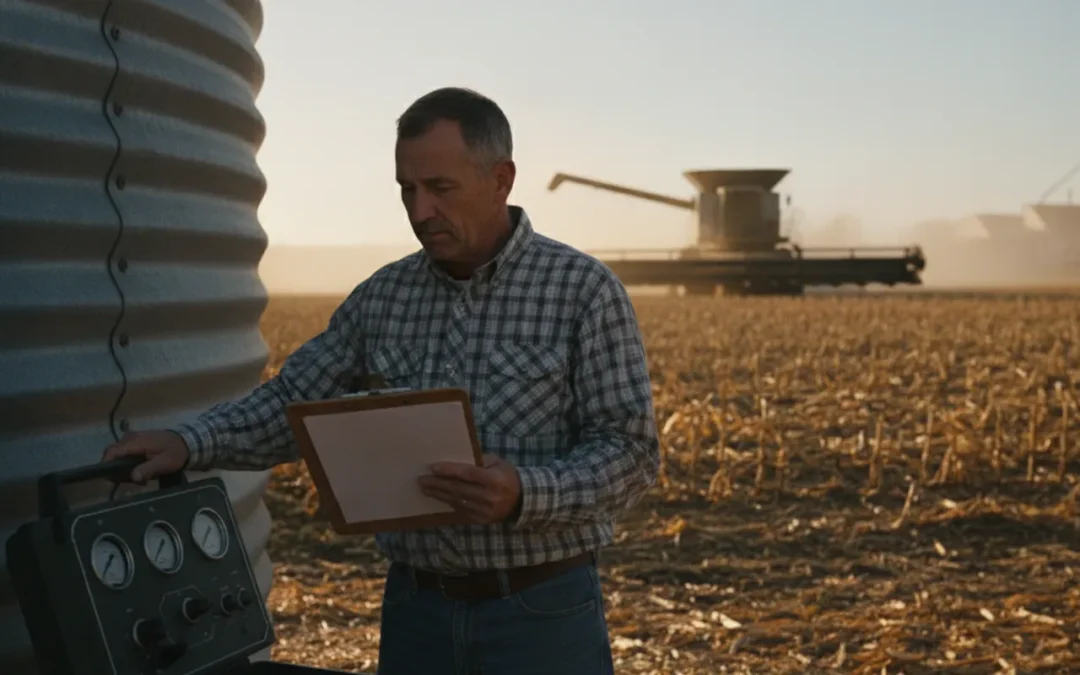
A grain storage monitoring harvest checklist helps you prepare bins before filling, establish a baseline during harvest, and follow changes while grain is stored. The goal is not to collect numbers for their own sake. It is to keep each reading tied to a bin, date, measurement point, and action so comparisons mean something.
What should you check before harvest?
Start before the first load arrives. A pre-harvest walkthrough helps uncover issues while there is still time to clean, repair, or plan. Check each bin separately; do not assume that two bins with similar capacity or appearance are in the same condition.
- Inspect accessible exterior surfaces, roof, doors, vents, and visible seams for damage or openings that may admit water or pests.
- Check the floor and unloading equipment for debris or problems that could complicate emptying and cleaning.
- Confirm fans and airflow equipment can be operated as intended. Note which controls serve each bin.
- Identify each bin clearly. Record its crop plan, approximate capacity, sensor locations, and unusual features.
- Choose a paper or digital log and tell everyone who checks bins where records belong.
- Confirm safe access and work procedures are understood. Monitoring does not make unsafe entry safe.
Keep the walkthrough focused on things you can observe safely. A sensor cannot inspect a roof seam, verify that a fan is running, or replace an equipment check. If you find a structural or electrical concern, arrange an appropriate inspection rather than treating a monitoring reading as reassurance. Include a written note for each issue, even if repairs are deferred. “Door seal needs attention before filling” is more useful than a mark on a map with no description or owner.
How should you establish a baseline as grain goes in?
Open a distinct record for every bin before filling. Note the crop, date filling begins, source or field when useful, and approximate amount or fill level. Record relevant incoming grain moisture information using the method available to your operation. If loads from different fields or harvest periods go into the same bin, mark when that change occurs.
Consistency matters more than a complicated form. Use the same units and method where possible. When you take a handheld meter reading, write down the date, meter or method, and sample context. A number without that context can be hard to interpret later. For a broader framework connecting handling and storage decisions, consult grain storage best practices.
Record starting temperature information when available. Label the sensor or location for each reading. A measurement near one point should not be treated as a whole-bin average unless the system and method support that interpretation. Write down whether fans were operating and any recent changes that could affect readings.
A baseline example
Imagine a bin filled over several days from two fields. Instead of writing only “corn, October,” make a short timeline: first fill date and source, date a second source was added, the method used for moisture checks, and the sensor locations available. If the readings change later, those entries help you ask whether the timing or location of grain placement matters. They do not prove a cause; they give you context to investigate.
What belongs in a grain monitoring log?
A useful log is short enough to maintain during a busy season, but detailed enough to make the next check comparable. Keep original entries; do not overwrite a previous value when you take a new reading. If an entry needs correction, make the correction visible and retain the date and context.
| Log item | What to record | How it helps |
|---|---|---|
| Bin identity | Label, crop, fill dates, and relevant source changes | Keeps readings connected to the right stored grain |
| Moisture context | Reading, date, method, sample, and meter if applicable | Shows what the measurement represents |
| Temperature | Value, time, sensor or position, and whether current | Makes comparison at the same point possible |
| Airflow equipment | Fan status, control setting, and changes made | Provides context for later changes |
| Observations | Odor, visible moisture, condensation, or unusual condition | Captures clues a number may not show |
| Follow-up | Action, person responsible, and next check date | Prevents unresolved concerns from being forgotten |
For example, “temperature higher” is not a strong entry. “Bin 3, north cable, 8 a.m.; reading differs from last check; fan status recorded; repeat check assigned for tomorrow” is more useful. It says where the observation came from and what will happen next, without claiming more than the measurement shows.
Make each entry answer five questions
Who checked? Which bin and point? When was the reading taken? What method or device produced it? What happens next? A log that answers these questions gives another person enough context to repeat the check. If no action is needed, record the next planned date rather than leaving the entry open-ended.
How often should you check stored grain?
Set an interval that fits the crop, storage conditions, equipment, and operating plan. There is no universal schedule that applies to every bin. A routine should include planned checks and additional attention when conditions change, readings are unexpected, equipment is serviced, or you take an action that may affect airflow.
At each check, compare a new reading with that bin’s own history, using the same measurement point when possible. Review more than the latest number: look at the direction and timing of changes, alongside fill dates, fan operation, weather or other relevant conditions, and observations. Do not assume that one measurement tells the condition of every part of the grain mass.
If an automated system reports remotely, note whether the data are current and whether the sensor is communicating. A missing alert is not proof that conditions are fine. Include a periodic check of the monitoring equipment itself in the routine, following its operating instructions.
Build a schedule people can actually follow
Choose a recurring time or event that fits the operation, such as a regular route through the bins. Put the responsibility on a person or role, not on “someone.” When a check is missed, make it visible and set a replacement time; do not quietly copy the previous reading into the new date. If you use a digital reminder, verify the reminder leads to an actual reading and record. The calendar entry is not the check.
For example, one operator may take readings while another handles equipment. Agree in advance who records fan changes and who closes follow-up items. During a busy harvest week, a short, repeatable routine is more dependable than an elaborate form that nobody finishes. Review the routine after the first few checks and remove fields that add no useful context, while keeping the information needed to interpret changes.
What changes should prompt a closer look?
Investigate readings that shift unexpectedly, disagree with nearby measurements, or do not fit other observations. Unusual odors, visible moisture, condensation, or equipment that does not appear to operate as expected also deserve follow-up. A signal can have more than one explanation, so verify it before deciding what it means.
- Confirm the bin, sensor, measurement point, date, and units.
- Check whether the reading is current and whether the measurement method was used consistently.
- Repeat or cross-check the reading with an appropriate method when safe and practical.
- Review recent entries, filling changes, fan status, maintenance, and actions already taken.
- Inspect accessible equipment and conditions without entering a confined space.
- Write down the result, decision, who owns the next step, and when it is due.
Do not respond to one unusual value by making an unplanned equipment change without considering the bin, grain, and operating instructions. If you cannot explain the change, or a condition appears urgent, seek qualified guidance. Keep the record factual: separate what you observed from what you suspect.
Turn a signal into a decision trail
Use a simple three-part note: observation, verification, next step. “Display reading differs from last entry” is the observation. “Confirmed timestamp and sensor identity; repeated check gave a similar result” is verification. “Review with the person responsible for storage decisions this afternoon” is the next step. This structure avoids jumping from an unexplained number to a diagnosis.
When an issue is not urgent but remains unresolved, set a due date and revisit it. If the next check does not resolve the discrepancy, add that result to the same record. A timeline is more useful than several disconnected notes because it shows what was tried and whether the condition persisted.
How do monitoring tools fit into the checklist?
Different tools answer different questions. A handheld moisture meter gives information about the sample tested. Fixed sensors can provide repeated readings at selected locations. Fan controls manage equipment operation according to their design. None of these functions automatically replaces the others, and each depends on correct setup and interpretation.
| Check or tool | Useful contribution | What to verify |
|---|---|---|
| Visual inspection | Observations about accessible structure and equipment | Safe access and consistent inspection points |
| Moisture meter | A moisture result for the tested sample | Instructions, sample context, and repeatable method |
| Temperature sensors | Repeated readings at installed measurement points | Location, communication, and timestamp |
| Fan control | Management of fan operation within its design | Settings, fan status, and fit with the bin plan |
Before relying on a tool, write down the question you expect it to answer. Is it tracking changes at known points, helping check a sample, or controlling fan operation? Then confirm that its installation, coverage, and instructions match that role. A tool that measures one condition should not be treated as a complete assessment of storage quality.
To explore equipment options, review Grain Temp Guard monitoring, the grain temperature monitoring system information, and EndZone fan control. The moisture sensor guide can help frame questions about moisture measurement. Compare a tool’s function with the checks already in your routine, rather than assuming that one device performs every job.
Compare the job, not just the display
When reviewing options, list the task first: repeated temperature checks, sample-based moisture information, or fan operation. Then ask what each tool measures, where it measures, how readings are presented, and what must still be checked manually. A clear comparison can prevent overlapping purchases and expose a gap that a display alone cannot address.
For example, if the main problem is that readings are not being recorded consistently, replacing a sensor may not solve the process gap. A labeled bin log, a clear assignment, or a check of communication status may be the needed first step. If the question is whether a system covers the locations that matter in a particular bin, review the installation and operating information for that system before deciding.
How can you make the routine work across several bins?
A multi-bin routine can fail when labels, routes, or records vary from one check to another. Put the bin identifier on the log and, where practical, on the monitoring record itself. Keep a simple route map or numbered list so the person checking can follow the same order and see quickly which bins remain.
- Make one log per bin, even if all logs use the same template.
- Put sensor positions and fan assignments at the top of the relevant record.
- Use a consistent route and mark each bin complete only after its record is entered.
- Flag a concern with a named owner and due date instead of relying on a verbal reminder.
- Review missed entries and recurring issues at a set point in the season.
- Keep records available to anyone assigned to cover checks.
Consider a simple weekly review during storage: scan for missing readings, unresolved follow-ups, and repeated changes. This is not a substitute for checking the grain. It is a way to ensure the monitoring process is working and that a concern has not disappeared between shifts or busy workdays.
Use a route and a handoff
Suppose you have several bins in different locations. Number them in the order usually checked and keep the route list with the log. If a person is covering another operator’s shift, note which bins have already been checked, which remain, and whether any follow-up has a deadline. This simple handoff prevents both skipped checks and unnecessary duplicate work.
At the weekly review, look for patterns in the process as well as the readings. Are the same fields repeatedly blank? Does one bin routinely lack a current timestamp? Is an action being assigned without a due date? Fix the process flaw instead of treating each missing entry as an isolated mistake. Consistent recordkeeping makes readings easier to use, but it does not make a reading more accurate than the method behind it.
How should you compare two readings that disagree?
First make sure the readings describe comparable things. A sensor at one position and a sample collected elsewhere may differ because of location or method, not necessarily because one is wrong. Check timestamp, units, device status, sensor location, and sample handling. Then repeat the measurement as directed by the equipment instructions or use an appropriate independent check.
Suppose a remote display shows a different value from a handheld check. Do not average them automatically. Record both values and their sources, verify that each is current, and compare measurement locations and methods. If the difference remains and matters to a storage decision, document the uncertainty and ask a qualified adviser or equipment support contact how to investigate it. The log should preserve the discrepancy rather than hide it.
A careful comparison in practice
Write two separate lines, not one blended number. On each line, record the device or method, point or sample, units, and time. Confirm whether one reading may be stale or whether the sample came from a different area. Repeat only in the manner recommended for the equipment and the site. If the readings still differ, preserve both and state what decision needs more information. That makes a useful handoff for an adviser without pretending the values are interchangeable.
What safety limits belong in the checklist?
A monitoring routine should make safe boundaries explicit. Never enter a grain bin simply to confirm a reading or investigate a concern. Flowing grain can engulf a person, and moving equipment can create severe hazards. Follow applicable safety procedures, lockout practices, and training requirements for the work being done. If the task cannot be completed safely from outside, stop and involve qualified, properly equipped personnel.
Do not climb or reach into equipment in a way that puts a person at risk. Plan checks so readings and accessible observations can be made without entering storage spaces. For official information on grain-handling hazards, review the U.S. Occupational Safety and Health Administration’s guidance on grain handling, including hazards associated with grain bins and handling operations. Use applicable safety rules and site procedures for your operation.
Make the safe option part of the process: identify readings that can be taken from a safe location, keep access equipment in suitable condition, and establish who to contact when inspection requires entry or specialized work. A checklist should never pressure someone to complete a task that they cannot do safely. Record the reason a check was deferred and who will arrange appropriate follow-up.
What should you do at the end of each check?
Close the loop before leaving the bin area. Confirm that the entry includes who checked, when it happened, which point was measured, and what action is due. If no action is needed, record that conclusion and the next scheduled check. If equipment was adjusted or serviced, record what changed and when, so the following reading has context.
Use a brief handoff when another person will make the next check. Identify the bin, concern, last confirmed reading, and next action. Avoid vague notes such as “watch this.” A specific handoff might say, “Check bin 2 sensor A on Thursday morning; confirm data are current and compare with the prior entry.” The person taking over then knows what to verify.
When grain is removed or a bin is emptied, close out the record with the date and relevant observations. A short end-of-season review can identify which checks were often missed, which equipment needed attention, and what should change before the next harvest. Keep the notes available for planning rather than starting from memory next season.
Close out by learning from the season
At season’s end, review the logs by bin. Note whether labels and sensor locations stayed clear, whether planned checks happened, and whether follow-ups were completed. If a problem recurred, record what information would have made the investigation easier. Carry those specific changes into the next pre-harvest walkthrough: perhaps the template needs a fan-status field, or the route needs a clearer bin identifier.
Keep conclusions modest and useful. A clean log does not prove that every part of a bin was in the same condition, and a missing entry cannot be replaced with a guess. The purpose of the review is to improve the next routine and preserve what was observed, not to turn incomplete records into certainty.
What is a practical next step?
Before harvest, label each bin, walk through checks that can be completed safely, and prepare a separate log. As grain goes in, establish the baseline; then keep the same measurement context during scheduled checks and document follow-ups. For a broader framework that connects equipment, handling, and monitoring decisions, read the grain storage best practices guide.
Use a short trial run before the season gets busy. Complete the checklist for one bin, see whether another person can understand the record without extra explanation, and refine the template. Add only fields that support a decision or a safe follow-up. Once the routine is clear, use the same structure across bins while preserving each bin’s own history.
Ask about a monitoring approach for your bins
A consistent record helps you notice what changed, understand what was measured, and decide what deserves a safe, timely follow-up.