
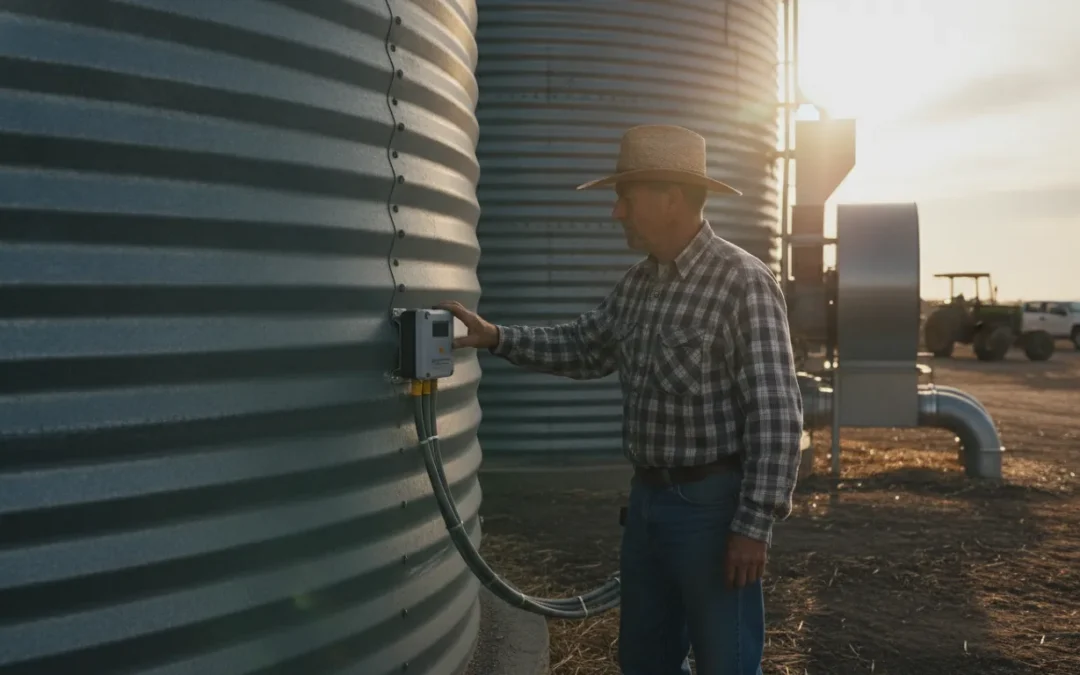
Stored grain can lose quality before a problem is obvious from outside the bin. The right monitoring setup gives you earlier visibility into temperature and humidity changes. That helps you decide when a closer inspection or corrective action is warranted. You do not have to rely only on a calendar or a lucky check.
Contact Farm Shop MFG about your grain monitoring setup
Grain bin monitoring without subscription means choosing equipment you can own and operate without an ongoing cloud or service fee. The tradeoff is not simply monthly cost. Compare what the system measures, whether probe coverage fits your bins, how alerts reach you, what happens when power or connectivity changes, and what maintenance the setup requires.
For some farms, a straightforward temperature-and-humidity monitor is the better fit than a system built around recurring access charges. Farm Shop MFG positions Grain Temp Guard as a no-subscription option that monitors grain-bin temperature and humidity, while automated fan control remains a separate function. Start by defining what ownership and monitoring access should look like in your operation.
What No-Subscription Grain Bin Monitoring Really Means
Grain bin monitoring without subscription changes the ownership question. You are not only comparing sensors and probes. You are comparing the cost of owning the equipment with the cost of continuing to access its data, alerts, or cloud platform year after year.
Upfront equipment versus recurring fees
A no-subscription system should have a clear upfront cost and a clear explanation of what remains available after installation. Ask whether the purchase includes the monitoring hardware, probes, power components, and the features you actually need, or whether basic monitoring requires an ongoing service plan. Then ask what happens if you stop paying. Do the sensors continue collecting data? Do alarms still work? Can you access the information locally?
That distinction matters because grain monitoring is intended to identify abnormal temperature increases associated with grain quality deterioration. A system that remains useful without a recurring cloud fee can make long-term ownership easier to budget. Farm Shop MFG positions Grain Temp Guard as a way to monitor grain-bin temperature and humidity without cloud subscriptions or ongoing fees. Confirm the current configuration and included features before buying.
Local alarms and remote access are different decisions
“No subscription” does not automatically mean “remote access.” Some farms may need an alarm they can check at the bin or during a routine inspection. Others may want notifications while they are in the field, at home, or away from the operation. Ask exactly how alerts are delivered, where readings are viewed, what connectivity they require, and whether remote access depends on a separate data plan.
Also confirm what the system measures. Temperature alone may fit one storage plan, while temperature and humidity may be more useful for another. Probe length and placement must match the bin and the coverage you expect.
Questions to ask before you buy
- What does the upfront purchase include, and are there recurring fees?
- Will local readings and alarms continue if internet or cloud access is unavailable?
- Does the system measure temperature, humidity, or both?
- Do the probe options fit my bin size and monitoring layout?
- What power, backup, installation, and maintenance does the system require?
Finally, keep monitoring separate from fan automation. Grain Temp Guard monitors conditions; automated aeration requires a separate control system such as EndZone.
What Should a Grain Bin Monitoring System Measure?
Start with the data you need to make a storage decision, not the number of features on a product sheet. Temperature is the basic signal for finding abnormal increases associated with grain quality deterioration. Humidity adds another view of moisture conditions, which can matter when you are trying to protect grain value and avoid unnecessary drying or reconditioning.
Some systems measure temperature only. Others measure temperature and humidity at the monitored location. Farm Shop MFG’s Grain Temp Guard is available in Dual-Temp and Humidity-Temp configurations. So the right choice depends on whether you need two temperature monitoring points or temperature and humidity together. Review the grain temperature and humidity monitoring options before choosing a configuration.
Match coverage to the bin, not just the sensor
Probe placement and length determine what part of the grain mass you can actually monitor. A probe that does not reach the intended area can leave gaps in coverage. A setup designed for a smaller bin may not make sense for a larger one, so ask where each probe will sit, how many locations need coverage, and whether the probe length fits the bin’s dimensions and grain depth.
Grain Temp Guard product specifications list probe options of 10m, 15m, 25m, 30m, and 45m. The appropriate length depends on the bin and installation plan. Larger storage capacity may also require multiple monitoring units rather than stretching one sensor across the entire bin.
Quick comparison checklist
- Measurement: Does the system read temperature, humidity, or both?
- Coverage: Are the probe locations positioned to identify abnormal conditions where they are most likely to develop?
- Fit: Do probe lengths and the number of monitoring points match the bin’s size?
- Ownership: Does the setup require recurring cloud or subscription fees?
- Response: Can you see or hear an alert clearly enough to act before a storage problem grows?
A grain bin monitoring system without subscription should still provide useful, actionable readings. Compare the measurement type, physical coverage, and bin fit together. That gives you a more practical basis for ownership cost than comparing a monthly fee alone.
Power, Alerts, and Installation Matter More Than the App
A grain monitor is only useful if it stays powered, can be checked where you work, and makes an abnormal reading hard to miss. Before choosing grain bin monitoring without subscription, look past the app or display and ask how the system behaves during a busy harvest week, a cold snap, or a power interruption.
Start with dependable power and visible alarms
Review the power source, backup plan, and alarm behavior together. Grain Temp Guard specifications list 110V external power with internal battery backup. That combination is intended to keep the monitoring unit useful when normal power is interrupted. But the installation still needs a suitable power connection and a clear plan for testing the backup.
Ask where an alarm can be heard and seen. Grain Temp Guard is listed with visual and audio alarms when readings move outside the normal range. That is different from assuming someone will always be watching a phone screen. A local alarm can draw attention at the bin site, while a monitoring routine determines what happens after the alarm sounds. Write down who checks the bin, what reading triggers action, and whether aeration or unloading is the next step.
Match installation to the bin
Probe placement and cable length should fit the bin, grain depth, and areas where a hot spot could develop. Grain Temp Guard lists probe options of 10m, 15m, 25m, 30m, and 45m. Do not select a length from a generic package description alone. Measure the actual route, account for mounting and access, and confirm that the probe reaches the intended monitoring location without leaving coverage gaps.
Installation should also leave the equipment accessible for inspection. Protect the enclosure from unnecessary exposure, keep connections orderly, and make sure a worker can test readings without creating a new fall or confined-space hazard. For more detail on cable coverage, sensor positioning, testing, and upkeep, review this grain bin temperature cable coverage guide.
Build maintenance into the storage routine
A no-subscription setup removes a recurring service charge, not the need for farm checks. Inspect power connections, confirm the backup battery is available, verify that alarms work, and compare readings against conditions you can observe at the bin. Keep a simple record of changes and actions. If the system measures humidity as well as temperature, use both readings to investigate developing storage problems rather than treating one number as a complete diagnosis.
Monitoring detects a problem. It does not automatically control fans. Grain Temp Guard and EndZone have separate roles, so confirm which equipment handles measurement and which equipment, if any, handles automated fan control before you install the system.
How Grain Bin Monitoring Without Subscription Fits a Practical Setup
The practical question is not only whether a monitor avoids a recurring fee. It is whether the system measures the conditions that matter, fits the bin, gives a useful warning, and keeps working when power or attention is limited. Grain Temp Guard is built around that straightforward monitoring job. It tracks grain-bin temperature and humidity, helping you spot abnormal temperature increases associated with grain quality deterioration.
| Setup question | Grain Temp Guard detail | Why it matters |
|---|---|---|
| What does it measure? | Temperature and humidity, with Dual-Temp (DT) and Humidity-Temp (HT) configurations. | Choose the measurements that match how you evaluate grain condition in storage. |
| How does it stay powered? | Listed specifications include 110V external power with internal battery backup. | Backup power helps preserve monitoring coverage during an interruption. |
| Can the probes fit the bin? | Listed probe options include 10m, 15m, 25m, 30m, and 45m lengths. | Probe length and placement should match bin size and the area you need to monitor. |
| What happens when readings move out of range? | Visual and audio alarms are listed for the monitoring system. | A clear local warning gives you a reason to investigate before a small issue becomes a storage loss. |
| Are there ongoing subscription fees? | Farm Shop MFG positions Grain Temp Guard as avoiding cloud subscriptions and ongoing fees. | You can evaluate the upfront equipment cost without adding a recurring monitoring charge. |
Review the Grain Temp Guard product details for the current configuration and probe information. The monitor and the fan controller are separate jobs. Grain Temp Guard reports conditions and alarms; EndZone automated grain-bin fan control manages when fans operate. Do not treat the monitor alone as an automatic aeration system.
How to Calculate the Value Before You Buy
The value of a grain monitor is not limited to the price on the invoice. It is the value of better information before a quality problem becomes a bin-wide loss, plus the labor and recurring costs you may avoid over the equipment’s useful life. Build the estimate from your own bins, grain values, checking routine, and risk tolerance.
- Start with the grain you are protecting. Record each bin’s capacity, crop, approximate value, and normal storage period. Then estimate what a quality event would cost if it caused spoilage, a moisture discount, overdrying, or extra handling. Use conservative assumptions rather than treating the full value of a bin as automatic savings.
- Estimate protected bushels and quality loss avoided. Decide how many bushels could realistically be affected by earlier detection of an abnormal temperature or humidity trend. Multiply that quantity by a defensible value per bushel, then apply a probability or percentage that reflects your operation. Monitoring can help identify conditions associated with grain quality deterioration, but it does not guarantee that every loss will be prevented.
- Put a value on labor and response time. Estimate the hours spent climbing bins, pulling samples, checking multiple locations, or responding to uncertainty during busy periods. Include only labor you expect the system to replace or reduce. A monitor is useful when its readings and alarms support a faster decision, not when it simply adds another screen to check.
- Separate monitoring from corrective equipment. Grain Temp Guard monitors grain-bin temperature and humidity. It does not automatically control fans. If automated aeration is part of your plan, evaluate that separate control equipment and its potential energy or moisture-management value on its own.
- Calculate ownership cost and payback. Add the equipment, probes, installation, power, maintenance, and any required connectivity. Subtract recurring fees avoided only when the system genuinely operates without them. Divide the net purchase cost by your conservative annual value estimate. Run a low, expected, and high case, and choose based on the low case rather than a best-case promise.
This approach makes grain bin monitoring without subscription a clear ownership decision. You can compare the upfront investment against measurable risk reduction, labor savings, and ongoing operating cost without assuming a guaranteed payback.
Choose the Setup That Fits Your Bins and Routine
The right no-subscription setup depends less on the label and more on what you need to watch. Consider how much grain is in each bin and how often someone can respond. Start with the bin, then match the monitoring coverage and alert method to your routine.
Match coverage to bin size
For a smaller bin, one monitoring point may provide a practical starting point if it covers the area where temperature or moisture problems are most likely to develop. As bin capacity and grain depth increase, one point may not give you enough coverage. Plan around probe length, sensor placement, and the number of locations you need to compare, rather than choosing a unit by price alone.
Grain Temp Guard options include 10m, 15m, 25m, 30m, and 45m probe lengths. The product line also includes single-location humidity and temperature monitoring and dual-temperature configurations. Confirm the probe reach and mounting requirements for each bin before ordering. If you are installing cables or repositioning sensors, use this guide to review grain bin temperature cable coverage.
Choose the data that answers your risk
If your main concern is finding hot spots, temperature monitoring may be the essential requirement. If moisture movement, overdrying, or changing grain conditions are also part of the decision, humidity data may justify a humidity-temperature configuration. The goal is actionable information, not a dashboard full of readings that does not change what you do next.
Also separate monitoring from control. A monitor can alert you to a developing condition, but it does not automatically control fans. EndZone is the separate automated fan-control system. Decide whether you need visibility only or a second system to automate aeration decisions.
Fit the system to your inspection routine
A subscription-free system still needs a response plan. Decide who checks readings, what temperature change triggers an inspection, and how you will document the action. Use a how often to check grain temperature schedule that reflects weather, grain condition, and storage duration. For crop-specific thresholds and aeration planning, keep the grain storage temperature chart available when reviewing readings.
Contact Farm Shop MFG about your grain monitoring setup
Frequently Asked Questions
How much does grain bin monitoring without a subscription cost?
Cost depends on the number of monitoring points, probe configuration, and bin coverage required. Farm Shop MFG lists Grain Temp Guard configurations with one-location temperature and humidity monitoring, probe options, and visual and audio alarms. Confirm the current price and configuration on the Grain Temp Guard product page before ordering.
Does a no-subscription grain monitor still have recurring fees?
It can, but the equipment must be evaluated by its connectivity and service model. Farm Shop MFG positions Grain Temp Guard as avoiding cloud subscriptions and ongoing fees. Ask whether the system requires a monthly data plan, cloud account, or paid monitoring service, and separate those costs from the one-time equipment purchase.
Should I monitor grain temperature, humidity, or both?
Temperature is useful for identifying abnormal increases associated with grain quality deterioration. Humidity adds another measure of storage conditions and can help when moisture management is part of the decision. Grain Temp Guard is available in Dual-Temp and Humidity-Temp configurations, so choose based on the conditions you need to watch.
How do grain bin monitoring alerts work without a subscription?
Not every alert requires a cloud service. Grain Temp Guard Alarm HT uses visual and audio alarms when readings exceed the normal range. Before buying, confirm where the alarm is visible, who will hear it, and whether you need remote notifications rather than an on-site alert.
Can a no-subscription setup fit different bin sizes?
Yes, but coverage must match the bin. Probe length options listed for Grain Temp Guard include 10m, 15m, 25m, 30m, and 45m. Larger or deeper bins may need additional monitoring points and longer probes, so compare bin capacity, grain depth, probe placement, and the area each unit can cover before selecting a configuration.
Contact us about your grain bin monitoring setup
Choosing the right monitoring approach starts with matching the equipment to your bins, storage goals, and preferred service model. Contact Farm Shop MFG to review Grain Temp Guard details or talk through a practical grain bin monitoring setup.