
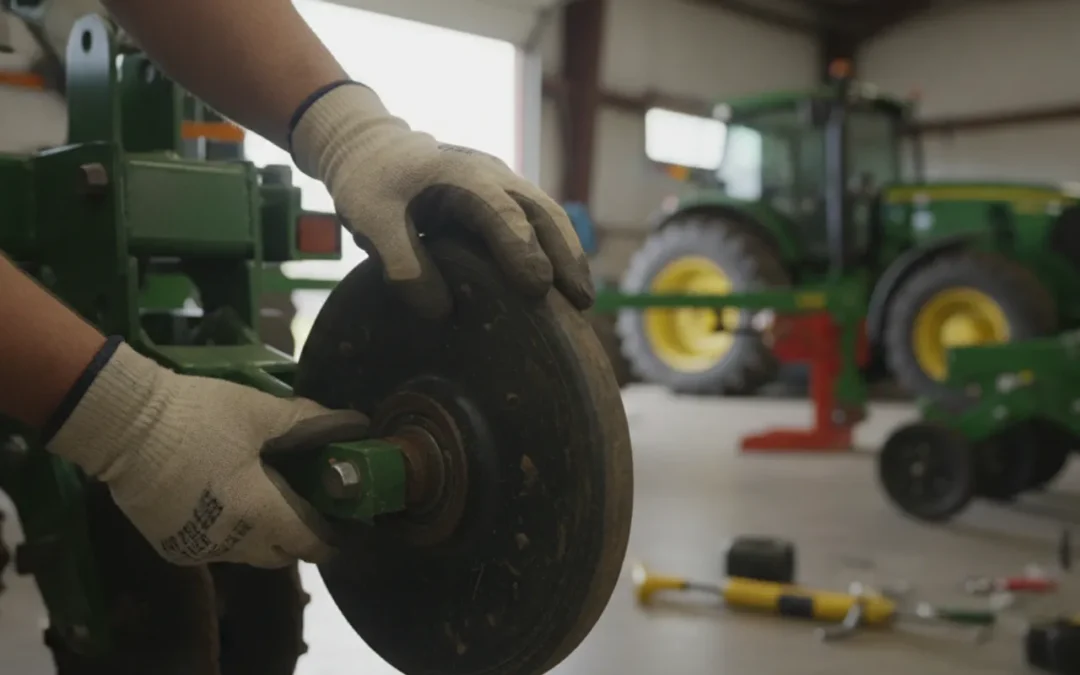
Closing wheel bearing symptoms can look like a planter setting problem at first. A wheel that wobbles, drags, feels rough when turned, or makes a repeated noise deserves a closer look before you blame pressure, alignment, or soil conditions. This guide explains what to inspect, how to distinguish bearing trouble from field effects, and how to plan a safe repair.
Ask Farm Shop MFG about closing wheel bearings
What signs point to a closing wheel bearing problem?
A bearing supports the wheel as it rotates. Wear or damage can interfere with that rotation and allow movement where the wheel should remain supported. The clearest clue is usually a physical change at the wheel hub, not a planting symptom by itself. Check for more than one sign and compare the suspect wheel with another row unit in similar condition.
- Rough or uneven rotation: With the planter parked and secured, turn the wheel by hand. A healthy assembly should rotate smoothly for its design. Grinding, a gritty feel, catching, or a repeated tight spot can point to a bearing or another part in the rotating assembly.
- Excess movement at the hub: Hold the wheel and gently check for movement side to side or up and down. Visible wobble, a knock, or movement that seems greater than on comparable row units calls for closer inspection. Do not assume every small movement is a failed bearing; assembly design and fastener condition matter.
- Unusual sound: Listen for scraping, clicking, rumbling, or a repeated squeak that follows wheel rotation. Soil, residue, a bent component, a loose fastener, or a damaged wheel can also make noise, so locate the sound before ordering parts.
- Drag or failure to turn freely: A wheel that stops abruptly, binds, or resists turning may have a bearing issue. Debris caught around the assembly, contact between components, or a bent mount can produce a similar result.
- Visible damage or contamination: Look for a damaged seal, rust, dirt intrusion, cracked or bent parts, and evidence that the hub has been rubbing. A visual check cannot confirm the condition inside a sealed bearing, but it can reveal a reason for further service.
- Recurring change during operation: If one closing wheel repeatedly leaves a different track, carries residue differently, or runs out of line, inspect the whole assembly. Field appearance is a clue to investigate, not proof that the bearing caused the pattern.
A single symptom can have several causes. For example, a wheel that will not spin freely could have a failing bearing, but it could also be packed with residue or contacting another part. Diagnose the component before changing settings or replacing hardware.
How can you check a bearing without confusing it with a field issue?
Start with a stationary inspection. Follow the planter manufacturer’s procedure for parking, blocking, and raising equipment. Keep hands and clothing clear of pinch points, support raised equipment with the specified safety equipment, and never work under a planter held only by hydraulics. Shut down the tractor and secure the machine before touching the row unit. For general workplace safety guidance, consult OSHA’s website.
- Choose a comparison row. Find a similar row unit with the same wheel arrangement and operating history. Comparing like with like makes roughness, looseness, or noise easier to notice than relying on memory.
- Look before you move anything. Check the closing wheel, hub, mount, fasteners, and nearby parts for obvious impact damage, residue, missing hardware, or a visible change in position. Take a photo if you need to track a developing condition.
- Turn the wheel slowly by hand. Note whether the rotation is smooth and consistent, whether it binds at one point, and whether a sound repeats with each turn. Do not force a wheel that is jammed; first check for obstruction or contact.
- Check movement at the hub. Apply gentle pressure in different directions and observe the hub and mount. Compare the amount and character of movement with the reference row. If movement is apparent, identify whether it comes from the bearing, loose hardware, a worn mount, or another joint.
- Inspect after a short field pass only if the static check is safe. Keep people away from moving equipment. After parking and securing it again, inspect for a changed track, residue buildup, noise reports from the operator, or parts that have shifted. A field pass can help reproduce a concern, but it does not replace a hands-on check.
Make the comparison repeatable rather than relying on one quick spin. Use the same hand pressure and check the same directions on the suspect wheel and reference wheel. Note whether the roughness stays at a particular point in each rotation or feels continuous. A tight spot that returns once per turn can direct attention toward a wheel or hub component, while resistance that changes when debris is removed may have a different cause. These observations do not identify the failed part on their own, but they give a technician or parts supplier a clearer starting point.
For product-specific service or replacement parts, identify the planter make and model, row-unit configuration, wheel type, and bearing dimensions or part number. Farm Shop MFG lists standard bearings for closing wheels and heavy-duty agricultural bearings. Confirm fit and application before ordering; a similar-looking bearing is not necessarily interchangeable.
Which symptoms are more likely to come from soil or setup?
Planting results depend on soil moisture, texture, residue, downforce, depth, wheel position, and travel conditions, among other factors. A row that closes differently does not automatically have a bad bearing. Separate the mechanical check from the field check: first establish whether the wheel turns and is supported normally, then evaluate what the wheel is doing in the furrow.
| What you notice | Possible bearing or assembly clue | Other causes to check | Useful next check |
|---|---|---|---|
| Wheel feels rough by hand | Gritty movement, recurring catch, or roughness at the hub | Residue, soil, contact with another part, or a bent component | Clean and inspect the assembly, then compare rotation with a similar row |
| Wheel wobbles or shifts | Movement at the hub that is greater than comparable units | Loose hardware, worn mount, damaged shaft, or wheel damage | Locate exactly where movement occurs; follow the planter manual for service |
| Furrow remains open or closes unevenly | Possible if a wheel binds or does not track as intended | Soil too wet or dry, residue, depth, pressure, alignment, or speed | Dig behind the row unit and inspect the seed trench and wheel track |
| Repeated squeak, click, or scrape | Noise may repeat as the hub rotates | Debris, loose fastener, wheel rubbing, or other row-unit part | With equipment secured, turn the wheel slowly and identify the sound source |
| One row has a different emergence pattern | Mechanical drag or wheel position may warrant inspection | Seed depth, seed-to-soil contact, compaction, moisture, or seed placement | Compare seed placement and soil conditions across affected and unaffected rows |
When the wheel turns smoothly, has no unusual movement, and shows no evidence of damage, check field settings and conditions before concluding the bearing is at fault. Dig several short sections across the suspect row and a comparison row. Look at furrow closure, seed depth, seed placement, and the condition of the soil surrounding the seed. A visible surface difference alone can hide what happened at seed level.
Keep the field check focused. Compare the same section of the field, preferably where the symptom was first noticed, and record whether soil texture, moisture, residue, or slope changes between rows. If the problem appears only in one patch and the wheel passes a careful stationary check, a field condition may be contributing. If the same wheel shows roughness or looseness in the shop and its track changes in multiple conditions, the evidence for a mechanical issue becomes stronger. Neither pattern is conclusive by itself; combine the physical check with what you observe in the furrow.
If the wheel binds or shifts while the field symptom is present, address the mechanical concern first. Changing pressure to compensate for a damaged rotating assembly can obscure the cause and may create a different problem elsewhere in the row unit. For broader planter checks, see the closing wheels for corn buyer’s guide and the planter sidewall compaction guide.
What should you do when a bearing may be worn?
Use the inspection findings to decide whether the row unit can remain in service, needs a scheduled repair, or should be taken out of operation pending service. Do not rely on a sound alone, and do not keep planting with a wheel that is visibly loose, binding, or at risk of coming apart. If you cannot determine whether the wheel is safe, stop and consult the planter’s service instructions or a qualified equipment technician.
Before ordering parts
- Record the planter make, model, row-unit type, and the closing wheel configuration.
- Identify the bearing part number or dimensions from the existing component or the manufacturer’s parts information. Verify rather than estimate.
- Note which row is affected and describe the symptom: rough rotation, movement, noise, drag, or visible damage.
- Check whether the bearing is serviceable or sealed and whether the manufacturer specifies related parts that should be inspected or replaced at the same time.
- Compare the proposed replacement’s fit and intended use with the equipment documentation. Do not assume a bearing fits because its outside dimensions look close.
A useful parts note includes when the symptom began, whether it changed suddenly or gradually, and whether the wheel has struck an obstruction or undergone recent service. Include clear photos of the wheel, hub, mounting arrangement, and any part markings, taken with the machine secured. If the bearing is already removed, keep its identification information and compare it with the parts diagram rather than relying only on a measurement taken without the correct reference. A few minutes spent documenting the assembly can prevent a second trip for the correct component.
Farm Shop MFG’s Germinator closing wheel information and Germinator product page can help you review the wheel system and available product details. These pages are not a substitute for confirming the bearing specification for your particular row unit.
During repair
Follow the equipment maker’s service procedure and use the correct tools. Keep replacement parts clean until installation, avoid striking a bearing in a way that transfers force through the rolling elements, and do not improvise a press fit or clearance. If the shaft, housing, seal, or mounting area is damaged, replacing the bearing alone may not solve the problem. Ask a qualified technician when the assembly design or repair method is unclear.
Before disassembly, note the orientation and order of washers, spacers, seals, and retainers. Lay parts out in sequence and compare the assembly with the parts diagram. Do not force a component that resists removal; the fastener, retaining method, or direction of removal may differ by design. Clean the surrounding area so dirt does not enter an open housing, and inspect mating surfaces for scoring or deformation once the bearing is accessible. If a part is cracked, distorted, or badly worn, pause and determine whether it must be addressed before fitting the replacement.
After repair, turn the wheel by hand and check that the assembly is secured and rotates as intended. Inspect the neighboring wheel and row-unit components as well. Make a short, controlled field check under suitable conditions, then stop and inspect again. Confirm that the wheel tracks normally and that the original symptom has not returned. Record what was changed so the next inspection has a useful baseline.
How can you reduce repeat bearing trouble?
No maintenance routine can prevent every failure, but consistent inspections can catch a developing issue before it disrupts planting. Use the service schedule and lubrication guidance for the specific planter and bearing. Some bearings require different care from others; do not add grease to a sealed unit unless its manufacturer says to do so.
- Inspect closing wheel assemblies before the season and during routine planter walkarounds.
- Remove residue and packed material that could hide damage or interfere with rotation, using a safe method with the equipment shut down.
- Check for loose fasteners, bent parts, worn mounts, damaged seals, and wheel-to-wheel contact as well as bearing condition.
- Compare similar row units and record unusual noise, movement, or a change in rotation rather than waiting until the difference is hard to locate.
- After hitting an obstruction or noticing a sudden change, recheck the affected assembly before returning to normal operation.
- Use parts suited to the machine and keep a record of repairs and part numbers for future reference.
Make inspections consistent enough that a change stands out. You might record the row number, date, wheel configuration, whether rotation felt smooth, whether hub movement was present, and what you did next. A simple notation such as “row 6: repeated click once per turn; no visible hub movement; debris removed; rechecked” is more useful than “wheel noisy.” The log also helps distinguish a problem that returns after service from a one-time obstruction.
A practical pre-season routine should cover the entire wheel assembly, not just the bearing. Farm Shop MFG’s equipment resources and information about available agricultural products offer additional starting points when reviewing planter components.
When should you stop and get help?
Stop using the affected row unit and seek service if the wheel is loose enough to shift visibly, will not turn, makes a harsh grinding sound, has a damaged hub or mounting area, or appears likely to detach. Also get help if the correct repair procedure is uncertain, the bearing is difficult to remove, or a replacement does not resolve the symptom. A short delay to identify the problem is safer than trying to plant through a mechanical failure.
For a part-fit or product question, share the machine and wheel details rather than only saying that a bearing is noisy. You can contact Farm Shop MFG or call 712-520-6051. For related planter inspection guidance, review the Germinator wheel package details alongside the manufacturer’s manual for your equipment.
Review standard closing wheel bearing options
What are common questions about closing wheel bearings?
Can a bad bearing make a closing wheel wobble?
It can, but wobble can also come from loose hardware, a worn mount, a bent shaft, or a damaged wheel. Check where the movement starts and compare the assembly with an equivalent row unit before identifying the bearing as the cause.
Should a planter closing wheel spin freely?
It should rotate as intended for its design, without a new rough feel, binding, or repeated scraping. How freely it turns can vary by wheel and bearing construction, so compare like components and use the planter service information rather than relying on an arbitrary spin time.
Can soil conditions make a good bearing look faulty?
Yes. Wet soil, residue, wheel contact, or a change in closing pressure can alter wheel rotation and furrow appearance. First inspect the stationary assembly for roughness or movement, then dig behind the planter to evaluate seed placement and closure in the field.
Can I keep planting if I hear a new noise?
Do not ignore a new repeated noise. Stop safely, secure the equipment, and inspect for binding, debris, loose hardware, or damage. If the wheel is loose, grinding, or will not rotate, do not continue operating that row unit until the cause is understood and corrected.
What is the most useful next step?
Start with a secured, hands-on comparison: inspect the hub, turn the wheel, and check for unusual movement before changing planter settings. If the bearing or another part is damaged, confirm the exact specification and repair it using the equipment maker’s procedure; if the mechanical checks are normal, investigate soil, residue, and setup as separate causes. A clear diagnosis helps protect both planting time and the row unit.