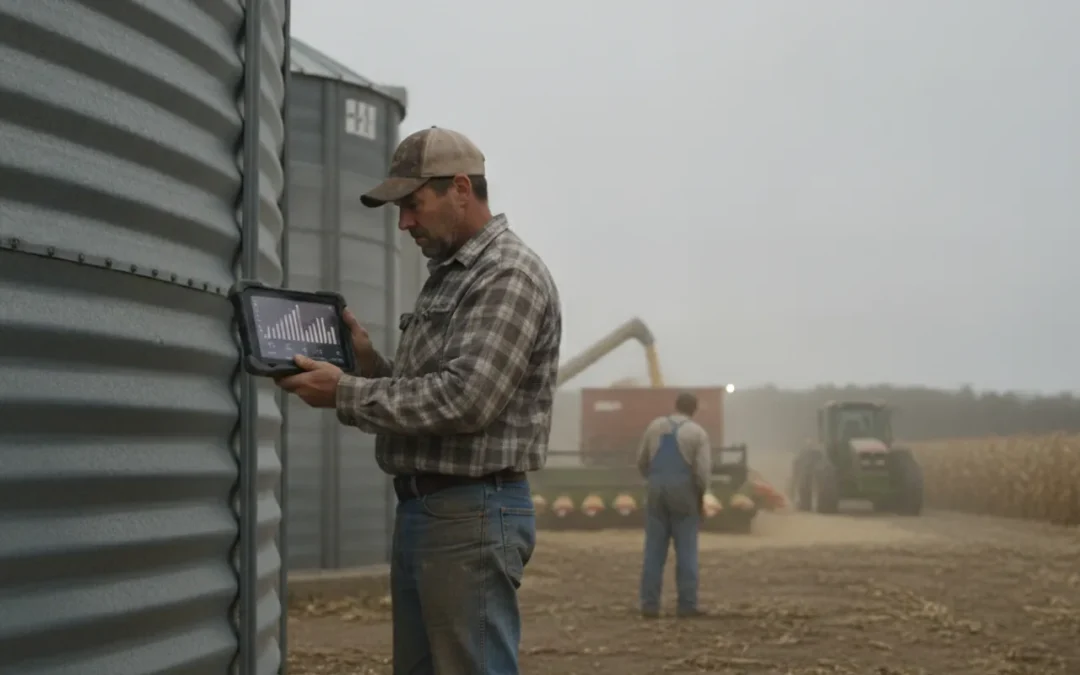
Grain monitoring review roles are easy to leave informal: one person checks readings when there is time, another assumes someone else is watching, and a change may not get a second look. A simple assignment of owners, backups, review times, and follow-up steps can make the readings part of the farm’s regular work instead of an extra task that depends on memory.
Talk with Farm Shop MFG about your monitoring setup
What does a review role actually cover?
A review role is more than having a name beside a bin on a clipboard. It describes who checks the information, when they check it, what they should compare, how they record the review, and who gets notified if something needs attention. It does not mean that one employee must make every storage decision. It means the farm team knows who is responsible for noticing and routing information.
That distinction matters on a busy operation. A sensor or monitoring system can make readings available, but a person still needs to decide whether the information calls for a closer look, a follow-up reading, or a management decision. A review plan should connect the reading to a human action without suggesting that monitoring equipment can inspect grain or correct a condition on its own.
For planning purposes, consider a grain monitoring system as one source of information within a broader routine. Farm Shop MFG’s Grain Temp Guard is designed for grain bin monitoring and management, including temperature and humidity monitoring. The team’s review process should match the system and bin setup actually in use.
Who should own each part of the review?
On a small farm, one person may hold several roles. On a larger farm, the responsibilities may be divided among the owner, a bin-site lead, an employee who makes routine checks, and someone who coordinates equipment or records. The right setup is the one that leaves no gap between receiving a reading and deciding who follows up.
- Primary reviewer: Checks assigned bins on the agreed schedule, records that the review happened, and flags readings or observations that differ from the farm’s plan.
- Backup reviewer: Covers absences, long workdays, travel, or competing harvest tasks. The backup must know where to find the information and how to reach the person responsible for a decision.
- Decision-maker: Makes or coordinates management decisions when a reading or observation needs action. This may be the farm owner or another person the farm has designated.
- Equipment contact: Helps address questions about system operation, sensor placement, connectivity, or equipment condition. This role is not a substitute for grain-management judgment.
- Record keeper: Maintains the bin list, review notes, and action follow-ups. This can be the primary reviewer if the work is small enough to do consistently.
Do not assign a role only by job title. Name a person and a backup. “The night crew” or “whoever is around” can sound flexible but often leaves it unclear who is expected to confirm that a review was done. If a role changes by shift, write down the handoff point and who accepts responsibility next.
How do you match people to bins?
Start with a current bin list. Give each bin a stable identifier that the whole team uses in conversation and records. If people call one structure “north bin,” “the big one,” and “bin three,” a reading can be reviewed under the wrong name or a follow-up can be hard to find. Use a label that makes sense at the site, then use it consistently in the monitoring display, written log, and team messages wherever possible.
Next, map each bin to a primary reviewer and backup. Keep the assignment simple enough to remember. A reviewer may own a site, a group of bins, or a specific shift. Avoid giving a person more bins than they can review within the time the farm has set aside. If the reviewer cannot complete the route in a normal workday, split the assignment or schedule it differently.
Make the assignment visible where the work is coordinated. A shared checklist, a whiteboard in the shop, or a farm record system can work. The tool is less important than having one current version and telling the team when it changes. For farms already building written routines, a grain storage resource library can be a useful place to continue learning, alongside the farm’s own operating notes.
| Role | Routine responsibility | When a follow-up is needed |
|---|---|---|
| Primary reviewer | Reviews assigned readings and records the check. | Notifies the decision-maker and notes the bin and reason for concern. |
| Backup reviewer | Covers the primary reviewer and confirms the handoff. | Contacts the primary reviewer or decision-maker if the plan is unclear. |
| Decision-maker | Sets the farm’s response and assigns any additional check. | Confirms who will carry out the next step and when it is due. |
| Equipment contact | Helps check system, sensor, or communication questions. | Reports equipment findings to the reviewer and decision-maker. |
| Record keeper | Keeps bin assignments, review notes, and action status current. | Ensures an open item remains visible until someone closes it. |
When and how often should someone review readings?
Choose a review schedule that fits the grain, storage arrangement, monitoring capabilities, and farm management plan. There is no single interval that is right for every bin and every condition, so do not copy a schedule without checking whether it fits your operation. The important point for role assignment is that a schedule has an owner and a clear expectation for what happens if the planned review is missed.
Some farms may set a recurring time for routine review and add checks when operations or observations warrant them. The team can use a calendar reminder, a shift handoff, or a written round sheet. Identify when each assigned check should be completed, not just the general phrase “check regularly.” A specific time window makes it easier for a backup to recognize that a task needs coverage.
During busy periods, keep the routine short and repeatable. The reviewer can confirm the bin identity, review available readings, note any change that merits attention, and record whether a follow-up was assigned. If a reading is unavailable or appears inconsistent, record that as a review finding rather than silently treating it as normal. The appropriate response depends on the equipment and farm plan; a missing value is not the same as a reassuring value.
Good records make it possible to see what was reviewed and what remains open. Research on stored-grain monitoring describes systematic monitoring of factors such as temperature, humidity, and moisture as important to grain quality management. See the review of grain condition information and monitoring approaches for context. This supports a deliberate monitoring process; it does not replace farm-specific guidance or make any particular schedule suitable for every bin.
What should the reviewer look at each time?
Make a short checklist based on the information your setup provides and the management plan you follow. A review can include several types of information, but the person doing it should know which items are expected and which conditions require escalation.
- Confirm the bin: Check that the displayed or recorded bin matches the assignment. This basic step can prevent a follow-up from being attached to the wrong structure.
- Check whether information is current: Note readings that are missing, stale, or not updating as expected. Follow the equipment instructions and the farm’s procedure for investigating the issue.
- Look at the pattern: Compare readings with earlier records for that same bin when available. A change over time may be more useful to the team than reading one value without context.
- Record other observations: If a person has inspected the bin or noticed a relevant change in site conditions, record the observation separately from the system reading.
- Decide whether to route a concern: Use the farm’s established thresholds and decision process. If no threshold or response is defined, ask the designated decision-maker rather than inventing one during a rushed check.
- Track the next step: Record who will act, what they will do, and when the team expects an update.
Keep observations separate from interpretations. “Reading changed since prior check” describes what was seen. “Grain is safe” or “the bin needs a specific treatment” is a conclusion that may require more information and appropriate expertise. Reviewers should know the limit of their role and whom to involve when a decision is outside their authority.
How should a concern move from one person to the next?
Agree on a simple escalation path before the first concern arises. For example: primary reviewer records and contacts the decision-maker; if that person does not respond within the farm’s chosen time, the reviewer contacts the named alternate; the assigned person confirms the next check or action. Each farm should set its own time expectations and contact method. Do not leave the reviewer to guess whether a text, phone call, or note is enough.
Use a communication method that people will actually check during the workday. A shared log can hold the durable record, while a direct message or call can notify someone about a time-sensitive question. A message should identify the bin, what changed or is missing, when it was noticed, what the reviewer already checked, and what response is needed. Avoid vague messages such as “look at the bins” when the next person needs a specific assignment.
Close the loop. The person who receives a concern should acknowledge it, assign a next step, and make clear who owns that step. The original reviewer should not assume that sending a message means the issue has been handled. A simple status such as “open,” “assigned,” or “reviewed and closed” can keep the team aligned without creating a complicated reporting system.
For questions about the equipment itself, separate the equipment path from the grain-management path. The reviewer may need to ask whether a reading is current or whether a sensor or connection needs attention. That is distinct from deciding what to do with stored grain. Farm Shop MFG provides product information for Grain Temp Guard monitoring; the farm should use its own management procedures for operational decisions.
What changes during harvest, weekends, or staff turnover?
Assignments are most likely to break down when the normal person is unavailable or the team’s routine changes. Before a busy stretch, identify who covers each reviewer, who is authorized to make decisions, and where the current bin list and contact details are kept. If the backup is unfamiliar with the process, walk through a sample review together rather than relying on a written name alone.
For weekend and holiday coverage, be explicit about the start and end of the handoff. “The backup is on call” does not say whether that person must review each bin or respond only when contacted. Write down the expectation and a way to reach the decision-maker. If coverage is limited, decide in advance which items require immediate contact and which can wait for the next planned review, according to your farm’s procedures.
When someone leaves or changes jobs, update the assignment before the next scheduled review. Remove outdated contact routes and make sure a new reviewer can access the right system and records. For a new employee, explain the boundary between observing, reporting, and deciding. This helps prevent both missed handoffs and well-intended actions that exceed the person’s authority.
Operations that also manage fan use may have separate responsibilities for monitoring and fan control. Keep those roles distinct: checking a reading is not automatically the same task as deciding to run equipment. Farm teams comparing those workflows can review EndZone automated fan control information and their own site procedures. A fan-control plan should identify who can review settings, who can override, and how a change is recorded.
How can you keep a review log useful?
A log needs enough detail to support a handoff, not a long narrative for every routine check. At a minimum, capture the date and time, bin identifier, reviewer, whether the reading was available, a short note on anything that changed or needs attention, and the assigned next step. Record the person responsible and a due time or next review point. If the check found no item to route, a simple completion mark may be enough.
Use consistent words and units where readings are recorded manually. If a system provides a history, do not copy every number into a second record unless the farm has a reason to do so. Instead, note where the reading can be found and capture what matters for follow-up. For ideas on making review records consistent, see this grain bin sensors for corn, then adapt the record to the tools and information you actually use.
Set a regular time to review open items. Otherwise, an action can remain in a log after the person who noticed it has moved on to another task. The record keeper or decision-maker can check that every open item has an owner and a status. Keep the log in a location the team can access, but follow your farm’s rules for protecting account credentials and private information.
What should a farm write down before using the plan?
A one-page role sheet is often enough to make expectations clear. Include the following items and keep the sheet with the records people use for daily work:
- Current bin names or numbers and any site label that helps the team identify them.
- The primary reviewer and backup for each bin or group of bins.
- The routine review schedule and where completion is recorded.
- The person authorized to make or coordinate management decisions.
- The contact method and escalation order for an urgent question or missed handoff.
- The steps for reporting unavailable readings or possible equipment issues.
- How open items are assigned, updated, and marked complete.
- The date the plan was last checked and who updates assignments when staffing changes.
Review the plan at the start of a storage period, after a staffing change, or when equipment or bin assignments change. A brief walkthrough can expose gaps that are hard to see on paper: an employee cannot access the system, two people believe the other is responsible, or no one knows who can approve a next step. Fix those gaps before relying on the routine.
How do you know the role plan is working?
Look for completion and follow-through, not an unrealistic promise that nothing will ever be missed. Are reviews recorded on the schedule the farm chose? Can the backup locate the same records? Does a concern reach a decision-maker? Do open items have an owner and a next check? Can someone tell which bins were reviewed during a shift handoff?
If the answer is no, adjust the assignment rather than simply asking the same person to try harder. The bin group may be too large, the check time may conflict with other duties, or the escalation route may be unclear. Keep the process modest and repeatable. A brief review that happens consistently is more useful than an elaborate checklist that no one can complete.
As the farm changes tools or adds bins, revisit the assignment map. Equipment can provide information, but the human workflow determines whether someone sees it, understands its context, and routes it to the right person. Farm Shop MFG’s grain management product information can help you understand available equipment options, while your team defines how checks fit farm operations.
Learn more about Grain Temp Guard
Frequently Asked Questions
Can one person be both the reviewer and the decision-maker?
Yes, if the person has the time, information, and authority to handle both parts. Still name a backup and state who takes over when that person is unavailable. The key is making responsibility explicit, not creating extra titles.
Should the backup review every bin on the same schedule?
That depends on the farm’s plan. Some farms may assign the backup to cover only when the primary reviewer is away; others may use a second-person check for selected situations. Write down which arrangement you use so a backup knows whether to review routinely or only after a handoff.
What should someone do if a reading is missing?
Record which bin and reading are unavailable, when the issue was noticed, and who was notified. Follow the system instructions and farm procedure to investigate. Do not treat a missing value as a normal reading or assume the system has resolved the issue.
Does a monitoring system replace physical inspection or management decisions?
No. Monitoring information is one input to the farm’s process. Follow appropriate storage practices, equipment instructions, and professional guidance for inspection and management decisions. Assign people to interpret and act on information within their role.
How often should we update our role sheet?
Update it whenever a person, bin assignment, or monitoring setup changes. It is also useful to confirm the list at the beginning of a storage period and after a season’s workflow review, so the next team is not working from outdated assignments.
Clear ownership turns monitoring into a team routine: each bin has a reviewer, every reviewer has backup, and each concern has a defined path to follow-up. Start with the assignments your farm can maintain, test the handoffs, and revise the plan when the work changes.