
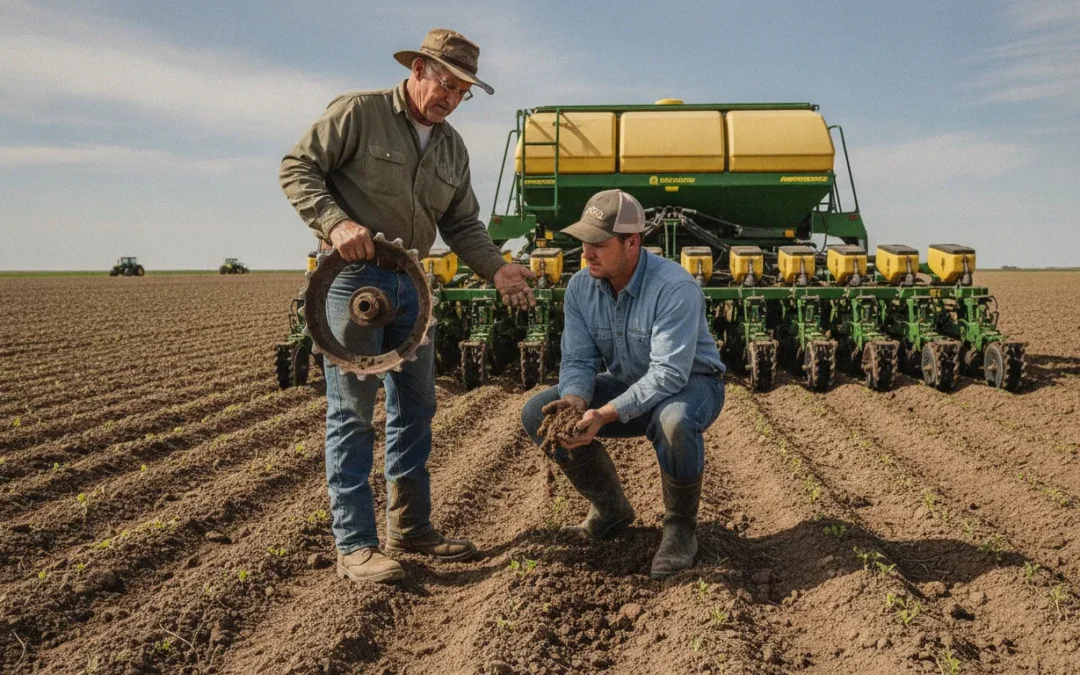
Closing wheels have a straightforward job: close the seed trench, improve seed-to-soil contact, and avoid creating more compaction around the seed. The right system should also make sense on the balance sheet, especially when you are outfitting multiple planter rows.
When comparing germinator closing wheels vs precision planting, the biggest difference is the entry cost: Farm Shop MFG lists the Germinator at $212 per row. Compared with $1,208 per row for the Precision Planting alternative. The Germinator also uses premium 50-grade steel and is designed to address sidewall compaction while improving seed-to-soil contact.
That price gap does not eliminate the need to evaluate performance, fit, and field conditions. It does change the investment required to address the same planting fundamentals. Here is how the two options compare before you decide which system belongs on your planter.
Germinator Closing Wheels Vs Precision Planting: Germinator vs Precision Planting: Quick Cost Comparison
For farmers comparing closing-wheel upgrades, the upfront price difference is substantial. The Germinator closing wheels are listed at $212 per row, while Precision Planting’s comparable closing-wheel system is listed at $1,208 per row. That is a difference of $996 per row before installation or other planter changes.
| Factor | Germinator | Precision Planting |
|---|---|---|
| Listed cost per row | $212 | $1,208 |
| Wheel material | Premium 50-grade steel | Compare the specified system and configuration when quoting |
| Ownership model | Standalone wheel design with no subscription | Part of a proprietary Precision Planting ecosystem |
| Primary value consideration | Lower initial investment and durable steel construction | Integrated system features and ecosystem compatibility |
What the price difference means on a planter
On a 16-row planter, the listed wheel cost is about $3,392 for Germinator compared with $19,328 for Precision Planting. On a 24-row planter, the same comparison is $5,088 versus $28,992. Those are equipment-price comparisons, not promises of identical configurations or total installed costs, so farmers should confirm fitment and package details before ordering.
Material and ownership structure also affect the longer-term calculation. Germinator uses premium 50-grade steel rather than plastic, with the design intended to address sidewall compaction and improve seed-to-soil contact. Precision Planting offers a proprietary ecosystem that may make sense for operations already invested in its equipment and workflow. Germinator’s standalone, subscription-free approach keeps the purchase simpler, with no recurring platform fee identified in the supplied product information.
The practical question is not whether the higher-priced system can deliver performance. It is whether the additional investment and ecosystem commitment fit your planter, acres, and operating priorities. Compare compatibility, replacement expectations, and the value of integrated features alongside the per-row price.
Sources: Farm Shop MFG product information; ownership-model comparison is based on the supplied research ledger.
What Does Precision Planting Actually Include at $1,208/Row?
Precision Planting’s FurrowForce is more than a replacement closing wheel. It is a two-stage manual closing system designed to manage the seed trench in separate passes. The first stage addresses the trench walls, while the second stage finishes closing the furrow over the seed. That approach gives operators more control over how the soil is firmed around the seed, especially when field conditions change across a field.
Two-stage closing and hydraulic control
The system pairs its closing mechanism with advanced hydraulic control and adjustment points. In practical terms, that means more setup decisions at the planter, including how much closing force is applied and how the system responds to different soil conditions. The benefit is control, but the tradeoff is a more involved installation and calibration process than a simple wheel swap. Operators need to understand the system, route and connect the hardware correctly, and make adjustments that fit their soil and planting conditions.
If you need a refresher on the basic job of a closing wheel, read how closing wheels work before comparing complete systems.
What the field data shows
Precision Planting’s own study reports that FurrowForce produced an average gain of 5.0 bushels per acre and an additional $20.79 per acre in revenue across all tillage environments. That is a meaningful performance claim, and it belongs in an honest comparison. The result comes from Precision Planting’s published research, so farmers should review the study conditions and determine how closely they match their own soils, crops, and management practices. It is evidence of potential performance, not a guaranteed result for every operation.
The ecosystem cost
At $1,208 per row, the purchase includes a proprietary system built around Precision Planting’s broader equipment ecosystem. That can be valuable for farms already standardized on the brand, but it can also create dependence on proprietary components, specialized installation, and a specific service path. Replacing or expanding the system may require staying within that ecosystem rather than selecting a straightforward standalone component. For farmers comparing germinator closing wheels vs precision planting, the key question is whether the additional control and integration justify the higher cost and complexity for their planter.
What Does the Germinator Include at $212/Row?
At $212 per row, the Germinator is built around a straightforward goal: close the seed trench without creating another problem beneath the soil surface. Farm Shop MFG designed it from a farmer’s perspective, with the practical demands of planting in real field conditions in mind. The result is a closing wheel system focused on durable construction, consistent seed-to-soil contact, and a price that fits the equipment budgets of working farms.
Premium steel instead of disposable plastic
The Germinator uses premium 50-grade steel rather than plastic. That material choice matters when closing wheels face abrasive soil, residue, and repeated contact with the ground across thousands of planted acres. Plastic components can wear as the season progresses, changing how they engage the seed trench. Steel gives the Germinator a more durable foundation for farmers who want a closing wheel that holds up to regular use.
The price difference is equally clear. The Germinator costs $212 per row, compared with $1,208 per row for the comparable Precision Planting option. That makes the Germinator 85% cheaper based on the listed row prices. For a 16-row planter, the difference represents a substantial amount of capital that can stay available for seed, repairs, or other planting needs.
Designed to improve contact without reinforcing the sidewall
The Germinator’s inner-rim shoulder-firmer design is intended to press soil back where it belongs while helping address sidewall compaction. A properly closed trench gives the seed better contact with surrounding soil, which supports more consistent conditions for germination. Closing wheels are not simply a finishing attachment. Their adjustment and engagement affect how the trench closes and how the seed sits in the row.
For farmers comparing Germinator closing wheels with higher-priced alternatives, the value is the combination of function and ownership cost. Farm Shop MFG positions the system for first-season ROI: a $212-per-row investment aimed at solving a costly planting issue without requiring a premium system price. Compatibility and setup still depend on the planter, soil, and field conditions, so the right installation and adjustment matter as much as the wheel itself.
Side-by-Side Field Trial Results
Yield data gives farmers a better comparison than price claims alone. Precision Planting’s published research reported that its FurrowForce two-stage closing system produced an average gain of 5.0 bushels per acre across tillage environments, along with an average additional revenue figure of $20.79 per acre. That is a meaningful result, and it is fair evidence that closing-wheel design can affect performance. Read Precision Planting’s study for the test details.
What the Germinator trials showed
Farm Shop MFG’s 2023 comparison tested Germinator against rubber closing wheels and reported a 13-bushel-per-acre advantage in no-till conditions and a 7-bushel advantage in conventional till. Those results should be read as trial results, not a guarantee for every soil type, planter, or planting season. Still, they provide a useful benchmark because the comparison used the same general baseline as Precision Planting’s published study: rubber closing wheels.
That makes the comparison more revealing than a simple brand-versus-brand claim. Precision Planting’s own study reported a 5.0-bushel advantage over its rubber-wheel baseline. The Germinator study also measured performance against rubber wheels, while reporting larger gains in both no-till and conventional-till environments. In other words, the Germinator results outperform the baseline used in Precision Planting’s own published comparison. Farmers evaluating germinator closing wheels vs precision planting should compare the test conditions, not just the headline number.
Independent data and farmer experience
Beck’s Practical Farm Research adds another data point. Its testing reported a 5.1-bushel-per-acre corn advantage and a 2.5-bushel-per-acre soybean advantage for Germinator. Those crop-specific results suggest the potential benefit is not limited to one crop, although field response will depend on soil, residue, closing-wheel adjustment, and weather.
Customer testimonials point in the same direction. Farmers have reported consistent advantages of roughly 3.5 to 5 bushels per acre over Yetter Twisters. Taken together, the studies and field reports support a practical conclusion: closing wheels are worth evaluating as part of planter setup. Particularly where sidewall compaction or uneven seed-to-soil contact is limiting emergence. The strongest decision is still a side-by-side test on your own acres, using the same planter settings and measuring both emergence and yield.
Which Closing Wheel Delivers Better ROI for Mid-Size Farms?
For a mid-size farm, the right comparison is not just purchase price. It is the cost to equip the planter, the useful life of the component, and how quickly the investment can pay back through better planting results. In a germinator closing wheels vs precision planting comparison, the upfront difference is large enough to change the payback calculation.
Start with the planter investment
Germinator closing wheels cost $212 per row. A 16-row planter therefore requires $3,392 in closing wheels. At Precision Planting’s listed price of $1,208 per row, the same planter represents a $19,328 investment. That is a difference of $15,936 before considering installation, replacement parts, or the cost of tying the planter to a broader equipment ecosystem. The per-row pricing is documented on the Germinator product page.
The gap grows on larger mid-size planters. For 24 rows, Germinator wheels cost $5,088, while the comparable Precision Planting investment reaches $28,992. Farmers should still compare compatibility and field performance for their specific planter. But the lower entry cost leaves more capital available for seed, fertilizer, repairs, or other planting improvements.
What does a conservative payback look like?
Consider a 1,000-acre corn operation using a 16-row planter. A conservative 3-bushel-per-acre improvement at $4 corn equals $12 per acre in additional crop value, or $12,000 across the farm. Against a $3,392 Germinator investment, that produces a payback within the first season, before counting any value from improved seed-to-soil contact or reduced sidewall compaction.
That calculation is not a guaranteed yield promise. Actual results depend on soil conditions, planter setup, weather, hybrid, and management. It is a practical way to stress-test the investment: the required gain to recover $3,392 across 1,000 acres is about $3.39 per acre. Or less than one bushel per acre at $4 corn.
Durability changes the long-term math
Germinator wheels use premium 50-grade steel rather than plastic. Farm Shop MFG states that they can cover more than 4,500 acres without replacement, while plastic alternatives may require replacement around 1,500 acres as they wear. Fewer replacement cycles reduce downtime, parts expense, and the chance of starting a planting season with worn closing wheels.
Germinator also avoids subscriptions and vendor lock-in. You buy the closing wheels, keep control of the planter, and do not add a recurring software charge to the ownership calculation. For a farm weighing durable hardware against a higher-cost system, that combination of first-season payback and lower replacement exposure makes the ROI case straightforward.
Frequently Asked Questions
What should I check before installing replacement closing wheels?
Confirm row-unit compatibility, mounting hardware, wheel spacing, and operating conditions. Then set closing-wheel pressure and alignment in the field, not only in the shop. Down pressure affects seed depth control, and excessive pressure can make soil around the seed too hard for strong emergence, according to South Dakota State University Extension.
Are Germinator closing wheels a good option for no-till planting?
They are designed to address sidewall compaction and improve seed-to-soil contact, two concerns that matter when the planter must close a trench through residue and firmer soil. Actual results depend on soil moisture, residue, down pressure, travel speed, and the rest of the planter setup. Evaluate emergence and trench closure in your own fields rather than treating any wheel as a substitute for proper adjustment.
How do the materials compare between Germinator and Precision Planting?
Germinator closing wheels use premium 50-grade steel rather than plastic, according to the product specifications. That gives farmers a metal construction option when comparing replacement wheels. The more useful comparison is how each system performs on your row unit, soil. And planting conditions, along with the service life and replacement cost you experience over multiple seasons.
What is the biggest cost difference between the two systems?
Farm Shop MFG lists Germinator at $212 per row, while the comparable Precision Planting price cited for this comparison is $1,208 per row. That is a $996-per-row difference before installation and related components. For a 16-row planter, the difference is $15,936, so row count and actual configuration should be part of your ROI calculation. Verify current pricing and compatibility directly before ordering.
Ready to choose the right closing wheels?
The best fit depends on your planter, field conditions, and priorities for durability and seed-to-soil contact. Talk to a farmer who can help you compare the Germinator with your current setup. Contact Farm Shop MFG to discuss compatibility and the right closing wheel option for your operation.