
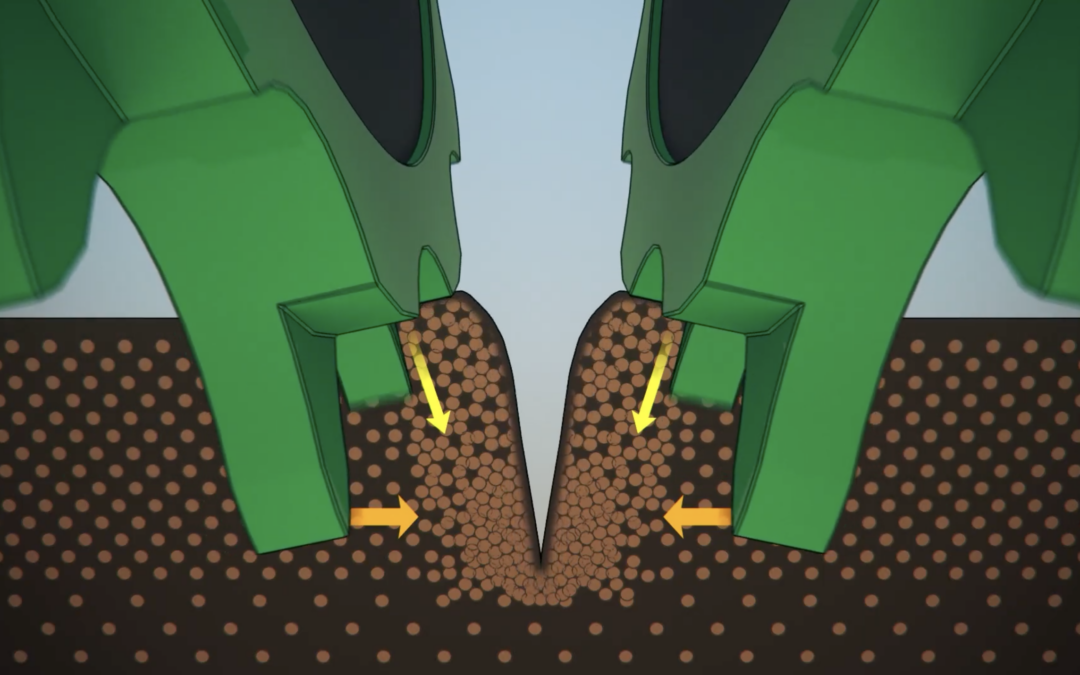
The condition of the seed trench at planting is one of the most consequential variables in a crop’s entire development cycle. Seed trench quality shapes what the seed experiences in its first hours underground, how the root system establishes in its first weeks, and how well the plant handles stress throughout the growing season. Farmers who focus only on inputs and weather while ignoring trench quality are missing a foundational factor that influences every other outcome on the farm.
Most of the physical environment a seed needs to succeed is determined in a few seconds as the planter passes through. The trench opens, the seed drops, and the closing wheel seals the environment around that seed until germination begins. What that sealed environment looks like, how moist it is, how firm the surrounding soil is, and whether air gaps are present all depend on how well the planter created and sealed the seed trench. Getting this step right at planting creates advantages that compound through every stage of crop development.
What Is Seed Trench Quality
Seed trench quality refers to the physical condition of the furrow that holds the seed after planting. A high-quality trench has clean sidewalls cut by sharp opener discs, seeds placed precisely at the target depth with consistent spacing, and a firmly sealed closure that removes air gaps and presses moist soil against all seed surfaces. This environment provides immediate access to moisture, physical stability, and temperature buffering that the seed needs to germinate quickly and reliably.
Low seed trench quality takes several forms. Ragged sidewalls caused by worn openers leave loose soil fragments that fall away from the seed rather than pressing against it. Shallow or inconsistent depth creates seeds in varying temperature zones across the same row. Poorly sealed closures leave air voids that block moisture transfer and expose seeds to temperature swings. Each defect in seed trench conditions reduces the reliability of germination and the strength of early plant establishment, setting a development trajectory that is harder to recover from as the season progresses.
Why Seed Trench Conditions Matter
Seed trench conditions control the immediate physical environment around the seed during its most vulnerable period. From the moment of planting until the seedling is self-sufficient above ground, the seed depends entirely on what the trench provides. Moisture, temperature stability, physical support, and root pathway quality all originate in how the trench was formed and sealed. No post-planting input can fully substitute for a well-formed trench created at the moment the seed enters the ground.
The planting environment also determines how the root system develops during its first two to three weeks. Roots follow the path of least resistance. A trench with compacted sidewalls redirects roots into already-disturbed soil rather than allowing them to move outward into the undisturbed root zone. A trench with loose, poorly firmed soil above the seed gives roots no physical anchor to push against as the seedling emerges. Both defects in crop development stages trace back to trench quality and have lasting effects on how well the plant accesses water and nutrients during the rest of the growing season.
How Farmers Improve Seed Trench Quality
Improving seed trench quality starts with the equipment doing the work and the conditions under which it operates. Sharp openers, properly adjusted closing wheels, matched down-pressure settings, and appropriate travel speed all contribute to consistent trench formation and closure. Farmers who regularly inspect their trenches after planting, adjust their equipment based on what they find, and make decisions based on field conditions rather than fixed settings consistently produce better trench quality across the full range of soils in their operation.
1. Better Furrow Formation
Furrow formation quality depends primarily on opener disc condition and the cutting angle at which the disc enters the soil. Sharp discs create clean, narrow trenches with smooth sidewalls that hold moisture and support firm seed-soil contact. Worn discs push soil aside rather than cutting through it, creating smeared sidewalls that shed moisture rather than retaining it. Better furrow formation through regular disc maintenance and proper down-pressure settings is the first step toward seed trench quality that supports reliable germination and strong early plant development.
2. Improved Soil Contact
Soil contact quality inside the closed trench determines how quickly moisture moves from the soil to the seed coat. Improved soil contact comes from closing wheels that press soil evenly and firmly against the seed from both sides of the trench. It eliminates the air gaps that block moisture transfer and creates the direct seed-to-soil bridge that germination depends on. Farmers who prioritize soil contact performance when selecting or upgrading closing equipment see immediate results in germination speed and emergence uniformity that persist across the whole growing season.
3. Reduced Air Pockets
Air pockets in the seed trench are invisible from above but devastating to germination reliability. They form when closing wheels fail to press soil fully against the seed, leaving empty spaces on one or more sides of the seed coat. Reduced air pockets require closing wheels that apply consistent, even pressure in both directions across the trench. Fields where air pocket formation is eliminated through better closing system performance show tighter emergence windows, fewer missing plants in the row, and more uniform crop development from early vegetative stages through reproductive growth.
4. Balanced Moisture Around Seeds
The ideal seed trench holds enough moisture to trigger germination chemistry without waterlogging the soil around the seed. Balanced moisture around seeds comes from firm trench closure that slows evaporation from the seed zone without trapping excess water in poorly draining soil. Farmers who match closing wheel pressure to soil moisture conditions at planting protect this balance. Too little pressure in dry soil allows rapid moisture loss. Too much pressure in wet soil creates a compacted zone that traps standing water and increases the risk of seed rot in cool, early-season conditions.
5. Stronger Early Plant Growth
Everything about seed trench quality connects to stronger early plant growth. Clean sidewalls support better root architecture. Firm soil contact accelerates germination. Reduced air pockets ensure moisture continuity. Balanced moisture prevents rot and dry-out. Each quality factor in the trench contributes to a seedling that emerges faster, roots deeper, and builds the structural foundation for strong plant development throughout the growing season. Stronger early growth from better trench conditions is not a subtle effect. It is visible in plant size, leaf development, and root mass within the first two weeks after emergence.
Impact on Seasonal Crop Performance
Seed trench quality effects do not end at emergence. Root systems established in well-formed trenches continue to benefit from the better soil structure in the seed zone as they grow deeper through the season. Plants with better early root architecture access deeper moisture during summer dry periods and capture more of the applied nutrients before leaching occurs. The advantage built into the seed trench at planting carries through pollination, grain fill, and final yield in ways that no mid-season input can fully replicate.
At the field scale, better seed trench conditions translate into more predictable, consistent seasonal performance. Fields with uniform stand establishment from high-quality trenches respond more efficiently to every management decision applied after planting. Herbicide timing, fungicide applications, and side-dress fertilizer all work better when the crop they serve is at a uniform development stage. Farmers who invest in better seed trench conditions build crop performance advantages that accumulate from the planting pass through the final combine pass at harvest, season after season, without exception.
Conclusion
Seed trench quality is the physical foundation on which the entire crop season is built. The conditions present in the trench at the time of planting shape germination rate, root development, early plant vigor, and the plant’s ability to withstand stress throughout the growing season. No input applied after planting can fully overcome the yield drag created by poor trench quality at the start. Farmers who treat trench formation and closure as primary performance variables rather than background details gain a real and lasting agronomic advantage.
Every improvement in trench quality, whether from sharper openers, better closing wheels, or more appropriate planting conditions, delivers value from the first seed placed to the last row harvested. Better seed trench conditions are not expensive to achieve. They require the right equipment working correctly under the right conditions. Farmers who build this foundation consistently produce stronger, more uniform crops that deliver the yields their soils and genetics are capable of, season after season, without the variability introduced by poor trench quality.