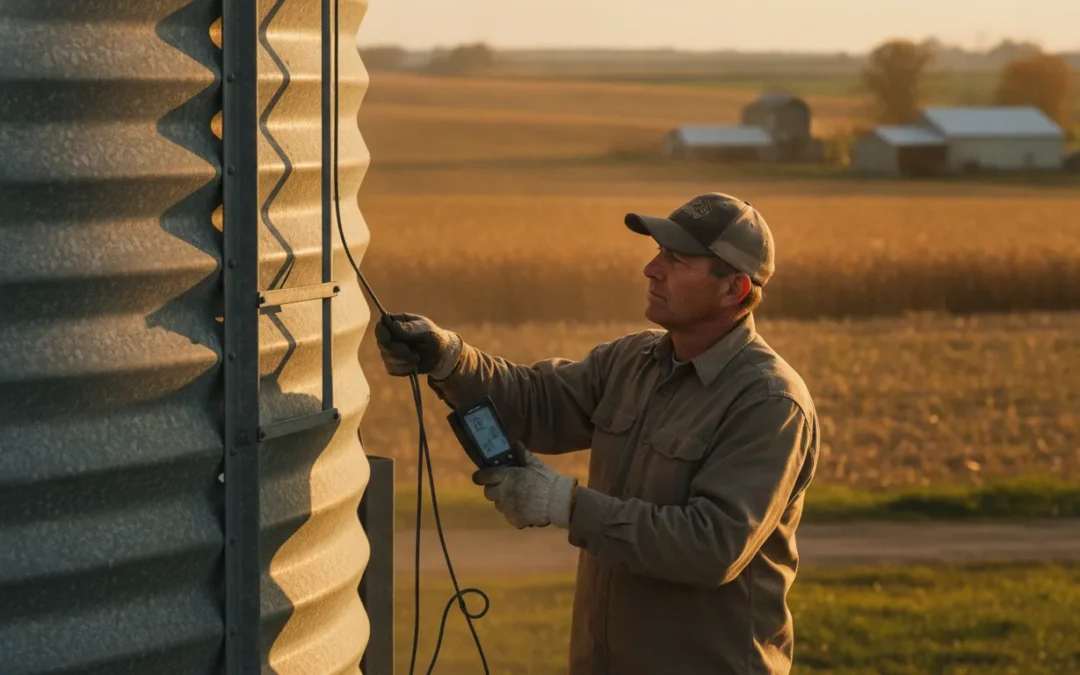
Grain temperature is not a set-it-and-forget-it detail. Temperature differences can move moisture toward colder areas, creating hot spots, crusting, and preventable storage losses. Keeping grain cool and uniform also extends allowable storage time. With storage time roughly doubling for every 10°F reduction in grain temperature, according to South Dakota State University Extension. For a practical foundation, review this guide to grain bin temperature monitoring.
For most farmers comparing cost, control, and ongoing ownership. Grain temp guard vs agi binmanager comes down to a $499 standalone monitor with no recurring subscription versus AGI BinManager at roughly $3,000-$8,000 or more per bin. Plus subscription fees. The right choice depends on how much enterprise automation your operation truly needs.
The numbers are far enough apart that the comparison deserves more than a feature checklist. Here is how the two systems differ in upfront cost, recurring obligations, installation, and the day-to-day data you need to protect stored grain.
Explore the $499 Grain Temp Guard and see if it fits your bins.
Grain Temp Guard vs AGI BinManager at a Glance
The price difference is the first thing most farmers notice. Grain Temp Guard starts at $499 as a standalone monitor. AGI BinManager typically runs $3,000 to $8,000 or more per bin, plus ongoing subscription fees. That is not a small difference when you are equipping several bins, and the subscription continues after the hardware is installed.
Both systems address the same basic storage question: what is happening inside the bin before a quality problem becomes a load of damaged grain? Temperature monitoring matters because temperature differences can move moisture toward colder areas, creating conditions for hot spots and crusting. The University of Minnesota Extension explains that aeration maintains a cool, uniform temperature and improves grain storability: see its stored-grain aeration guidance.
| Feature | Grain Temp Guard | AGI BinManager |
|---|---|---|
| Price | $499 standalone. | $3,000 to $8,000 or more per bin. |
| Subscription | No recurring subscription fee. | Ongoing cloud subscription fees. |
| Installation | DIY-friendly installation and operation. | Enterprise-style setup that may require professional installation. |
| Power | External power with internal battery backup, sealed in a poly case. | Platform-specific power and system setup. |
| Monitoring focus | Practical temperature visibility for detecting changing grain conditions. | Cloud-connected enterprise monitoring and management. |
| Who it fits | Farmers who want essential bin data without vendor lock-in or recurring fees. | Operations that need a broader enterprise platform and accept its higher cost. |
The monitoring decision is ultimately about risk, not just equipment. A temperature trend can prompt you to inspect, aerate, or correct a problem while the grain is still worth protecting. Farm Shop MFG estimates that preventing overdrying can protect $1,650 in corn or $3,850 in beans per 30,000-bushel bin. For a farmer who needs clear temperature information without paying enterprise-platform prices, the lower-cost system can make the economics easier to justify.
What Does AGI BinManager Include at $3,000+?
AGI BinManager is built as an enterprise grain-management system, not just a temperature monitor. At the $3,000 to $8,000-plus per-bin price point. The package is aimed at putting several jobs under one roof: IoT temperature sensors, cloud-connected dashboards, automated aeration decisions, and fan-control functions. For a large operation that wants centralized oversight across many bins, that integrated approach can be valuable.
The attraction is visibility and automation. Instead of checking each bin manually and deciding when to run a fan. An integrated system can collect sensor data, present it through a dashboard, and connect monitoring to aeration management. That matters because temperature differences can move moisture through stored grain, creating conditions for hot spots and spoilage. The University of Minnesota Extension explains that aeration helps maintain a cool, uniform temperature throughout the bin. Farmers evaluating the automation side should also review this guide to grain fan automation and drying control.
The tradeoff is the platform, not just the hardware
The quoted investment is typically $3,000 to $8,000 or more per bin, and recurring cloud subscription fees add to the lifetime cost. Those fees are part of the operating model, so the purchase decision is not finished when the equipment is installed. Over several storage seasons, the farmer is paying for continued access to the connected ecosystem as well as the original hardware.
That model can make sense when a commercial operation needs centralized dashboards, automated fan management, and a broader vendor-supported system. It can also mean more setup, more components, and more dependence on the vendor’s cloud platform. The question is whether those enterprise features solve a problem you actually have. Or whether they add complexity to a job that mainly requires dependable temperature information and timely fan decisions.
What you are buying at this price
In practical terms, the BinManager price buys an integrated ecosystem and automation layer, not merely probes in a bin. That is the honest reason it costs more. The tradeoff is lock-in: subscription expense and cloud-platform dependency continue after installation. Grain Temp Guard takes the opposite approach, giving farmers control without dependency on cloud platforms or recurring fees. For a farm comparing the two, separate the value of automation from the cost of maintaining the platform. If the enterprise features will prevent losses or save enough labor across your bins, they may earn their keep. If not, the added lifetime cost deserves a hard look.
What Does Grain Temp Guard Include at $499?
At a $499 entry price, Grain Temp Guard is built around the part of bin management that matters most: knowing what is happening inside the grain. It is a standalone temperature monitor, not a subscription-based cloud platform. You get the information needed to watch stored grain and respond before a temperature problem turns into a quality or financial problem.
Monitoring that pays for itself quickly
Overdrying can quietly take money out of a bin even when the grain looks fine from the outside. For a 30,000-bushel bin, the potential loss is estimated at $1,650 for corn and up to $3,850 for beans. Those numbers put the $499 purchase in practical perspective. Preventing one avoidable overdrying loss can cover the cost of the monitor, without adding a recurring software bill.
The monitor does not replace sound grain-handling practices or aeration. It gives you visibility so you can make those decisions with better information. Temperature changes can signal that conditions inside the bin need attention. Rather than leaving you to find a problem after spoilage, moisture migration, or quality discounts have already started.
Farmer-friendly hardware, without a complicated setup
Grain Temp Guard is designed for DIY-friendly installation and operation. That matters on a family farm, where equipment needs to be useful without bringing in a specialist for every setup or adjustment. The unit uses external power with an internal battery backup, and the electronics are sealed in a poly case for protection around the bin site.
The probes are designed for approximately 18 months of battery life, giving you a long operating window before routine battery replacement. The combination of external power, backup protection, and durable housing keeps the system focused on dependable monitoring instead of unnecessary complexity.
No subscription or cloud dependency
The $499 price is not an entry fee into a larger payment system. Grain Temp Guard avoids recurring subscription charges and cloud-platform dependency, giving you direct control over your monitoring investment. That is a meaningful difference for farmers comparing a straightforward standalone monitor with enterprise platforms that can cost $3,000 to $8,000 or more per bin, plus ongoing fees.
You are paying for practical temperature monitoring, durable hardware, and the ability to protect the grain you already worked to raise. For farmers who want actionable information without lock-in, that is the complete value proposition.
Which System Works Better for a 3-Bin Family Farm?
For a family farm with three grain bins. The better system is usually the one that gives you useful temperature information without charging you for an entire enterprise platform. Grain Temp Guard delivers that practical middle ground. At $499 per unit, three monitors cost $1,497 before installation. An AGI BinManager setup at the commonly cited $3,000+ per bin starts at more than $9,000 for the same three bins, before recurring subscription fees. That is a difference of at least $7,503 upfront.
That money matters on a family operation. You may have grain to condition, equipment repairs to schedule, and inputs to purchase before harvest. Paying for a system that is over-engineered for your storage needs does not automatically protect grain any better. The value comes from seeing temperature changes early enough to make a sound aeration or inspection decision.
Pay for the data you will actually use
A three-bin farm needs dependable answers to practical questions: Is the grain staying cool? Is one area warming? Do conditions justify running a fan or checking the bin? Grain Temp Guard focuses on that essential, actionable temperature data instead of surrounding it with enterprise-level complexity. For many mid-size farms, those are the decisions that matter most.
The cost difference also gives you room to manage risk. Grain Temp Guard helps prevent overdrying losses that can reach $1,650 for corn or $3,850 for beans per 30,000-bushel bin, according to Farm Shop MFG. Even one avoided loss can put the monitor’s price in perspective, although actual results depend on the crop, storage conditions, and management decisions. The point is not to promise a payback. It is to put a reasonable monitoring cost against a real storage risk.
Simple ownership fits the family-farm workflow
Grain Temp Guard is designed for DIY-friendly installation and operation. You can add monitoring to each bin without building a larger technology project around it. There is no recurring cloud subscription and no vendor platform dependency, so the system remains a tool you own rather than another service to renew every year.
If you are comparing options, review the best grain bin monitoring systems with your bin count, storage goals, and budget in mind. For the broader role of temperature data in protecting stored grain, use this grain bin temperature monitoring guide. For a three-bin family farm, the answer is straightforward: choose the system that delivers the information you need without enterprise cost and lock-in you do not.
Which System Works Better for a 10+ Bin Commercial Operation?
At ten or more bins, the decision is less about whether temperature data matters and more about how much infrastructure you want wrapped around it. An integrated platform can make sense for a large commercial operation with staff, automated controls, and a need to manage every bin from one dashboard. It can also bring a substantial capital and subscription commitment.
AGI BinManager typically runs $3,000 to $8,000 or more per bin, plus ongoing subscription fees. Across ten bins, that puts the equipment investment at roughly $30,000 to $80,000 before recurring service costs. That may be justified when centralized automation and enterprise reporting save enough labor to cover the difference. The calculation should include installation, connectivity, annual fees, and the cost of remaining tied to that platform over the life of the storage system.
Grain Temp Guard takes a different approach. At $499 per unit, ten bins require about $4,990 in monitoring hardware, with no recurring subscription. You can add monitoring one bin at a time as storage expands, rather than committing the entire operation to an enterprise rollout. That independent setup can be a better fit when the goal is reliable temperature awareness and control over ownership costs.
What does commercial-scale monitoring need to accomplish?
Regardless of the system, the job is to catch temperature changes early enough to act. South Dakota State University Extension recommends using fans to cool grain to 20 to 30 degrees Fahrenheit for overwinter storage. Allowable storage time approximately doubles with every 10-degree reduction in grain temperature. Keeping grain below 50 degrees also causes insect dormancy, reducing one source of storage risk. See the storage guidance from South Dakota State University Extension.
That information gives a commercial operator a practical management target: watch each bin. Identify a rising temperature or uneven cooling pattern, and run aeration before a small issue becomes a spoilage event. Grain Temp Guard does not replace fan automation. It can work alongside automated fan control, letting you build the system around your operation instead of buying every feature in one package.
For a 10+ bin operation, the better choice depends on labor savings and desired automation. Choose an integrated platform if centralized dashboards and automation clearly repay the higher total cost. Choose independent monitoring if you want to protect grain across multiple bins while keeping ownership simple, scalable, and free from recurring platform fees.
Compare bin monitoring options for your farm with the Farm Shop MFG team.
Frequently Asked Questions
What is the primary difference between Grain Temp Guard and AGI BinManager?
Grain Temp Guard is a focused, standalone temperature monitor for farmers who want actionable bin data without buying into a larger platform. AGI BinManager is positioned as an enterprise-style system with broader integrated management and automation features. The practical choice is whether you need simple, independent monitoring or a more extensive connected system.
Does Grain Temp Guard require a subscription like AGI BinManager?
No. Grain Temp Guard is designed to operate without recurring cloud-platform fees. Farm Shop MFG lists it at $499, while AGI BinManager typically costs $3,000-$8,000 or more per bin, plus ongoing subscription fees. Source: Farm Shop MFG product information.
How do grain bin monitors help prevent spoilage?
They give you temperature information that can reveal developing hot spots before grain condition declines. Temperature differences can drive moisture migration toward colder areas, while aeration helps maintain a cool, uniform temperature. The University of Minnesota Extension explains this relationship in its stored-grain aeration guidance. Monitoring supports a timely decision, but it does not replace proper sampling, fan management, or inspection.
Is automated aeration worth the added cost?
It can be worthwhile when labor, bin count, or operating conditions make manual fan decisions difficult. For a family farm with a few bins, simple temperature monitoring may deliver the information needed at a much lower entry cost. Larger operations may value automation, but the return depends on how often it saves labor, reduces unnecessary fan runtime, or helps prevent storage losses.
How long do Grain Temp Guard probe batteries last?
Grain Temp Guard probe batteries are designed to last up to 18 months. The unit also uses external power with internal battery backup and is sealed in a poly case. That combination helps keep the monitor available through normal farm operation while limiting routine battery attention.
Contact us about your bin monitoring setup
The right monitoring system depends on your bin count, operating habits, and how much control you want over your stored grain. If you’re weighing Grain Temp Guard against AGI BinManager. The Farm Shop MFG team can answer practical questions about the equipment and help you compare the options for your operation. Contact us to talk through your setup.